

A father named Chris George spent the better part of a year trying to answer a question that should not have been hard to answer: that grew and processed the lettuce that nearly killed his son?
Colton George, now ten, was nine years old when he ate romaine contaminated with E. coli O157:H7 in the fall of 2024. He spent eighteen days in the hospital. He developed hemolytic uremic syndrome — the complication I have watched destroy children’s kidneys for more than thirty years — and he came out the other side on nine days of continuous dialysis, five more days of intermittent dialysis, and five blood transfusions. He recovered from the acute phase. He will see a nephrologist for the rest of his life.
While Colton was in that hospital bed, the FDA already knew the names of the companies that grew and processed the lettuce. It had the names in its files. It posted a case count and a likely source on its outbreak table on December 4, 2024. And it left the one fact that mattered to Colton’s family — the names — blacked out, because there was no active recall and the agency had decided that a company’s names were “confidential commercial information.”
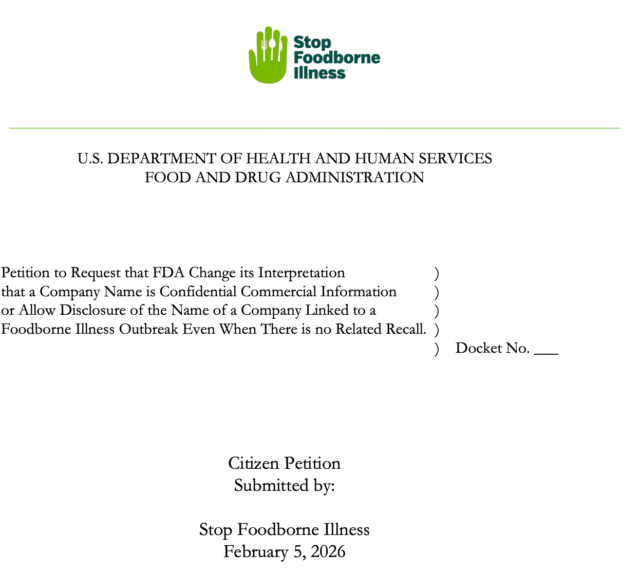
I have been making the same argument for years, and I am going to make it again, because the FDA keeps forcing me to: a company’s name is not a trade secret, and it is not confidential commercial information. Stop Foodborne Illness has now put that argument in front of the agency in a formal citizen petition, and the petition is right. The FDA should grant it.
Let me be clear at the outset about what I am — and am not — asking for. I am not asking the FDA to name a company on a hunch, a rumor, or a single unconfirmed complaint, and I am certainly not asking it to disclose a name where the evidence does not establish that company or product as a source of the outbreak. I am asking for disclosure when the agency’s own investigation — the epidemiology, the traceback, and the laboratory evidence — points to a particular company or product as a source. When the evidence is there, the name belongs to the public. When it is not, no one is asking the agency to guess.
The line is not hard to draw
The agency hides behind the Trade Secrets Act and FOIA Exemption 4, and it treats the name of a food company linked to an outbreak as if it were a proprietary formula. It is not. Read the statute. Section 1905 protects trade secrets, processes, operations, style of work, and the financial guts of a business — income, profits, losses, sources of revenue. It says nothing about a company’s name, because a name is none of those things.
The courts have already drawn the line the FDA refuses to draw. In CREW v. Department of Justice, the D.C. Circuit held that a company’s name is not “commercial or financial” information in and of itself, and that the possibility of reputational or economic fallout from being named is not enough to make it so. And under the Supreme Court’s Argus Leaderdecision, information only qualifies as “confidential” if it is customarily kept private and shared under some assurance of secrecy. Neither is true here. A company that grows, processes, and sells food to the public operates in the open. It puts its name on the package. It advertises on that name. It builds a brand on that name. You cannot market a product to millions of people under your name on Monday and then call that same name a confidential secret on Tuesday when the product turns out to be contaminated.
This is the distinction I have drawn my entire career, and it has never been complicated. Formulations, ingredients, and how a product is made are trade secrets and deserve protection. Who supplied the tainted raw material, who made the tainted product, and where it was sold are not — especially during an outbreak. The agency simply refuses to draw that line, and it dresses up a public-health record as proprietary business information to avoid drawing it.
We have already run the experiment
We do not have to guess whether naming companies would cause the sky to fall. We ran the experiment two decades ago. For most of the 2000s, the USDA’s Food Safety and Inspection Service would name the manufacturer of E. coli-contaminated meat but refused to say where it was sold. I still remember people sickened in the 2002 ConAgra outbreak telling investigators they had heard about the recall but figured it did not apply to them because they bought their hamburger at Safeway, not at ConAgra. FSIS eventually started naming retailers. Chicken Little was wrong. The sky did not fall. What changed was that people could finally figure out whether the dangerous product was in their own refrigerator.
That is the part of this that the FDA keeps missing. Withholding the name does not protect anyone but the company. The agency’s current policy actually leaves consumers of fresh produce in the dark more often than consumers of processed food — because produce spoils, recalls happen less often, and so the trigger that unlocks disclosure never gets pulled. We tell Americans to eat more fruits and vegetables. This administration has built an entire health initiative around “whole, healthy” food and radical transparency. And then, when leafy greens sicken and kill people, the agency refuses to tell those same Americans which brand did it. That is not transparency. That is the opposite.
A name, when the evidence supports it — not before
I said at the top that I am not asking the agency to guess, and it is worth pausing on why, because this is where industry will try to muddy the water. The standard I am describing is not a loose one. It does not mean publishing a list of every farm, processor, or brand that happened to be somewhere in the supply chain, and it does not mean naming a company on a single complaint or an early hunch. It means disclosure once the agency’s investigation has done its work — when the epidemiology, the traceback, and the laboratory evidence point to a particular company or product as a source.
What I am asking for is the opposite of guessing. That is the standard the FDA already applies to itself every day. It is the same evidence the agency relies on to post an outbreak, to issue a warning, to support a recall. If the evidence is strong enough for the FDA to act on it, it is strong enough to share with the families whose lives that evidence is about. The objection is never that the FDA might name the wrong company. The objection is that it would have to name the right one.
Stop Foodborne Illness is asking for exactly that.
What the FDA should do
The petition lays out a clean path, and the agency can take it tomorrow without waiting years for a rulemaking:
First, stop calling a company’s name confidential commercial information. The simplest fix is also the most honest one. The FDA can issue a statement or memorandum announcing that it no longer reads the Trade Secrets Act to cover the name of a company linked to an outbreak. The statute does not require the agency’s current interpretation, and the case law cuts against it.
Second, if the agency insists on keeping the CCI label, it can still release the name under its own public-health authority. The FDCA directs the FDA to ensure that food is safe, wholesome, and properly labeled. That is “provided by law” disclosure, full stop. The agency has already done exactly this — in the 2022 “Power Greens” outbreak it named the brands involved even though there was no recall and the product was past its expiration date. It can do that every time. It should.
Third, and least preferred, the agency can rewrite 21 C.F.R. §20.91 to allow disclosure of a brand name whenever it is known, not only when a recall is underway. This works, but it takes years, and families do not have years.
There is no public-health argument for secrecy here, only a public-relations one — and not even the company’s, but the agency’s. Naming a company linked to an outbreak prompts people who got sick but never connected the dots to seek care and report. It tells people who still have the product at home to throw it out. And it does the one thing that actually makes food safer over time: it gives a company a powerful reason not to be named again.
Chris George should not have had to hire me to spend a year chasing a name the government already had. The next parent should not have to either. Grant the petition.
Here is the full Petition:
https://www.marlerblog.com/files/2026/06/STOP-CCI-Petition-Final-2.4.2026.pdf