

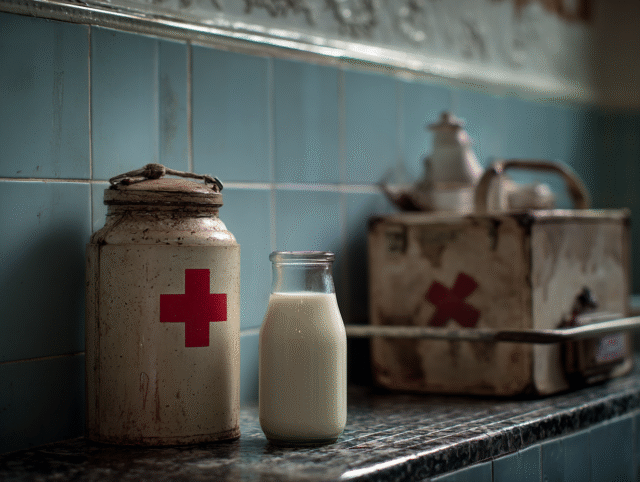
I have spent time sitting across kitchen tables from people whose lives were upended by a single meal. Some of those conversations stay with me.
The ones about raw milk and Guillain-Barré syndrome are near the top of that list, because they involve a complication most people have never heard of, caused by a bacterium most people can’t pronounce, delivered by a product that an entire movement insists is a health food.
Let me say plainly what I have said in courtrooms, in legislative hearings, and on this blog for the better part of two decades: raw milk can put you in a wheelchair.
Campylobacter is the most common cause of bacterial gastroenteritis in the developed world, and raw, unpasteurized milk is one of its favorite vehicles. For most people, an infection means a miserable week of cramping, fever, and diarrhea. But in a small and unlucky fraction of cases, the immune system, in its effort to fight the bacteria, turns on the body’s own nerves. The result is Guillain-Barré syndrome — an ascending paralysis that can climb from the feet to the lungs in a matter of days. GBS is an infrequent, but well-documented and well-known, consequence of Campylobacter infection. It is not exotic. It is in the medical literature.
The cruelest part is that contaminated raw milk gives you no warning at all. It does not look spoiled. It does not smell off. There is no way for a consumer standing at a farm stand or a cow-share pickup to know whether the jug in their hands carries a pathogen. You are, quite literally, taking it on faith.
In June 2008, Campylobacter jejuni in raw milk from Alexandre EcoDairy Farm in Del Norte County, California sickened sixteen people. The milk was distributed through a “cow-leasing” arrangement — the kind of legal workaround that lets dairies sell raw milk while pretending they are not.
One of those sixteen was a woman named Mari Tardiff. Within days of drinking the milk, Mari had flu-like symptoms. Then her vision blurred. Then her hands went numb. By the time the doctors landed on the words “Guillain-Barré,” her legs were on fire with a pain that only hot towels could touch. She woke one night unable to move. Her husband had to lift her. She was airlifted to intensive care, intubated, and placed on a ventilator. She remained hospitalized for two and a half months.
Mari came home to a family room converted into a hospital ward — a hospital bed, a Hoyer lift, a stand-up frame, a portable toilet, a remodeled bathroom, and round-the-clock nursing care her family paid for out of their own pockets. She fought through therapy that her husband eventually could not bear to watch because of how much it hurt her. She has never walked normally again. She lost the plans she had made for her life.
That is what a glass of “natural,” “living,” “nutrient-rich” raw milk did to one healthy woman.
If Mari’s story were a freak event, I might not keep telling it. It is not.
In 2012, a 67-year-old man named Jim Orchard drank raw milk from Pasture Maid Creamery in New Castle, Pennsylvania. He, his wife, and his daughter were among roughly ten people sickened. Everyone recovered — except Jim, who developed Guillain-Barré syndrome and ended up paralyzed in intensive care at UPMC Presbyterian. His wife told reporters that no one could give the family a timeline, because with GBS, everyone is different.
Here is the detail that should make every regulator’s stomach turn: state officials had already warned the public, back in February 2009, to throw out Pasture Maid’s milk because it contained Campylobacter. Three years later, the same farm, the same bug, and a man on a ventilator. The warning was there. The system simply let it happen again.
People sometimes treat these cases as cautionary tales from a less careful time. They are not. In 2010 and 2011 alone, I counted at least nine raw milk outbreaks across Washington, Utah, Nevada, New York, Pennsylvania, and a multistate cluster spanning Michigan, Indiana, and Illinois — more than fifty confirmed illnesses involving E. coli O157:H7, Salmonella, and Campylobacter, with at least one Pennsylvania victim left hospitalized with GBS. And just this past November, Illinois public health officials reported eleven Campylobacter infections linked to raw milk — while declining to name the common source.
Then look at Idaho, which has become a case study in everything I am about to ask for. Last summer, eighteen people were sickened with Campylobacter tied to one dairy. By late November, the state was reporting at least twenty-three Campylobacter cases — six of them in children under twelve — plus three Shiga toxin–producing E. coli infections among raw milk drinkers, with no producer named. And then, just days ago, in early June 2026, Idaho announced two more outbreaks: nearly sixty people sick since mid-May, at least forty-five of them confirmed with Campylobacter, and eight hospitalized. Two milking operations — one in the north of the state, one in the south.
The state declined to name either dairy. A health department spokesperson explained that they did not name the operations because the danger “is a potential risk for any raw milk producer.” Read that again. The agency’s own justification for staying silent is that the hazard is not unique to one farm — it is inherent to the product. That is not an argument for protecting a dairy’s name. That is the single best argument I have ever heard for not drinking raw milk in the first place.
And California — the same state that gave us Mari Tardiff — has given us the largest example of all. Beginning in the fall of 2023, raw milk and cream from Raw Farm, LLC of Fresno, the operation formerly known as Organic Pastures, was linked to a Salmonella Typhimurium outbreak that whole-genome sequencing eventually tied to at least 165 illnesses across four states. Health officials called it the largest raw-milk Salmonella outbreak in the country in a decade. Several of those patients were carrying Campylobacter or E. coli on top of the Salmonella. This was not Raw Farm’s first time, or its tenth; the same operation has been tied to outbreak after outbreak and recall after recall stretching back to 2006. And here is the part that should sound familiar: after announcing a handful of San Diego cases in October, state and local officials went quiet, even as the confirmed count climbed past 165. The public only learned the true scope because I obtained the records and handed them to the Associated Press. I should not have to be the one to tell a community how many of its neighbors were poisoned.
We are still having this conversation. We are still watching people get sick — children among them. And too often, we are still watching agencies stay quiet about where the milk came from, as if the name of a dairy were a trade secret worth more than the public’s right to protect itself.
I am not asking anyone to ban farms or jail dairy farmers. I have spent my career suing companies, and I would rather they never give me a reason to.
I am asking for three things I have asked for many times before.
First, tell the truth on the label. When I urged Wisconsin to reject its raw milk bill years ago, I argued that any raw milk sold should at minimum carry a blunt warning that the product is unpasteurized and may contain E. coli O157:H7, Campylobacter, Listeria, and Salmonella — and that infection can mean hemolytic uremic syndrome, Guillain-Barré syndrome, reactive arthritis, miscarriage, or death, with the highest risk to children, pregnant women, the elderly, and the immunocompromised. Consumers deserve to make an informed choice. They cannot do that in the dark.
Second, when an outbreak happens, name the source. Fast. Silence does not protect the public; it protects the defendant.
Third — and this is the simplest of all — pasteurize the milk. Pasteurization is not a corporate conspiracy. It is a 150-year-old public health triumph that turns a high-risk product into a safe one without meaningfully changing what is in the glass. Why should raw milk be held to a lower standard than hamburger, or peanut butter, or bagged spinach? It shouldn’t.
I understand the appeal of food that feels close to the land. I have nothing against farmers or family dairies. But Mari Tardiff trusted that her milk was clean. So did Jim Orchard. Trust did not keep them out of the ICU.
Drink pasteurized milk. It is the easiest decision you will ever make to keep yourself off a ventilator.