Year old Salmonella outbreak announcement slipped into FDA Warning Letter

According to a recently released FDA Warning Letter, in early 2013 ARO was associated with three Reportable Food Registry (RFR) reports that detailed positive Salmonella findings detected in two shipments of raw pistachios.  In addition, according to the letter, a cluster of salmonellosis infections reported from January through May 2013, were investigated by local, state, and federal public health and regulatory agencies. Epidemiological data from the outbreak investigation coupled with results of FDA inspection findings and analyses from product and environmental samples collected from ARO’s processing facility indicate that pistachios were the likely source of the Salmonella outbreak.

During the May 21st through May 24th, 2013 inspection, environmental samples were collected from various locations within ARO’s processing facility and analyzed. The analysis revealed the presence of Salmonella enterica serotype Senftenberg (S. senftenberg) in seventeen (17) subsamples.

During the FDA inspection, investigators observed the following significant violation:

a.         An employee in the roasting room was observed repeatedly touching the bottom of shipping boxes that were resting on the floor and then touching roasted, ready-to-eat, pistachios without washing or sanitizing hands.

b.         Maintenance personnel were observed entering and exiting the hand sorting room through a door that opens directly to the outside of the facility. Apparent bird droppings were observed on the floor of the outside areas where maintenance personnel were observed working and entering the hand sorting room.

c.         Inside the hand sorting room, two buckets containing floor sweepings of pistachios, dust, and debris, were observed near the hand sorting production lines. During the inspection, ARO stated that the buckets of floor swept pistachios would be reworked into finished product.

d.         The movement of employees from the outside of the facility (where apparent bird droppings were observed) into the hand sorting room may introduce contaminants into the facility and contaminate finished food, particularly based on the practice of reworking pistachios from the floor.

I wonder how many ads they will need to run to now make you buy pistachios?

I moved up one spot from 2013 on the Daily Meals List, but was No. 46 in 2012, but not on it at all in 2011.  Here is 2014’s:

50. Danielle Nierenberg and Ellen Gustafson, Co-Founders, The Food Tank
49. Adam Rapoport, Editor in Chief, Bon Appetit
48. Matt Maloney, CEO, GrubHub Seamless
47. Bill Marler, Foodborne Illness Lawyer and Attorney
46. Steve Ells, Founder/ Co-CEO, Chairman, Chipotle Mexican Grill
45. Tom Colicchio, Chef-Restaurateur and TV Personality
44. Catherine Cassidy, Vice President and Editor-in-Chief, Taste of Home
43. Ingrid Newkirk, President and Co-Founder, People for the Ethical Treatment of Animals
42. Mark Bittman, Journalist and Author
41. Tracey Ryder, President and CEO, Edible Communities Publications
40. Dana Cowin, Editor-in-Chief, Food & Wine
39. Alice Waters, Chef-Restaurateur and Founder and Director, The Edible Schoolyard Project
38. Dawn Sweeney, President and CEO, National Restaurant Association
37. Thomas Keller, Chef-Restaurateur
36. Susan Ungaro, President, James Beard Foundation
35. Danny Meyer, Restaurateur
34. Michael Pollan, Author
33. Bill Shore, Founder and CEO, Share Our Strength
32. Dan Bane, Chairman and CEO, Trader Joe’s
31. Bob Aiken, President and CEO, Feeding America
30. Steve Spinner, CEO, President, and Director, United Natural Foods, Inc.
29. Julie Packard, Executive Director and Vice-Chairman, Monterey Bay Aquarium
28. John Mackey, Founder and Co-CEO, Whole Foods Market
27. David Kirchhoff, CEO, Weight Watchers International
26. Mario Batali and Joe Bastianich, Chef/ Restaurateurs
25. David Murdock, CEO, Dole Food Company
24. Kevin Systrom, Co-Founder and CEO, Instagram
23. Ben Silbermann, Founder and CEO, Pinterest
22. Michelle Obama, First Lady of the United States
21. Rodney McMullen, Chairman and CEO, The Kroger Co.
20. Fred DeLuca, Co-Founder and President, Subway
19. Bob Tuschman, General Manager and Senior Vice President, Food Network
18. José Andrés, Chef-Restaurateur
17. Pamela Bailey, President and CEO, Grocery Manufacturers Association
16.  Paul Grimwood, CEO and Chairman, Nestlé USA
15. Donald Thompson, Vice Chairman and CEO, McDonalds
14. Pete Wells, Restaurant Critic, The New York Times
13. Craig Jelinek, CEO, Costco
12. Donnie Smith, President and CEO, Tyson Foods
11. William J. Delaney III, CEO, Sysco
10. David MacLennan, Chairman and CEO, Cargill
9. Jeremy Stoppelman, Co-Founder and CEO, Yelp
8. Jack Menzel, Product Managing Director, and Dan Entin, Director of Digital Product Management, and their teams, Google
7. Patricia Woertz, Chairman, President, and CEO, Archer Daniels Midland
6. James P. Hoffa, General President, International Brotherhood of Teamsters
5. Indra Nooyi, Chairman and CEO, Pepsi
4. Michael R. Taylor, Deputy Commissioner for Food, Federal Drug Administration
3. Doug McMillion, President and CEO, Walmart
2. Hugh Grant, Chairman, President, and CEO, The Monsanto Company
1. Thomas Vilsack, Secretary, USDA

According to recent research, once Salmonella bacteria get into a food processing facility and have an opportunity to form a biofilm on surfaces, it is likely to be extraordinarily difficult, if not impossible, to kill it, according to a study published ahead of print in the journal, Applied and Environmental Microbiology.

A biofilm is any group of microorganisms in which cells stick to each other on a surface. These adherent cells are frequently embedded within a self-produced matrix of extracellular polymeric substance (EPS). Biofilm EPS is a polymeric conglomeration generally composed of extracellular DNA, proteins, and polysaccharides.

Researchers from National University of Ireland, Galway conducted a study in which they attempted to kill Salmonella biofilms on a variety of hard surfaces, using three types of disinfectant.

“We found that it was not possible to kill the Salmonella cells using any of the three disinfectants, if the biofilm was allowed to grow for seven days before the disinfectant was applied,” said Mary Corcoran, a researcher on the study. Even soaking the biofilms in disinfectant for an hour and a half failed to kill them

She warned that food-processing facilities must take strict care to keep Salmonella out of the clean areas where cooked foods get further processing and packaged.

I am working this weekend instead of watching the Seahawks – 49’s game because I will be sitting down with a couple of families this week to talk with them about the long-term complications that their children actually face because of something they ate.

It is not something that their children’s physicians have not told them, but I have to talk with them about it in the context of a lawsuit and trying to financially prepare for a unknown, but risk-filled future.

E. coli O157:H7 caused Hemolytic Uremic Syndrome (HUS), even in the best hospitals, can be a life-altering event.  Even children, who have apparently recovered normal renal function following the acute episode of HUS, have a high risk for the development of late complications from their acute episode of HUS. The risk is substantially lower in children who did not require dialysis and in children who were not oliguria or anuric while the risk is the highest in children who had oligo/anuria for more than 7 days.  However, the opposite is also true.

Among the serious complications for children with extensive renal damage caused by E. coli O157:H7 HUS are:  (1) alterations in calcium and phosphate balance, known as renal osteodystrophy, that cause the bones to become weak and soft, resulting in bone pain and susceptibility to fracture; (2) anemia—which is characterized by a low red blood cell count and consequent lack of energy; (3) growth failure caused by the damaged kidney’s inability to properly regulate the calcium necessary for bone growth; and (4) high blood pressure, which, among other things, stresses the heart and can lead to coronary artery disease, heart attack, and stroke.

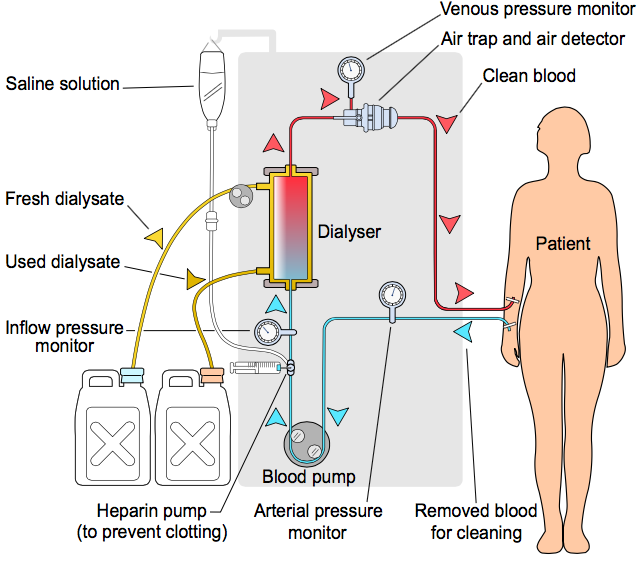
Development of ESRD means the patient will require dialysis or transplantation for survival.  Most Americans who suffer ESRD opt for a kidney transplant, but the wait for a donor kidney is often a year or more.  Once the ESRD patient has only about 15% of normal filtration capacity, they will start to need dialysis.

The preferable course in a transplant situation is for a deceased or living relative (e.g. a parent or sibling over age 18 and compatible) to donate a kidney.  Fortunately, children have the shortest waiting time on the deceased donor transplant list. The average waiting time for children age 0-17 years is approximately 275-300 days; the average waiting time for a transplant candidate who is 18-44 years old is approximately 700 days.

Cost of hemodialysis can be in the range of $100,000 annually.  Cost of a transplant can be as high at $150,000 with yearly cost for anti-rejection medication being at least $20,000.

Following transplantation, a patient will require immunosuppressive medications for the rest of her life to prevent rejection of the transplanted kidney.  Medications used to prevent rejection have considerable side effects.  Corticosteroids are commonly used following transplantation.  The side effects of corticosteroids are Cushingnoid features (fat deposition around the cheeks and abdomen and back), weight gain, emotional instability, cataracts, decreased growth, osteomalacia and osteonecrosis (softening of the bones and bone pain), hypertension, acne, and difficulty in controlling glucose levels.  The steroid side effects, particularly the effects on appearance, are difficult for children, particularly teenagers, and non-compliance with the treatment regimen is a problem with teenagers due to unsightly side effects.

Cyclosporine and tacrolimus are also commonly used immunosuppressants.  Side effects of these drugs include hirsutism (increased hair growth), gum hypertrophy, interstitial fibrosis in the kidney (damage to the kidney), as well as other complications.  Meclophenalate and imuran are also commonly used, each of which can cause a low white blood cell count and increased susceptibility to infection.  Many other immunosuppressive medications and other medications (anti-hypertensive agents, anti-acids, etc.) are prescribed in the post-operative period.

Immunosuppressants like those described above function to reduce the body’s immune response, thereby preserving the transplanted kidney, which the body would otherwise recognize as foreign and dangerous, thereby setting off a chain of events that would culminate in kidney rejection.  But because a healthy and timely immune response is a critical host defense against illness, life-long immunosuppression necessarily dictates a life-long, heightened susceptibility to infection, accelerated atherosclerosis (hardening of the arteries), cancer, and chronic kidney rejection.

No kidney transplant lasts forever.  United States Renal Data Systems states that the half-life—i.e. the time at which 50% of transplanted kidneys are still functional and 50% have stopped functioning—is 10.5 years for children 0-17 whose transplanted kidney came from a deceased, unrelated donor, and 15.5 years where the kidney comes from a living, related donor.  Similar data for a transplant at age 18 to 44 years is 10.1 years and 16.0 years for a deceased donor and a living related donor, respectively.  Each transplant will be preceded by ESRD, dialysis, an increase in kidney-related medical problems and then the recovery from transplantation.

It is going to be a long week.

Listeria Cheese

Queso Fresco cheese imported illegally from Mexico and sold in a Latino grocery store in Woodburn, Oregon may be tainted with Listeria, Oregon state officials warned Friday.

Oregon’s Health Authority and Department of Agriculture launched an investigation into the dairy product after an infant in Clackamas County fell ill from the bacteria.  Officials traced the infection to batch of queso fresco, a soft white cheese manufactured in Mexico.

Officials believe the cheese was brought into the country illegally because it was found unlabeled and sold in plastic bags, the spokesman said.

Norovirus Oysters

The U.S. Food and Drug Administration is warning consumers not to eat raw or partially cooked oysters harvested from Copano Bay, in Aransas County, Texas, harvested between Dec. 26, 2013 and Jan. 9, 2014.

Oysters harvested from Copano Bay, Texas, on Dec. 26, 2013, and then shipped by Alby’s Seafood of Fulton, Texas, have been linked to six norovirus illnesses in Louisiana.

The Texas Department of State Health Services closed Copano Bay to shellfish harvesting on Jan. 9, 2014.

The FDA is warning consumers not to eat raw or partially cooked shellfish from Copano Bay, in Aransas County, Texas, harvested between Dec. 26, 2013 and Jan. 9, 2014.

Alby’s Seafood disclaimer icon has issued a recall of the oysters harvested on Dec. 26; however, other shellfish harvested from Copano Bay before it was closed may still be in the marketplace.

All shellfish dealers, restaurants, retail food establishments and consumers are advised to check the identity tags on all containers of shellfish in their inventories. If the tag indicates the shellfish were harvested from Copano Bay between Dec. 26, 2013 and Jan. 9, 2014 the product should be disposed of and should not be sold, served or eaten.

Listeria Ham

Gusto Packing, a Montgomery, Ill. establishment, is recalling approximately 67,113 pounds of sliced, spiral ham products due to concerns about possible Listeria monocytogenes contamination, the U.S. Department of Agriculture’s Food Safety and Inspection Service (FSIS) announced today.

The hams were shipped to wholesalers for further distribution in Illinois, Indiana, Kentucky and Ohio, while some were exported to Canada. The following products are subject to recall:

45.5-lb. cases, with six individual sized hams each labeled “Centrella Signature, Hardwood Hickory Smoked, Spiral Sliced Ham with Natural Juices” with the case code “71292603304,” packaged on Nov. 29, 2013, having a Use or Freeze by date of “02/06/14.”

45.8-lb. cases, with six individual sized hams each labeled “AMISH VALLEY, Fully Cooked, Hickory Smoked Spiral Sliced Ham” with the case code “71292645104,” packaged on Nov. 29, 2013, having a Use or Freeze by date of “02/06/14.”

45.8-lb. cases, with six individual sized hams each labeled “AMISH VALLEY, Fully Cooked, Hickory Smoked Spiral Sliced Ham” with the case code “71292645104,” packaged on Nov. 30, 2013, having a Use or Freeze by date of “02/06/14.”

31.6-lb. cases, with four individual sized hams each labeled “Ripple Creek Farms, Fully Cooked, Ready To Eat, Hickory Smoked, Spiral Sliced Ham” with the case code “71292603312,” packaged on Nov. 30, 2013, having a Best Before date of “2014 FE 13.”

Food Safety News reports that government prosecutors today recommended sentences of five years probation for brothers Eric and Ryan Jensen, owners of the cantaloupe farm tied to one of the deadliest foodborne illness outbreaks in U.S. history. (Prosecutor’s Recommendation)Each of the Jensen brothers previously pleaded guilty in October to six counts of Introducing an Adulterated Food into Interstate Commerce that resulted in the outbreak, which killed more than 30 people and sickened at least 147 with Listeria from contaminated cantaloupes grown at Jensen Farms.

The maximum sentence for each of the six counts would have been a year in prison, a $250,000 fine, or both.

The Listeria outbreak in 2011 sickened at least 147 and killed more than 30.

As of January 15, 2014, a total of 430 individuals infected with the outbreak strains of Salmonella Heidelberg have been reported from 23 states and Puerto Rico. Most of the ill persons (74%) have been reported from California. Since the last update on December 19, 2013, a total of 14 new ill persons have been reported from four states: Arizona (1), California (11), Idaho (1), and Virginia (1).

Most of the ill persons (74%) have been reported from California. The number of ill persons identified in each state is as follows: Alaska (1), Arkansas (1), Arizona (19), California (321), Colorado (9), Connecticut (1), Delaware (1), Florida (4), Idaho (5), Illinois (1), Kentucky (1), Louisiana (1), Michigan (3), Missouri (5), North Carolina (1), Nevada (10), New Mexico (2), Oregon (10), Puerto Rico (1), Texas (10), Utah (2), Virginia (4), Washington (16), and Wisconsin (1).

Among 418 persons for whom information is available, illness onset dates range from March 1, 2013 to December 26, 2013. Ill persons range in age from less than 1 year to 93 years, with a median age of 18 years. Fifty-two percent of ill persons are male. Among 359 persons with available information, 137 (38%) reported being hospitalized. Thirteen percent of ill persons have developed blood infections as a result of their illness. Typically, approximately 5% of persons ill with Salmonella infections develop blood infections. No deaths have been reported.

The number of reported infections from the outbreak strains of Salmonella Heidelberg has returned to baseline levels indicating that this particular outbreak appears to be over. However, activities related to this investigation are ongoing. Illnesses that occurred after December 15, 2013, might not be reported yet due to the time it takes between when a person becomes ill and when the illness is reported.

Epidemiologic, laboratory, and traceback investigations conducted by local, state, and federal officials indicate that consumption of Foster Farms brand chicken is the likely source of this outbreak of Salmonella Heidelberg infections.

The outbreak strains of Salmonella Heidelberg are resistant to several commonly prescribed antibiotics. Although these antibiotics are not typically used to treat Salmonella bloodstream infections or other severe Salmonella infections, antibiotic resistance can increase the risk of hospitalization in infected individuals.

Seven people have fallen ill — with one of them in critical condition — after eating at a restaurant in Montreal this past December. The people contracted E. coli O157:H7 bacteria, after eating raw meat at Marché 27 on Prince Arthur St.

The agriculture, fisheries and food ministry, MAPAQ, is responsible for verifying food safety in restaurants in Quebec, and officials with the agency have repeatedly told CTV News they will not confirm where those afflicted with the infection ate because there is no current contamination. MAPAQ did confirm that everyone sick with E. coli O157:H7 had eaten at the same restaurant.

Restaurant owner Jason Masso has confirmed the seven people were infected at his restaurant, however he believes the problem will ultimately be traced to the slaughterhouse or the butcher who provided the meat.

In a statement, the meat supplier, Viandes Decarie, said no infection could be traced back to them.

As of January 13, 2014, a total of 9 persons infected with the outbreak strain of Salmonella Heidelberg have been reported from Tennessee.

Two (22%) of 9 ill persons have been hospitalized, and no deaths have been reported.

All of the ill persons were incarcerated at a single correctional facility located in Tennessee.

Epidemiologic and traceback investigations conducted by Tennessee and federal officials indicate that consumption of Tyson brand mechanically separated chicken is the likely source of the outbreak of Salmonella Heidelberg infections at the Tennessee correctional facility.

On January 10, 2014, Tyson Foods, Inc. recalled approximated 33,840 pounds of mechanically separated chicken products that may be contaminated with Salmonella Heidelberg.

Institutions that purchased recalled chicken products should not serve them.

The recalled products were not available for consumer purchase in retail stores.

This strain of Salmonella Heidelberg is commonly reported to PulseNet. Nineteen additional persons infected with this same strain have been identified from 12 other states.

Investigations are ongoing to determine if these cases are related to the outbreak at the Tennessee correctional facility.

Sure seems that way.

The above and below are slightly different questions than the one I posed the other day: Why did Tyson Recall, but Foster Farms Not? So, here they are:

1. Why has Cargill and Tyson collectively recalled millions of pounds of its products after customers were sickened and Foster Farms recalls nothing after 550 sickened in two outbreaks?

2. Why has no reporter asked that question of three of the largest poultry producers in the world and the government agency, FSIS, which oversees them?

What is FSIS’s role in all of this? Given that FSIS’s Mission Statement, you would think a bit more activist role would be warranted? Here is the Statement:

The Food Safety and Inspection Service (FSIS) is the public health agency in the U.S. Department of Agriculture responsible for ensuring that the nation’s commercial supply of meat, poultry, and egg products is safe, wholesome, and correctly labeled and packaged.

OK, lets go over some background: FSIS does not have authority to recall. Unlike the FDA under the Food Safety Modernization Act, FSIS cannot order a recall it can only suggest one. In can, and has done on rare occasions – like Foster Farms cockroach problem – pull FSIS inspectors which stops production by removing the USDA mark of inspection.

According to the FSIS a food recall is a voluntary action by a manufacturer or distributor to protect the public from products that may cause health problems or possible death. A recall is intended to remove food products from commerce when there is reason to believe the products may be adulterated or misbranded. The most serious type of a recall, a Class I recall, involves a health hazard situation in which there is a reasonable probability that eating the food will cause health problems or death.

The definition for “adulterated” is found in 9 CFR 301.2. Adulterated shall apply to any carcass, part thereof, meat or meat food product under one or more circumstances (for example: if it contains poisonous substances, pesticides, or chemicals; or if it has been prepared under insanitary conditions). And, remember, FSIS does not consider Salmonella an adulterant. For a more detailed look at the problem this has created for FSIS, the meat industry and consumers, see, FSIS’s and Foster Farms’ Reason for NOT Recalling Salmonella Chicken: “Shit Happens!”

FSIS is frightened, err, chicken, to pull inspectors for Salmonella contamination or Salmonella illnesses because its inspectors have been ordered back in on at least one occasion of note. See, Butz, Supreme Beef and FSIS’s Salmonella Policy – A Bit(e) of History.

However, FSIS fear aside, again, why has Cargil and Tyson collectively recalled millions of pounds of its products after their customers were sickened and Foster Farms recalls nothing after 550 sickened in two outbreaks?

2014 Tyson Salmonella Heidelberg Outbreak AND Recall:

The FSIS was notified of a Salmonella Heidelberg cluster of illnesses on Dec. 12, 2013. Working in conjunction with the Tennessee Department of Health (TDH), FSIS determined that there is a link between the mechanically separated chicken products from Tyson Foods and the illness cluster in a Tennessee correctional facility. Based on epidemiological and traceback investigations, seven case-patients at the facility have been identified with illnesses, with two resulting in hospitalization. Illness onset dates range from Nov. 29, 2013 to Dec. 5, 2013. Tyson Foods, Inc. recalled approximately 33,840 pounds of mechanically separated chicken products.

2013 Foster Farms Salmonella Heidelberg Outbreaks with NO Recalls:

Outbreak No. 1: In July 2013 a total of 134 persons infected with the outbreak strain of Salmonella Heidelberg were reported from 13 states. Collaborative investigative efforts of local, state, and federal public health and regulatory agencies indicated that Foster Farms brand chicken was the most likely source of this outbreak.

Testing conducted by the Washington State Public Health Laboratories identified the outbreak strain of Salmonella Heidelberg in four intact samples of chicken collected from three ill persons’ homes in Washington, which were traced back to two Foster Farms slaughter establishments.

Outbreak No 2: In December 2013 a total of 416 persons infected with seven outbreak strains of Salmonella Heidelberg have been reported from 23 states and Puerto Rico.

Epidemiologic, laboratory, and traceback investigations conducted by local, state, and federal officials indicate that consumption of Foster Farms brand chicken is the likely source of this outbreak of Salmonella Heidelberg infections. On October 7, 2013, U.S. Department of Agriculture’s Food Safety and Inspection Service (USDA-FSIS) issued a Public Health Alert due to concerns that illness caused by Salmonella Heidelberg is associated with chicken products produced by Foster Farms at three facilities in California. FSIS did issue a public health alert.

I did a little searching on www.outbreakdatabase.com and found more that a few example of meat recalls – chicken and beef – due to Salmonella contamination.

Recalls and Outbreaks by Cargill or one of its companies:

Salmonella Enteriditis Due to Contaminated Cargill Ground Beef 2012 40 sick – On July 22, 2012 Cargill Meat Solutions announced a recall of 29,339 pounds of fresh ground beef products due to possible contamination with Salmonella Enteriditis.

Hannaford Hamburger Ground Beef 2011 20 sick – On December 16, Hannaford, a Scarborough, Maine-based grocery chain, recalled fresh ground beef products that may have been contaminated with a strain of Salmonella Typhimurium.

Cargill Meat Solutions Ground Turkey 2011 136 sick – The U.S. Department of Agriculture’s Food Safety and Inspection Service (FSIS) issued a public health alert, on July 29, due to concerns about illnesses caused by Salmonella Heidelberg that associated with the use and the consumption of ground turkey.

Beef Packers, Inc., Cargill, Ground Beef 2009 2 sick – In December, Beef Packers, Inc., owned by Cargill, recalled over 20,000 pounds of ground beef contaminated with a drug-resistant strain of Salmonella Newport.

Beef Packers, Inc., Cargill, Ground Beef 2009 68 sick – A Beef Packers, Inc. plant in California owned by Cargill, distributed approximately 830,000 pounds of ground beef that was likely contaminated with Salmonella Newport.

Emmpak/Cargill Ground Beef 2002 47 sick – In early 2002, isolates of Salmonella Newport in New York State were found to be resistant to more than nine antibiotics and had a decreased susceptibility to the antibiotic, ceftriaxone.

It cannot be the numbers of sickened.  Frankly, Foster Farms in two outbreaks sickened more than Cargill and Tyson did in seven.

Would someone please ask the questions?