

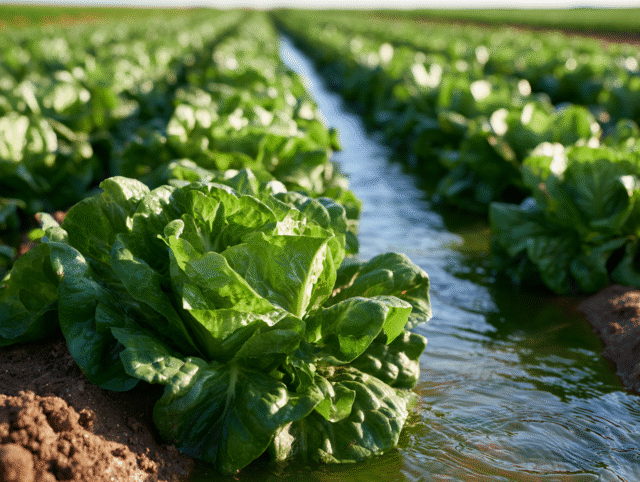
Tamar Haspel makes the case against lettuce in the Washington Post this morning. It makes people sick, it takes land and water, we throw away roughly as much as we eat, and it delivers almost nothing nutritionally. Her illness numbers are real, and I went and found the paper behind them. Her conclusion is where I part company, and I say that as the lawyer who has spent nearly thirty years suing companies that sold contaminated lettuce, and who does not eat bagged salad himself.
It is a serious column, and it asks a question the produce business would rather not hear asked out loud, which is whether a food this fragile earns its place at all. I am not going to pretend that is unfair. More than thirty-two thousand Americans have been counted sick this summer with a parasite that arrived on shredded iceberg.
Her illness figures come from a real paper, and they are the top of a range.
The 2024 analysis is Yang and Scharff, Foodborne Illnesses from Leafy Greens in the United States: Attribution, Burden, and Cost, in the Journal of Food Protection. It attributes to leafy greens as many as 2,307,558 illnesses a year in this country at a cost of as much as $5.278 billion, and it finds that lettuce accounts for up to 75.7 percent of those illnesses and 70 percent of the cost. Run the multiplication and you land near 1.75 million illnesses and $3.7 billion, which is where the column’s figures come from. Two honest notes. Those are upper bounds. The paper’s own ninety percent interval runs from 1,077,815 to 4,075,642 illnesses and from $3.23 billion to $8.221 billion, so the lettuce share at the bottom of the range is closer to 820,000 illnesses and $2.3 billion. And the paper is two years old. It does not include this summer.
This summer is worse than the paper that already put lettuce at the top.
As of its most recent update, CDC counts 10,930 people sick in the multistate Cyclospora outbreak traced to iceberg lettuce grown in central Mexico, at least 454 of them hospitalized, two dead, across seventeen states, with illness onsets running from June 14 through August 11. On its separate surveillance page, with data through August 17, the agency counts 15,716 laboratory-confirmed cases acquired in this country since May 1, at least 11,841 more awaiting confirmation, and cases in forty-seven states plus the District of Columbia and Puerto Rico, against 1,180 for the same stretch of last year. National hospitalizations on that page now stand at 828, up eighty-eight in a single week. My own fifty-state tally, built from what each health department publishes, was 32,135 on Sunday night. Nobody needs to convince me that lettuce can hurt people. I have spent the summer counting the people it hurt.
She is right that there is no kill step, and that is the honest structural fact underneath all of it.
Everything that makes lettuce worth eating is what makes it dangerous. It reaches the table raw, so nothing along the way kills what is riding on it. Washing is not a kill step. Ortega and Sanchez wrote in Clinical Microbiology Reviews that washing and sanitizing may reduce the risk but cannot be expected to eliminate it, and have been demonstrated not to remove oocysts completely. FDA says in its own voice that chlorine and other common antimicrobial treatments are not effective against this parasite. The National Restaurant Association tells its own members that washing produce under running water cannot guarantee removal of it. I wrote before IAFP this year that there is no kill step for Cyclospora, and that is still the shortest true sentence anyone can write about this food. It is also why I skip the bag.
The pathogen is not a property of the plant. It is a property of the water.
Cyclospora cayetanensis lives only in people. It reaches a lettuce field exactly one way, which is human waste getting into the irrigation water or onto the ground. That is not something lettuce does. It is something we do upstream of lettuce, and the record says so every time. FDA’s advisory changed this month from an onsite inspection at the processing plant to onsite inspections at iceberg lettuce growers in Mexico, which is the agency saying in public that the problem sits upstream of the plant. The 2018 romaine outbreak was traced to an irrigation canal in the Yuma growing region. In 2020 FDA found Cyclospora in a canal serving an Indiana farm that supplied a salad processor, though the agency said its genetic typing could not establish that the canal parasite caused the illnesses. The same Guanajuato facility sat at the center of a Cyclospora outbreak in 2013, and FDA’s environmental assessment then told the firm to determine whether the parasite was a reasonably likely hazard in that growing region and to re-evaluate the wash step. Stop eating lettuce tomorrow and every one of those water sources is still there, still running onto something somebody eats.
Quitting the category is what a traceability failure already does, and we watched it happen in July.
The column proposes as policy what this market already did to itself by accident. After the recall, Chopt traffic fell about 12 percent and weekly spending at Sweetgreen dropped roughly ten percentage points against last year, and neither chain has been linked to anything. Paul Sellew, who grows lettuce in the eastern United States and has no connection to Mexico or to Taylor Farms, watched his sales fall by double digits and said his customers were motivated by fear. NielsenIQ measured fresh lettuce unit sales down 9 percent in a single week. Not one of those declines made a single person safer. That is the mechanism worth understanding. When nobody can say which lot, people stop buying the category, and the loss lands on growers who did nothing wrong while the contaminated water stays exactly where it was. It is also the best economic argument there is for the traceability rule Congress passed and then pushed to 2028.
The cost-benefit only works if you price one side of it.
The column prices carefully what lettuce costs us and never prices what fixing it would cost. Those numbers exist, and they are small. USDA’s Economic Research Service puts the annual national cost of cyclosporiasis at $5.3 million, a figure resting on a case estimate from 2011 that nobody has updated. Read what that model actually assumes: about twenty Cyclospora hospitalizations a year in the entire country, eleven of them domestically acquired and foodborne. CDC counted 828 this season. The Microbiological Data Program, the produce-testing program killed in 2012, ran about $4.5 million a year. FDA costed the traceability delay itself in the Federal Register at 90 FR 38084 on August 7, 2025, and the arithmetic is the agency’s own: forgone public health benefit of $91 million to $112 million a year against $54 million to $73 million in industry savings, which means the delay destroys roughly $37 million to $39 million a year more than it saves. Set all of that next to Spalding and Sexton in the American Journal of Agricultural Economics, who put the total societal loss from the single November 2018 romaine incident at $276 million to $343 million, and whose own conclusion was that the answer is mandatory standards and better traceability. One of my degrees is in economics, and it does not take one to read that ledger. Outbreaks are expensive. Preventing them is cheap.
Adding E. coli and Listeria to the Ledger Makes the Case for Fixing It, Not for Quitting It.
The obvious objection to everything above is that I have priced one parasite. Fold in the pathogens that made lettuce famous and the numbers do change, though not in the direction the column needs. Start with the correction. The $3.7 billion is already the multi-pathogen figure. Yang and Scharff built it out of norovirus, Shiga toxin-producing E. coli both O157:H7 and non-O157, Campylobacter, nontyphoidal Salmonella and the rest. E. coli and Listeria do not stack on top of that number. They are most of it. Cyclospora is the pathogen barely in it. What changes when you go pathogen by pathogen is severity, and the spread is enormous.
| Pathogen | ERS cost per case | Where it shows up in lettuce |
| Cyclospora cayetanensis | $464.63 | 10,930 people in this summer’s federal outbreak alone |
| STEC E. coli O157:H7 | $7,238 | 12,496 illnesses a year attributed to romaine |
| Nontyphoidal Salmonella | $16,668 | Among the largest contributors to the leafy green total |
| Listeria monocytogenes | $2,504,296 | About 1,500 US infections and 250 deaths a year, with packaged salad a recurring vehicle |
Per-case costs from USDA’s Economic Research Service, Cost Estimates of Foodborne Illnesses, in 2023 dollars, read August 2026. Lettuce attribution from Yang and Scharff and from CDC. Check the arithmetic: 10,930 times $464.63 is $5,078,406, which is 2.03 times what ERS assigns to a single case of listeriosis.
Read the two ends of that column together. The entire federal Cyclospora outbreak this summer, all 10,930 people and 454 of them hospitalized, comes to roughly $5.1 million at the government’s own per-case figure. Two cases of listeriosis match it. That is why a cost-benefit run on this parasite by itself always loses. It is the highest-volume and lowest-priced pathogen on the page, and no program aimed at it will ever clear a threshold built that way.
The intervention set does not change with the pathogen, and that is the whole answer. Treating agricultural water, traceability, restored surveillance and a water rule that measures something other than generic E. coliwork on all of them at once. FDA’s arithmetic on the traceability delay was never a Cyclospora calculation in the first place; it covers every food on the traceability list and every pathogen that rides in on them. Add a pathogen to the benefit side and the cost side does not move. Each one folded in improves the ratio for fixing this, and not one of them improves the ratio for quitting.
E. coli is the strongest card the other side holds, and it deserves saying plainly. The Interagency Food Safety Analytics Collaboration attributes more than 85 percent of E. coli O157 illnesses to vegetable row crops and beef, with row crops significantly higher than every other food category. FDA maintains a standing Leafy Greens STEC Action Plan whose stated purpose is breaking a cycle of reoccurring outbreaks. The same O157 strain has come back since 2016. A commodity that produces the same genotype for a decade is not having bad luck.
And the answer to it is the same water. USDA researchers found Listeria monocytogenes in 43 percent of environmental samples taken in a watershed connected to a major leafy green growing region. Yuma in 2018 was a canal. Guanajuato was sewage in 2013 and again this summer. Three pathogens, one failure mode, which is an argument that gets stronger with E. coli and Listeria in it rather than weaker.
One asymmetry belongs here honestly. Listeria in packaged salad is a plant problem rather than a field problem. The 2015 outbreak traced to a processor whose own records showed Listeria in the facility across nineteen months. That is the one place the record runs the column’s way, and it is exactly why I do not eat the bag. The answer to harborage in a plant is environmental monitoring and enforcement, not abstinence.
I already skip the bagged salad, and I still will not tell anyone to give up vegetables.
My list of foods I do not eat has been on this blog for decades, and prewashed, precut produce is number four on it. I told the Washington Post the same thing in December. That is a personal calculation made with information most people do not have, and it is not public health advice. Most Americans already fall short of the vegetable recommendation, and the last thing anyone in this field should want is a country that is afraid of produce. The column concedes the point itself, that the salad on the table is partly what keeps the second helping of pasta off it. People who give up salad do not switch to lentils.
The column closes on a choice between a solar-powered home and explosive diarrhea. That is a false choice, and both halves are available. Treat the agricultural water. Name Cyclospora in the water rule instead of scoring that water with a bacterial indicator that cannot see it. Restore the surveillance that tells us how many people are sick. Turn on the traceability rule that is already law, so the next recall can name a lot instead of a vegetable. Do that and my docket empties, which has been the point since 1993. Nobody has to give up a salad to get there.