

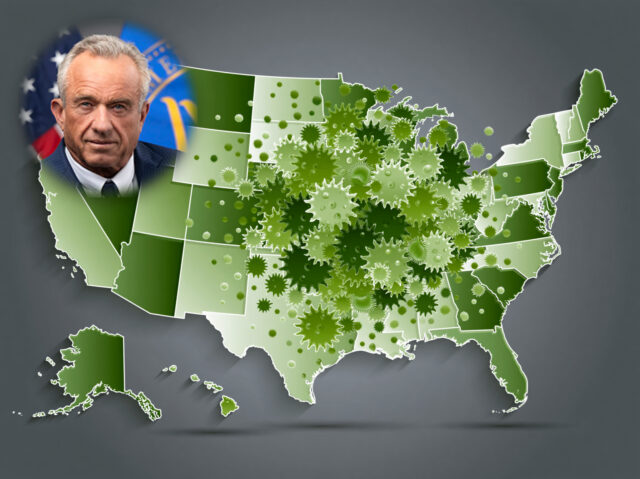
Under Control says RFK Jr.
CDC updated its outbreak investigation page today, August 20, and the multistate Cyclospora outbreak linked to Taylor Farms de Mexico iceberg lettuce now stands at 10,930 illnesses and 454 hospitalizations across 17 states, with 2 deaths in Michigan and illness onsets running from June 14 through August 11. Counting every state that publishes a number of its own, the fifty-state total is 31,889, up from 30,523 on Saturday. Nine rows on my chart have moved.
Cyclosporiasis is a diarrheal illness caused by Cyclospora cayetanensis, a microscopic parasite spread through food or water contaminated with human feces. It is not spread person to person, symptoms usually begin about a week after exposure, and without treatment they can come and go for a month or more.
CDC added 1,449 people to the outbreak today and did not add a single state.
A week ago the federal outbreak was 9,481 illnesses and 398 hospitalizations. Today it is 10,930 and 454, and the Fast Facts block says seventeen states with none new. That has not happened before in this investigation. Every prior update grew the map as well as the count, from five states to nine to fifteen to seventeen. This one added fourteen hundred people inside the footprint the agency already had.
For the first time, CDC says laboratory work ties these illnesses to each other.
Buried at the end of today’s update is a paragraph that was not there last week. Public health investigators are performing genotyping on samples from sick people, and CDC says the parasites that caused these illnesses are genetically related, which it calls additional evidence that the people in this outbreak got sick from the same source. CDC is careful to say genotyping is not whole genome sequencing. It targets particular markers to group related parasites rather than reading the whole organism.
Read that precisely, because it matters in both directions. It ties the patients to one another. It does not tie them to a head of lettuce, because there is no product isolate to compare them against and there never was. What it does do is close off the argument that this summer is just a lot of unrelated cyclosporiasis piling up at once, which is the strongest version of the case I laid out on my own blog yesterday. It also explains something I flagged two days ago, when the surveillance page quietly changed from saying CDC was working to develop and validate molecular tools to saying it uses them. The tools are being used, and today we learned what they found.
FDA updated on the same day, with the same figures, and changed one sentence that says a great deal. On August 13 the agency said it had initiated an onsite inspection and sampling at Taylor Farms de Mexico, the processor. Today it says it has initiated onsite inspections and sampling at iceberg lettuce growers in Mexico, plural, and that it is working with federal, state and international partners. The investigation has moved upstream from the plant to the fields. That is where a water-borne parasite would have reached the lettuce in the first place, and it is the part of the chain the traceability rule was written to make visible.
The backlog grew by 1,386 in the same week confirmations grew by 1,821.
CDC’s surveillance page is a different count from the outbreak count, and it updated Tuesday with data through August 17. It stands at 15,716 laboratory-confirmed cases of cyclosporiasis acquired in the United States since May 1, with 828 hospitalizations, across forty-seven states, the District of Columbia and Puerto Rico. The travel-associated series, counted separately and not part of this outbreak, is 1,681 with 61 hospitalizations.
The number of additional cases awaiting further investigation went from 10,455 to 11,841. New illnesses arrived faster than the laboratory work could clear them. A week ago that pile shrank for the first time all season and I read it as the lag finally clearing. It grew again. Confirmed and pending together now come to 27,557.
Seven in ten confirmed cases are now assigned to the lettuce.
Set the two federal counts against each other and the attribution ratio finally moved the right way. Of the 15,716 confirmed cases, 10,930 are assigned to the recalled lettuce, roughly seven in ten, where a week ago it was closer to six. Against the combined federal figure it is four in ten, and against the fifty-state total below it is about a third, which is another way of saying that two out of every three people counted in this country this summer have no federal attribution of any kind. Attribution here means a sick person told an interviewer what they ate, and the outbreak’s first illness is still dated June 14, three weeks in front of the earliest lettuce in the recall.
CDC also refreshed its outbreak map today, and the bands on it are worth a second look. The highest category tops out at 5,000 illnesses, which means no single state has more than five thousand of its cases assigned to this outbreak. Michigan by itself reports 14,277 cases of cyclosporiasis this season. The two figures count different things, because CDC counts only laboratory-confirmed illnesses it has attributed to the lettuce and Michigan counts every case reported during the investigation period. The gap is still the whole argument in one line. The hardest-hit state in the country has, at most, about a third of its illness assigned to the food that was recalled.
Not one state publishes an attribution split of its own. Michigan says plainly that it counts every case of cyclosporiasis reported during the investigation period rather than lettuce-attributed cases, and its investigators interviewed more than 2,900 sick people, many of whom never reported eating at Taco Bell, at another chain, or at any food establishment at all. New Hampshire is the exception, and it is the whole argument in one building. Sixty-nine cases statewide, thirty-two of them tied to recalled product, and the cluster began with nine people who ate from a hospital cafeteria salad bar in Keene. Ten of the sixteen people known to be exposed there were employees. That is the highest attribution rate in the country, and the reason is not that the lettuce in New Hampshire was different. A hospital can see illness in its own workforce and report it the same week. A grocery store cannot.
CDC deleted the paragraph that told readers where the lettuce went.
Something else changed today and it was not a number. The paragraph naming where the recalled lettuce was distributed, at least thirty-one states, to consumers, restaurants and retailers, including Taco Bell locations and Marketside products at select Walmart stores, has been removed from the consumer page, and the link to the recall notice, issued under the name Taylor Fresh Foods, went with it. What is left says the recall happened and the best-by dates have passed. The caption under the photograph now reads that the outbreak was linked to Taylor Farms de Mexico lettuce, in the past tense, where last week it read is. The tense is defensible, because the product really should be off the shelves by now. The distribution list is a different matter. It was the only place on a consumer-facing federal page where a reader could learn whether the lettuce reached their state, and it came down on the day the count went up by 1,449. FDA still publishes both lists, the foodservice distribution across thirty-one states and the Walmart retail list of fifteen, so the information has not vanished from the government. It has come off the page a worried consumer is likeliest to land on.
The six other clusters are still there. CDC says it and FDA are investigating at least six more groups of cases whose sources have not been confirmed, and points readers to FDA’s active investigation table, where they sit at 172, 25, 18, 11, 8 and 2 illnesses. That is 236 people carrying this parasite with no food named for any of them. That table has not been updated since August 12.
Michigan had its smallest week of the outbreak, and Texas turned out to be short by 117.
Michigan posted this morning at 14,277 cases and 335 hospitalizations, up 368 and 21. That is a rise of under three percent, the smallest week the state has had, and the department says the increase largely reflects a processing backlog rather than new illness. Wayne County is at 2,029 and Oakland at 1,499. Elsewhere, Missouri released a Sunday figure of 1,950, up 373 in a week. Illinois turns out to have been at 1,260 as of August 11 and Iowa at 300 across fifty-five counties as of August 13, and I had been carrying both at older numbers. Indiana posted 2,069 and crossed two thousand. New York posted 939 in its Wednesday update. Virginia is at 214 and Arkansas at 277. West Virginia holds at 304 and reports again on Friday.
Then there is Texas, and that correction is mine rather than anybody else’s. My chart last week carried 198, which is the figure the state gave a reporter on August 5. Texas does not run a dashboard. It hands a count to reporters once a week, and the most recent one published is 315 cases with 52 hospitalizations, an increase of more than a hundred in a single week. Texas is not one of the seventeen states in the federal outbreak, and the state says no source has been identified for its own cases.
Texas is also the row CDC’s new map flagged. When CDC published a downloadable state map last week the values came in bands rather than exact counts, and seven rows on my chart sat below the bottom of the band CDC had placed that state in. Texas was the first one I went back to and it was low by 117. Louisiana, Georgia, Tennessee, Minnesota, New Jersey and Pennsylvania are the other six, and every one of them still rests on a July roundup rather than on a state page. Utah belongs in the same paragraph: this chart says 1, and Utah’s own health department reports 48 cases since May 1, of which 17 is the like-for-like figure against the rest of this table. Those rows are mine to fix, and I would rather say so than quietly restate them.
Here is where all fifty states stand today. The Lettuce column is whether FDA has confirmed that recalled Taylor Farms de Mexico lettuce reached that state. The last column is a different question and the more important one: whether anybody has tied that state’s illnesses to Taylor Farms at all.
| State | 2026 cases | As of | All of 2025 | Lettuce | Taylor Farms |
| Michigan | 14,277 | Aug 20 | 50 | Yes | Linked |
| Ohio | 5,452 | Aug 13 | 76 | Yes | Linked |
| Indiana | 2,069 | Aug 19 | 27 | Yes | Linked |
| Missouri | 1,950 | Aug 16 | none reported | Yes | Linked |
| Illinois | 1,260 | Aug 11 | 301 | Yes | Linked |
| New York | 939 | Aug 17 | 694 | Yes | Unknown |
| North Carolina | 906 | Aug 11 | 300 | Yes | Linked |
| Kansas | 748 | Aug 12 | 29 | Yes | Linked |
| Kentucky | 620 | Jul 29 | 45 | Yes | Linked |
| Oklahoma | 506 | Aug 11 | 41 | Yes | Linked |
| Florida | 407 | Aug 8 | 210 | Yes | Unknown |
| Texas | 315 | Aug 11 | 512 | Yes | Unknown |
| West Virginia | 304 | Aug 14 | 8 | Yes | Linked |
| Iowa | 300 | Aug 13 | 64 | Yes | Linked |
| Arkansas | 277 | Aug 17 | 13 | Yes | Linked |
| Nebraska | 218 | Aug 6 | 51 | Yes | Linked |
| Wisconsin | 216 | Aug 5 | 65 | Yes | Unknown |
| Virginia | 214 | Aug 17 | 115 | Yes | Unknown |
| Colorado | 150 | Jul 17 | 205 | No | Unknown |
| Massachusetts | 145 | Aug 5 | 74 | Yes | Linked |
| Alabama | 85 | Aug 3 | 19 | Yes | Unknown |
| Pennsylvania | 82 | Jul 29 | not notifiable | Yes | Linked |
| Maryland | 69 | Jul 17 | 123 | Yes | No link found |
| New Hampshire | 69 | Aug 4 | 7 | Yes | Linked |
| New Jersey | 46 | Jul 11 | 180 | Yes | Unknown |
| California | 41 | Jul 14 | not available | May have | Unknown |
| Minnesota | 41 | Jul 17 | none reported | No | Unknown |
| Washington | 36 | Aug 7 | not available | May have | Travel link |
| Connecticut | 35 | Jul 17 | 41 | Yes | Unknown |
| Maine | 27 | Aug 7 | 4 | Yes | Linked |
| Oregon | 23 | Jul 24 | not available | No | Travel link |
| Arizona | 19 | Jul 17 | 49 | No | Unknown |
| Georgia | 11 | Jul 17 | 116 | Yes | Unknown |
| Tennessee | 11 | Jul 17 | 38 | Yes | Unknown |
| Mississippi | 7 | Jul 22 | not notifiable | Yes | Unknown |
| Alaska | 5 | Jul 16 | 6 | No | Unknown |
| Rhode Island | 4 | Jul 17 | 6 | May have | No link found |
| South Dakota | 3 | Jul 16 | 3 | May have | Unknown |
| Louisiana | 1 | Jul 17 | 99 | Yes | Unknown |
| Utah | 1 | Jul 17 | 37 | No | No link found |
| Hawaii | 5, all travel | Aug 14 | not available | No | No link found |
| Delaware | no count published | — | 1 | May have | Unknown |
| Idaho | no count published | — | not notifiable | No | Unknown |
| Montana | no count published | — | 8 | No | Unknown |
| Nevada | no count published | — | not notifiable | No | Unknown |
| New Mexico | no count published | — | 9 | No | No link found |
| North Dakota | no count published | — | 4 | May have | Unknown |
| South Carolina | no count published | — | 45 | Yes | Unknown |
| Vermont | no count published | — | 3 | May have | Unknown |
| Wyoming | no count published | — | 0 | No | Unknown |
| All fifty states | 31,889 | 31 | 17 |
2026 cyclosporiasis counts as published by each state health department, as of August 20, 2026, compiled from the sources linked in each row. The forty counted rows sum to 31,889; Hawaii’s five travel-associated cases are shown and excluded from the total.
Twenty-six states have illnesses nobody has tied to this outbreak or ruled out of it.
Seventeen states are marked Linked, and that is the whole federal outbreak. They are the states FDA and CDChave attributed to the recalled lettuce, and for the nine that came first the attribution rested on Taco Bell exposure, which is to say on a customer remembering where they ate. Two more, Oregon and Washington, are marked Travel link, because their cases are residents who got sick after visiting an outbreak state rather than from anything sold at home. Five health departments have looked and said their cases are not tied to this outbreak: Rhode Island, New Mexico, Maryland, Utah and Hawaii. New Hampshire is still the only state anywhere that has named a Taylor Farms product at a specific place, a hospital cafeteria in Keene.
That leaves twenty-six marked Unknown. Between them they have reported thousands of illnesses, and not one of those illnesses has been either tied to this outbreak or ruled out of it. Thirteen of the twenty-six are on the federal list of states that received the recalled product, and they are still Unknown. That is not a finding that the lettuce stopped at their borders. It is the absence of the question.
Forty states publish a 2026 count that is added into the total above. Hawaii publishes five and says all five are travel-associated, so they are shown and left out of the sum. Nine states publish nothing at all: Delaware, Idaho, Montana, Nevada, New Mexico, North Dakota, South Carolina, Vermont and Wyoming. South Carolina is on FDA’s confirmed distribution list and reported 45 cases in 2025, so it plainly counts this disease when it wants to. Its residents cannot look up a single number this season.
The numbers are larger than we can comprehend. Most people with cyclosporiasis never get a stool test, because the parasite is missed by the routine ova and parasite exam and has to be asked for by name, and because somebody with a diarrheal illness that comes and goes for a month often never sees a doctor at all. The standard estimate of that gap comes from Scallan and colleagues, Foodborne Illness Acquired in the United States, Major Pathogens, in Emerging Infectious Diseases in 2011, which puts the underdiagnosis multiplier for Cyclospora at 83.1. Applied to CDC’s 15,716 laboratory-confirmed cases, that puts the real number near 1,306,000.
Three questions I am being asked this week.
Is the recalled lettuce still out there?
Both agencies say no. The best-by dates on the recalled Taylor Farms de Mexico product ran out weeks ago and it should not be in a store or a restaurant. The count keeps climbing because of the reporting lag, not because the same lettuce is still being served.
I got sick in July. Am I in these numbers?
Probably not yet, and possibly never. A case reaches the federal count only if a stool sample was tested specifically for this parasite and the person was interviewed afterward, and CDC says that can take as long as six weeks. Routine stool testing does not look for Cyclospora unless a physician asks for it by name.
Is it over?
The most recent illness CDC has dated began on August 11, nine days ago. The season the agency tracks closes on August 31.
Michigan had its smallest week of the outbreak today, and on the same day CDC added 1,449 people to the federal count without finding a new state to put them in. Both of those things are true at once. Eleven days remain in the season. The counting will not stop with it.