

The FDA’s official account posted a chart on August 21 under the words do not believe the fake news, reporting 1,836 recalls in fiscal 2026 and calling that among the lowest levels recorded in over a decade. Susan Mayne, who ran the agency’s food center from 2015 to 2023, went to the same FDA dashboard and filtered it to food. Food recall events stand at 483 with forty-five days left in the fiscal year, on a pace for roughly 551. That would be the highest food recall total since 2018. The chart FDA posted was not a food chart at all.
Sarah Despres flagged the post, and Susan Mayne went and checked the data behind it
Sarah Despres, a public health advocate, saw the post first and said on LinkedIn that it was strange for FDA communications to tout fewer food recalls as a good thing, since fewer recalls could just as easily be the product of chaos and understaffing at the agency. She said it was unclear what message the post was trying to send.
Mayne read that and did something more useful than argue about it. She said the numbers looked wrong to her, so she pulled FDA’s own recalls dashboard, filtered to the same years and to food recall events, and produced her own chart. Then she went the other direction and adjusted the filters until she reproduced what FDA had published. What she found is that the agency had released a graphic covering all product recalls, drugs and devices and tobacco and veterinary products and biologics and food together and described it as food recalls at the lowest levels in over a decade. Her conclusion, in her own careful wording, is that the assertion appears to be based on incorrect data.
It matters who is saying this. Mayne was Director of the Center for Food Safety and Applied Nutrition from January 2015 until she retired at the end of May 2023. That span covers nine of the fourteen fiscal years on FDA’s own graphic. She is not an outsider squinting at a dashboard for the first time. She is describing years she was accountable for, using the tool her own center helped feed. She is now an adjunct professor of epidemiology at Yale.
The chart FDA posted counts drugs, devices, tobacco and veterinary products alongside food
The dashboard is run out of FDA’s Office of Inspections and Investigations, and product type is a filter on it. Leave the filter off and you get every commodity the agency regulates. Nothing on the graphic FDA posted says food. The y-axis says recall events and the title says recalls by fiscal year, and that is the whole of it.
Back the food out and the arithmetic tells its own story. Of the 1,836, food accounts for 483, or about twenty-six percent. The remaining 1,353 are everything else. Pro-rated across a full year that non-food remainder lands near 1,543, against 1,623 for all of fiscal 2025. Whatever decline exists inside that green bar is a drug and device story. FDA let it stand as a food story, in the middle of the largest Cyclospora outbreak ever recorded in this country.
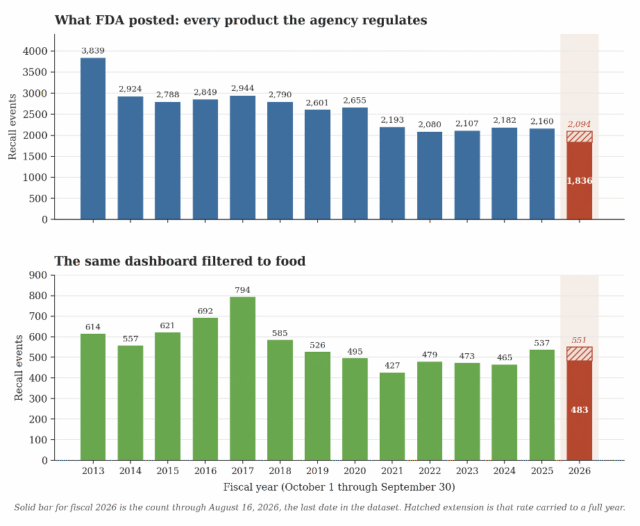
Figure 1. The same FDA dashboard, queried two ways. Upper panel is the unfiltered series the agency posted on August 21. Lower panel is the identical query filtered to food, as run by Susan Mayne. The solid 2026 bar is the count through August 16, 2026, the last date in the dataset; the hatched extension carries that daily rate to a full year. Source: FDA Data Dashboard, Compliance, Recalls, retrieved August 21, 2026.
Filtered to food, fiscal 2026 is running toward the highest recall year since 2018
Here are both series side by side.
| Fiscal year | All FDA recall events | Food recall events |
| 2013 | 3,839 | 614 |
| 2014 | 2,924 | 557 |
| 2015 | 2,788 | 621 |
| 2016 | 2,849 | 692 |
| 2017 | 2,944 | 794 |
| 2018 | 2,790 | 585 |
| 2019 | 2,601 | 526 |
| 2020 | 2,655 | 495 |
| 2021 | 2,193 | 427 |
| 2022 | 2,080 | 479 |
| 2023 | 2,107 | 473 |
| 2024 | 2,182 | 465 |
| 2025 | 2,160 | 537 |
| 2026, through Aug. 16 | 1,836 | 483 |
| 2026, pro-rated to 12 months | 2,094 | 551 |
Recall events by fiscal year, FDA Data Dashboard, Compliance, Recalls, retrieved August 21, 2026. Column two is the unfiltered series FDA posted. Column three is the same query filtered to food, as run by Susan Mayne. The federal fiscal year runs October 1 through September 30, so fiscal 2026 covers October 1, 2025 through September 30, 2026. Check: the last date in the dataset is August 16, 2026, which is 320 days of a 365-day year; 483 divided by 320 and multiplied by 365 is 550.9, and 1,836 by the same method is 2,094.
With forty-five days still to run, food recalls in fiscal 2026 have already passed four of the five most recently completed fiscal years. The 483 is above fiscal 2021 at 427, fiscal 2022 at 479, fiscal 2023 at 473 and fiscal 2024 at 465. It sits twelve short of fiscal 2020 and fifty-four short of fiscal 2025. At the current rate of about one and a half food recall events a day, it passes fiscal 2025 around September 21, nine days before the fiscal year closes.
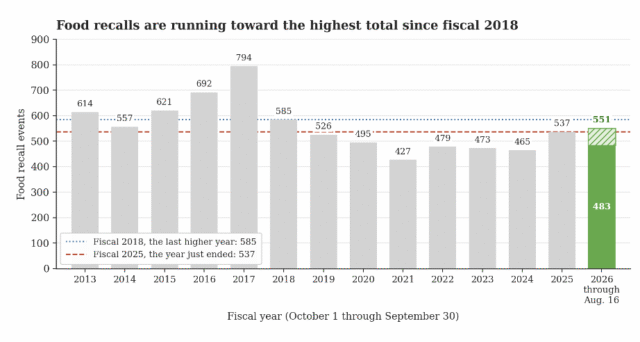
Figure 2. Food recall events only, fiscal 2013 through 2026. Fiscal 2026 is shown as the count through August 16 with the pro-rated remainder hatched above it. Check: 483 divided by 320 days and multiplied by 365 is 550.9. Source: FDA Data Dashboard, Compliance, Recalls, retrieved August 21, 2026.
One more thing the table shows. Even the unfiltered series FDA chose to publish is not a record low once you annualize it. Pro-rated, 1,836 becomes 2,094, which is above fiscal 2022’s 2,080, the lowest completed year on the agency’s own chart.
The fiscal year has forty-five days left and the dataset only holds recalls that have already been classified
Two things make that green bar short, and FDA states both of them on the page the data came from.
The first is the calendar. The federal fiscal year runs October 1 through September 30. FDA printed that on the graphic. Every navy bar is twelve months tall, and the green one is ten months and two weeks.
The second is the one almost nobody knows about. The dashboard’s own caveat says the dataset is updated weekly and includes only recalls that have been classified. A recall does not enter the count until FDA has assigned it Class I, II or III, and classification runs weeks to months behind the recall itself. Recalls initiated in June and July are not in the 483 yet. The most recent bar on any FDA recall chart is short by construction, and the thirteen bars behind it have each had a year or more to fill in. The 551 is a floor, not an estimate. The underlying enforcement reports are where those classifications land.
A recall count measures what companies did, not whether the food was safe
Take the number entirely at face value and the inference still runs backwards. FDA’s own definition on that dashboard is that a recall event is a firm’s recall of one or more products. Recalls are overwhelmingly voluntary and company-initiated. The agency’s mandatory recall authority arrived with the Food Safety Modernization Act in 2011 and has been used a handful of times since. Counting recalls up or down is counting what companies did.
The consumer group whose recall data everyone has been quoting this month says this in terms. U.S. PIRG’s Food for Thought 2026 reports 320 food recalls announced in 2025 against 296 in 2024, then says plainly that this does not mean food was less safe or regulation better. The total, they write, reflects only how many recalls were announced. It can be driven by how many people got sick enough to see a doctor, by how much testing companies and regulators did, by how many inspections happened, or by whether investigators could identify a specific food at all.
A note on comparing figures, because somebody will try. PIRG counts recalls announced by FDA and USDA in a calendar year. The dashboard counts classified FDA recall events in a fiscal year. Those are different series and they should not be set against each other. The point they share is the one that matters, which is that the count is not a safety metric in either direction.
Seventeen of twenty-eight outbreaks in 2025 produced no recall at all
PIRG counted twenty-eight foodborne illness outbreaks announced by U.S. food regulators in 2025. For seventeen of them, no brand-specific recall was ever announced. Thirteen investigations never identified even the type of food. Those twenty-eight outbreaks account for 1,003 illnesses, 235 hospitalizations and 22 deaths.
Every one of those seventeen is invisible on FDA’s chart. There were real problems and real sick people, and the recall column stayed empty because nobody could say what to recall. A low recall count is partly composed of the outbreaks nobody solved. PIRG also found that FDA does not post a public announcement for every potentially life-threatening recall and pointed to a Class I breadcrumb recall in July 2025 that surfaced only in the enforcement database.
Ten of the eighteen outbreak investigations FDA has open today have no food identified
FDA’s Investigations of Foodborne Illness Outbreaks table was updated August 21. It carries eighteen investigations in its active section. Ten of them show Not Yet Identified in the product column. Nine show no on-site inspection initiated. Seven of the eighteen are Cyclospora files, and six of those seven have no food named.
I have been counting the ones with nothing in the product column all summer, and the ratio has barely moved. There is good news on that table today, and it should be said: FDA posted an advisory naming alfalfa sproutsdistributed by a Minneapolis company as the source of an E. coli and Salmonella outbreak and merged two clusters into one file on the strength of the traceback. That is the system working, but even there, where fifty-five people are sick in fifteen states and four are hospitalized, FDA has had to recommend a recall rather than announce one.
The backdrop is the rest of the table. As of the August 20 update, CDC and FDA put the iceberg lettuce outbreak at 10,930 illnesses, at least 454 hospitalizations and two deaths across seventeen states, with onsets from June 14 to August 11. Nationally, CDC has 15,716 laboratory-confirmed domestically acquired cases since May 1, with at least 11,841 more that may require further investigation, against 1,180 for the same stretch of 2025.
The inspections that would find the problem are the ones that were cut
Despres asked what message the post was trying to convey. The honest answer is that a falling recall count, if it were falling, would be evidence of exactly what she suspected.
The Government Accountability Office reported in January 2025 that FDA conducted an average of 917 foreign food facility inspections a year from fiscal 2018 through fiscal 2023, against a statutory target of 19,200. The best year on record was fiscal 2019 at 1,727, about nine percent of the target. GAO identified workforce capacity as the primary constraint and noted that as of July 2024 the agency had 432 investigators to cover both domestic and foreign inspections.
ProPublica then reported in November 2025 that foreign food inspections had fallen to their lowest level since 2011, excluding the pandemic years, running nearly thirty percent below the two prior years by the end of July. The cause was not a decision to inspect less. Sixty-five percent of the staff in the divisions that book travel and process budgets left or were fired, so investigators had to arrange their own flights, visas and diplomatic clearances while a reimbursement backlog climbed past a million dollars.
This outbreak’s lettuce came from central Mexico. I have written before that you cannot genotype your way out of a surveillance system nobody is paying for, and the same holds for recalls. You cannot recall what you never found.
The chart does not say what the agency said it says
There is a fair version of the underlying point, and it deserves stating. Recall counts have been broadly flat for six years, the big drop on that chart happens between 2020 and 2021 rather than recently, and fiscal 2021’s 427 remains the true low on the food series. That belongs to the pandemic, not to anyone currently in office. None of that is what FDA claimed.
What the agency claimed is that food recalls are among the lowest in over a decade and that this proves public health protection is working. The chart it posted is not about food. The food series is running toward its highest total in eight years. The bar is forty-five days short and the dataset behind it is weeks behind besides. And in the same three sentences the post argues both that fewer recalls prove the system works and that recalls prove FDA oversight ensures swift action, which cannot both be true.
A recall is not proof that a system worked. It is a notice sent after the fact, usually by the company that failed, about food people have already eaten. There are more than ten thousand people in the federal outbreak count this summer and two of them are dead. They are not fake news.