

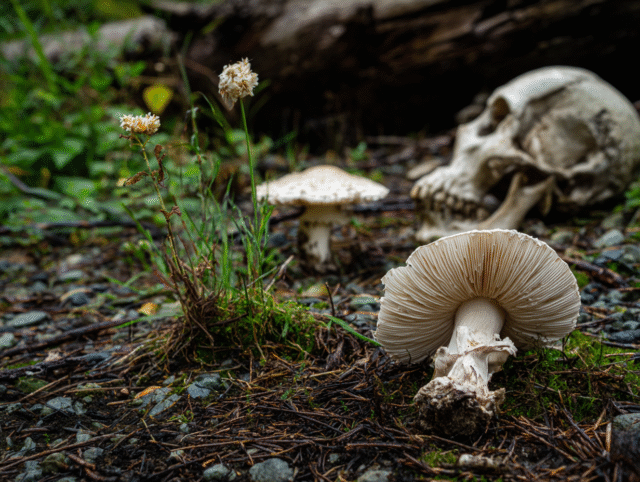
Death Cap and Western Destroying Angel mushrooms
- As an update to the January 2026 Health Advisory describing an increase in mushroom poisoning cases identified in the Northern California and Central Coast regions, the California Department of Public Health (CDPH) and the California Poison Control System (CPCS) are alerting health care providers of a recent resurgence in poisoning cases associated with consumption of amatoxin-containing mushrooms in the Northern California and Central Coast regions.
- As of May 11, 2026, 47 cases have been reported to CPCS, with severe illnesses resulting in four deaths and at least four liver transplants. Eight cases have been reported in the last four weeks (with four of the eight reported in the last week), in a time frame past the normal peak season. This greatly exceeds the typical report of less than 5 cases of mushroom poisonings each year in California. Since November 2026, hospitals across 12 counties have provided treatment to patients with poisoning symptoms. Death Cap and Western Destroying Angel mushrooms have reportedly been collected in a wide variety of locations including city, county, and national park areas across the Northern California and Central Coast regions beyond the initial clusters identified in the Monterey and San Francisco Bay areas.
- Health care providers should consider mushroom poisoning as a differential diagnosis in patients presenting with recent or active gastrointestinal symptoms or elevation of liver enzymes. Ask patients about possible consumption of foraged mushrooms; Death Cap and Western Destroying Angel mushrooms can be mistaken for several edible mushroom varieties at different stages of growth. Contact California Poison Control System at 1-800-222-1222 for guidance on diagnosing and treating patients with suspected mushroom poisoning and to report cases. CDPH can assist with rapid amatoxin detection in the urine of patients as well as laboratory analyses of mushroom specimens – contact the CDPH Laboratory Response Network’s CT Training and Outreach Coordinator, Terri Jackson at (530) 304-7439 or Terri.Jackson@cdph.ca.gov.
- CDPH and CPCS have developed materials in multiple languages to support outreach and education on amatoxin-containing mushrooms. CDPH has also developed a dashboard to provide updated information on the outbreak including a case definition, an epidemic histogram of the outbreak, and selected case characteristics.