

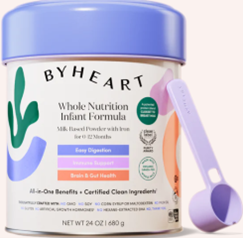
On August 28, 2026, ByHeart announced that the Food and Drug Administration had told the company in writing that, apart from two pending items, it has no further questions about the roughly 400-page root cause investigation and action plan ByHeart submitted after the November 2025 infant botulism outbreak — 48 sick babies, 28 confirmed and 20 probable, in seventeen states, every one of them hospitalized. The trade press ran it as the agency clearing the company.
Two documents are now doing public work: ByHeart’s submission and FDA’s written response. Neither has been released. Both should be.
The principle is one every lawyer knows and most people understand on contact. You cannot put a document in issue and then decline to let anyone read it. ByHeart did not have to say anything at all. It chose to announce the conclusion of a document on a national wire, and within hours the announcement was reprinted as news. Having relied on the submission and the letter to tell the public where things stand, the company owns the obligation to produce them.
The page count makes the point rather than answering it. “Approximately 400 pages” is offered as evidence of thoroughness, and nobody can weigh 400 pages they are not allowed to read. The same goes for the letter. The release quotes four words from it — no further questions — and withholds the rest. A company that quotes four words from a letter and will not publish the letter has told you the letter says more than four words.
The announcement does answer some real questions
Start with what it settles, because it settles some things and a fair reading has to say so. FDA has finished reading the submission and said so in writing, which is a dated fact and more than most companies in this position disclose. ByHeart is not coming back to shelves soon: before restarting production, it must give FDA 28 days’ notice and complete verification activities and pre-production commitments it does not describe. The company is changing its whole milk ingredient supplier, which is a concession that the old chain is not being resumed. It is also changing how it treats facility surfaces, adopting a new sporicidal method. And its detection science is public — the research and the protocol were both published rather than held as trade secret. Parents asking whether the formula is returning have an answer: not yet, and not without more steps.
FDA’s own page still says it has not determined a root cause
That is where the release and the record part company. FDA’s outbreak page, current as of June 3, 2026, reports that whole genome sequencing has identified seventeen different strains of Clostridium botulinumacross patient samples, finished product and ingredients, and states that the agency has not yet determined a root cause. The banner across the top of that page says the root cause investigation, with a focus on ingredients, is ongoing. A headline announcing that the root cause points to a milk ingredient states as settled the very thing the agency says is not.
Two smaller things are worth noticing in the same breath. FDA wrote that the inspections identified the organism in a powdered milk ingredient. The release wrote a powdered whole milk ingredient sourced from a third-party ingredient supplier. And FDA’s sentence is that the inspections did not identify any additional factors within ByHeart’s facilities that could explain the cause of this outbreak. The word doing the work is additional. That sentence says nothing further was found beyond what was already found.
“No further questions” means FDA has finished reading a submission. It is not a determination of root cause, not an approval of the action plan, not a clearance to resume production and not an exoneration of anyone. The release concedes as much when it lists the steps still standing between the company and the shelf.
FDA said the day before that the two outbreaks share a common source
On August 27, 2026 — the day before the announcement — FDA updated its advisory on the Nara Organics outbreak, the second infant botulism outbreak tied to powdered formula in seven months. Four confirmed cases in California, Pennsylvania and Washington, onsets between April and May 2026, all four babies hospitalized. CDC declared it over. What FDA published alongside the closeout is the part that matters.
Whole genome sequencing shows that a clinical sample from an infant in the Nara outbreak is a genetic match to a clinical sample from an infant in the 2025 ByHeart outbreak, to a ByHeart powdered infant formula base sample, and to four samples of unopened cans of ByHeart formula. FDA determined that the Nara lots linked to illness were made with milk supplied by Organic West Milk and spray dried by Dairy Farmers of America — the same suppliers as ByHeart. And the agency states plainly that the matching sequencing results and the supply chain commonalities indicate a common source of contamination between the two outbreaks, while adding that it still cannot say whether the milk was contaminated before drying or during it, and that its root cause investigation is ongoing.
Four unopened cans. That forecloses any suggestion that this was something introduced in a kitchen after purchase.
There is one more thing on that page. During the 2025 investigation FDA ran a trace-forward to learn whether Organic West Milk had supplied milk to other formula manufacturers. Organic West gave the agency a customer list that did not include Nara Organics. Only during the 2026 investigation did the company tell FDA the earlier list had been incomplete. Between that list and the second recall, four more babies were hospitalized with botulism.
That was the state of the public record on August 27. On August 28, a company whose entire announcement is about ingredient supply chain root cause issued a release that mentions none of it. And FDA’s own post-outbreak response page — the page the agency says will carry future root cause updates — is still stamped July 13 and has not caught up to its own sequencing result.
The questions still open are exactly the ones the submission would answer
Where in the milk chain did this happen? If an ingredient is the vehicle, was the milk contaminated before it was dried or during drying? Neither agency has said, and the release does not touch the dryer.
Why is a new sporicidal treatment for facility surfaces needed if the facilities were not implicated? That question comes from the company’s own disclosure. Nobody rebuilds surface sanitation over an ingredient somebody else made.
What about the second lot? ByHeart’s own published research reports that an isolate from one finished lot was genetically identical to a base powder, while an isolate from another lot was distinct. One contaminated ingredient lot does not explain a second, different strain in a second lot.
What happened between 2022 and 2025? CDC widened the case definition back to the product’s March 2022 release, and children who got sick in December 2023 and in early 2024 are inside this outbreak only because it did. A more sensitive test adopted in 2026 does not explain why nothing caught this in the years before it. The inspection records went back to 2022 as well, and that history has never been reconciled with a root cause that begins and ends with somebody else’s milk. The company also holds retained samples from that period, and the release does not say whether the new protocol has been run backward across them.
And how does a root cause that begins and ends with somebody else’s milk account for a second brand? FDA has now said the two outbreaks share a common source of contamination. The submission either addresses that, or it does not.
Every one of those questions is answered somewhere in 400 pages, or it is not answered at all. Either way, the document is the answer.
ByHeart is the only party that can release the submission
This is the part most readers will not know, and it closes the obvious door before anyone walks through it. A company’s submission to FDA lands in the confidential commercial information bucket. Ask the agency for it and you wait months for a version with the interesting parts blacked out. That protection belongs to ByHeart, and it is ByHeart’s to waive. FDA cannot publish this. ByHeart can publish it this afternoon.
The letter is easier still. It is short, it is presumably favorable, and it is the entire foundation of the announcement. Posting it costs the company nothing if it says what the company says it says.
And ByHeart has already accepted the principle. This is not a company that went silent. It published the research with IEH Laboratories, it published the testing protocol, and it kept a public timeline of the investigation, including its own positive results and the January genetic match between its formula and whole milk powder collected from its supplier. The argument is not that the company should start being transparent. It is that having chosen transparency in pieces, it should finish.
Redact what genuinely needs redacting and publish the rest
Employee names come out. Genuine formulation secrets unrelated to the hazard come out. That is a small fraction of 400 pages, and saying so up front is what makes this a request rather than a stunt. If material belonging to the milk supplier or the processor is in there and is not ByHeart’s to publish, publish the rest and say which sections were withheld and why.
I will get these documents eventually. There are lawsuits, and discovery does that work. That is precisely the point. A protective order delivers a 400-page root cause analysis to me and to nobody else — not to the next company buying milk powder, not to the pediatrician trying to understand what happened to a patient, not to the parents of the babies in the next outbreak, who do not have a subpoena.
None of this assumes the documents say something other than what the company claims. They may say exactly that. The trouble is that nobody outside ByHeart and FDA can know and ByHeart is the party that made it a public matter.
An investigation nobody outside the company can read has not taught the industry anything. It has only told the industry that somebody learned something.