


Since 2000, the U.S. Centers for Disease Control and Prevention (CDC) and the U.S. Food and Drug Administration (FDA), working with state and local partners, have publicly reported a series of multistate Escherichia coli outbreaks linked to romaine lettuce (and, in several cases, to leafy-green products in which romaine was the implicated or strongly suspected component). The below summarizes each of those publicly reported outbreaks in chronological order, with primary-source citations to the relevant CDC and FDA notices provided in the footnotes.
Context: The Pre-2010 Period and Why the Catalog Begins in 2010. Although this compilation addresses the period since 2000, the earliest outbreaks the CDC and FDA reported as standalone, romaine-specific investigations date to 2010 (O145 / Freshway) and 2011 (O157:H7 / St. Louis). Before roughly 2010, the agencies did not routinely publish individual produce-outbreak notices in the web format adopted later; earlier produce events are generally captured in retrospective CDC surveillance reviews — for example, Rangel et al., “Epidemiology of E. coli O157:H7 Outbreaks, United States, 1982–2002” (Emerg. Infect. Dis., 2005), and Heiman et al., “E. coli O157 Outbreaks in the United States, 2003–2012” (Emerg. Infect. Dis., 2015) — rather than as named public outbreak reports. The FDA frames the modern record as 28 STEC outbreaks with a confirmed or suspected link to leafy greens between 2009 and 2017.
Just as important, the prominent, widely publicized leafy-green outbreaks of the 2000s were attributed to greens other than romaine, so they do not belong on a romaine-specific list. The two most significant are noted here for completeness and explicitly distinguished:
September 2006 — Fresh bagged spinach (not romaine). An E. coli O157:H7 outbreak tied to fresh spinach caused roughly 205 illnesses and three deaths across about 26 states; the probable origin was a California cattle ranch adjacent to spinach fields. FDA later treated this as the benchmark large produce outbreak that the 2018 Yuma romaine outbreak surpassed (FDA Environmental Assessment).
December 2006 — Shredded iceberg lettuce (not romaine). Green onions were suspected first, but a CDC case-control investigation pointed to lettuce, and FDA identified the vehicle as shredded iceberg lettuce served at Taco Bell restaurants in the northeastern U.S. (about 71 illnesses). A concurrent Taco John’s outbreak in Iowa and Minnesota — a genetically different strain — was likewise traced to iceberg lettuce (CIDRAP; FDA Q&A).
Romaine and other lettuces did cause E. coli outbreaks before 2010 — including a 1995 Montana leaf-lettuce outbreak and assorted restaurant clusters — but those were generally recorded in aggregate surveillance rather than as romaine-specific public outbreak reports. Accordingly, the catalog below is believed to be complete for publicly reported, romaine-attributed CDC/FDA outbreaks since 2000, and it begins in 2010 for that reason.
Publicly Reported CDC/FDA Romaine Lettuce E. coli Outbreaks Since 2010
- 2010 — E. coli O145, Shredded Romaine Lettuce (Freshway Foods)
Pathogen: Shiga toxin-producing E. coli O145
Vehicle: Shredded romaine lettuce processed by Freshway Foods (Sidney, OH); an unopened bag tested positive for the outbreak strain
Scope: 31 cases (27 confirmed, 4 probable) across 5 states (MI, OH, TN, PA, NY)
Outcomes: 14 hospitalized (45%); 3 HUS; no deaths
Notes: Documented as the first U.S. foodborne outbreak of STEC O145; CDC supported the investigation, FDA led the traceback and recall
Source(s):[1]
- 2011 — E. coli O157:H7, Romaine Lettuce (St. Louis / Schnucks salad bars)
Pathogen: E. coli O157:H7
Vehicle: Romaine lettuce (illnesses linked to salad bars; traced to a single processor/grower)
Scope: 58 cases across 9–10 states (concentrated in Missouri)
Outcomes: 33 hospitalized (67%); 3 HUS; no deaths
Notes: CDC posted a final outbreak summary in March 2012 identifying romaine lettuce as the source
Source(s):[2]
- 2017–2018 — E. coli O157:H7, Leafy Greens (U.S.) / Romaine Lettuce (Canada)
Pathogen: E. coli O157:H7
Vehicle: Leafy greens in the U.S.; the Public Health Agency of Canada identified romaine lettuce as the source of the genetically linked Canadian outbreak
Scope: 25 U.S. cases across 15 states
Outcomes: 9 hospitalized; 2 HUS; 1 death (California)
Notes: CDC did not name a specific food in the U.S. because no common source was identified before the short shelf-life product was gone
Source(s):[3]
- Spring 2018 — E. coli O157:H7, Romaine Lettuce (Yuma, AZ growing region)
Pathogen: E. coli O157:H7
Vehicle: Romaine lettuce from the Yuma, Arizona growing region; the strain was found in Yuma-region canal water
Scope: 210 cases across 36 states
Outcomes: 96 hospitalized; 27 HUS; 5 deaths (AR, CA, MN ×2, NY)
Notes: The largest U.S. E. coli O157:H7 outbreak since the 2006 spinach outbreak
Source(s):[4]
- Fall 2018 — E. coli O157:H7, Romaine Lettuce (Central Coastal CA / Santa Maria)
Pathogen: E. coli O157:H7
Vehicle: Romaine lettuce from the Central Coastal growing regions of northern/central California; strain found in an agricultural water reservoir at an Adam Bros. Farming ranch
Scope: 62 cases across 16 states and the District of Columbia
Outcomes: 25 hospitalized; 2 HUS; no deaths
Notes: Prompted a nationwide consumer warning later narrowed to specific California counties; coincided with the rollout of harvest-region labeling
Source(s):[5]
- October 2019 — E. coli O157:H7, Possibly Linked to Romaine Lettuce (FDA disclosure)
Pathogen: E. coli O157:H7
Vehicle: Romaine lettuce (likely source); product past shelf life by the time the source was identified
Scope: 23 illnesses
Outcomes: No deaths reported
Notes: Disclosed by FDA after the fact (Oct. 31, 2019); distinct from the larger November 2019 Salinas Valley outbreak
Source(s):[6]
- November 2019 — E. coli O157:H7, Romaine Lettuce (Salinas Valley, CA)
Pathogen: E. coli O157:H7 (same strain as 2017 leafy-greens and 2018 romaine outbreaks)
Vehicle: Romaine lettuce from the Salinas Valley growing region; strain detected in romaine products and the surrounding environment
Scope: 167 cases across 27 states (CDC final); a related analysis reported 172 across 28 states
Outcomes: 85 hospitalized; 15 HUS; no deaths
Notes: CDC advised consumers not to eat Salinas-grown romaine during the investigation
Source(s):[7]
- Fall 2020 — E. coli O157:H7, Leafy Greens (romaine-related strain)
Pathogen: E. coli O157:H7 (genetically related to the fall 2019 romaine strain)
Vehicle: Leafy greens; a specific type or brand was not confirmed. Romaine was among the leafy greens commonly reported by cases
Scope: 40 cases across 19 states
Outcomes: 20 hospitalized; 4 HUS; no deaths
Notes: Outbreak strain matched in cattle feces collected uphill from a leafy-greens growing area
Source(s):[8]
- Fall 2020 — E. coli O157:H7, Romaine Lettuce (Tanimura & Antle; “Unknown Source 3”)
Pathogen: E. coli O157:H7
Vehicle: Romaine lettuce; the outbreak strain was identified in a single-head package of Tanimura & Antle romaine, recalled Nov. 6, 2020
Scope: 18 cases across 9 states
Outcomes: 6 hospitalized; no HUS; no deaths
Notes: Investigators could not confirm that any ill person had eaten the specific recalled product
Source(s):[9]
- The November 2024 Outbreak: Reported Privately, Not Publicly
A multistate E. coli O157:H7 outbreak coded by PulseNet on November 25, 2024, as 2411MOEXH-2 and reported to the National Outbreak Reporting System (NORS) as NORS ID 511856. The investigation began after Missouri public-health colleagues identified illnesses linked to events served by the same Missouri-based caterer between November 6 and 8, 2024.
As of January 15, 2025, the investigation included 89 cases across 15 states (AR, CO, IL, IN, KS, KY, MO, MT, ND, NE, OH, PA, SD, TN, WI), with the heaviest concentration in Missouri (50). Reported onset dates ran from November 4 to November 30, 2024. Among cases with available outcome data, 36 (49%) were hospitalized, there were 7 reported cases of HUS, and one death was attributed to the outbreak. Seven subclusters — including three Missouri catered events, a secondary school, two restaurants, and an event run by a different caterer — were tied together by a salad containing an iceberg/romaine lettuce blend.
Epidemiologic and traceback evidence pointed to romaine lettuce. Of cases who could recall the type of leafy green consumed, 88% reported romaine — well above the roughly 49% background rate in the FoodNet population survey. A three-leg traceback converged on a single processor sourcing romaine from a single grower, and four implicated lots tied to a common ranch. The CDC closed the investigation on January 15, 2025, as an outbreak with a confirmed vehicle of romaine lettuce. According to the memorandum and the FDA records cited within it, the processor of the implicated lettuce was Taylor Farms of Salinas, California, and the grower was Anthony Costa and Sons, LLC.[10]
Why This Outbreak Is Treated as “Not Reported”
Unlike the outbreaks listed above — each of which received a public CDC investigation notice, periodic case-count updates, and a final report — this outbreak never received a comparable public communication. The FDA logged a brief, source-anonymous entry in its CORE outbreak investigation table (carried under reference #1280, described only as an “iceberg and romaine lettuce blend served at catering events, restaurants, and a school”), with case counts that grew over time from 69 to 75 to 86 across as many as 12 named-only-by-count states. The agency then closed the investigation in February 2025 without issuing a final outbreak report, without naming the implicated supplier or grower, and without identifying the affected venues.[11]
Reporting by NBC News, working with attorney Bill Marler, subsequently established that the closed investigation corresponded to the 89-case, one-death outbreak — information the public had not been given through any ordinary CDC or FDA outbreak announcement.[12]
Bill Marler’s Position
Marler — a food-safety lawyer whose firm represents victims of the outbreak — has argued that this outbreak should have been publicly reported in the same manner as the earlier romaine outbreaks. After obtaining the FDA’s investigation records, his firm’s on-staff epidemiologist concluded that the common link among genetically matched cases across multiple states was consumption of Taylor Farms romaine lettuce during the outbreak period. Marler contends that, had the agencies completed their normal process, “they would have publicized the same conclusion.”[13]
He has tied the silence to reduced federal public-health capacity, asserting that informing the public and identifying the cause of outbreaks had ceased to be a priority, and stating that his firm would “step up to inform and protect the public” in the agencies’ place. To press the point publicly, Marler Clark filed several lawsuits naming Taylor Farms as the source of the romaine lettuce and amended earlier suits accordingly. Taylor Farms denies that its product was the source, stating that its raw and finished-product testing found no evidence of contamination.[14]
The core of Marler’s criticism is one of transparency rather than epidemiology: the investigative work was done, a vehicle was identified internally, and a person died — yet, in his view, the public was deprived of the timely, named, and complete outbreak notice that the CDC and FDA had routinely issued for every comparable romaine outbreak in the preceding fifteen years.
Here is a bit more detail:
On November 25, 2024, PulseNet coded an outbreak of E. coli O157:H7, given the code 2411MOEXH-2. This outbreak was coded following notification from colleagues in Missouri after they identified and investigated multiple illnesses linked to events catered by the same Missouri-based caterer. These events occurred between November 6 and November 8. All events included the same menu items with a few modifications. A case was defined as a person with an E. coli O157:H7 infection, with an isolate related to the outbreak strain within 0-4 alleles by cgMLST, and an isolation date ranging from November 7 to December 1, 2024. Specimen were collected from November 7, 2024, to December 1, 2024, all related within 0-4 alleles by cgMLST.
This outbreak was related to six historical outbreak investigations: 2302MLEXH-1, 2210MLEXH-3, 2210MLEXH-2, 2209MLEXH-1, 2112MLEXH-1, and 2106CAEXH-1. The only vehicle identified was for 2112MLEXH-1, which was closed with a confirmed vehicle of organic power greens. The NCBI tree for this outbreak strain, 2411MOEXH-2, included numerous nonclinical beef isolates.
Aa of January 15, 2025, this investigation included 89 cases from 15 states: AR (2), CO (1), IL (7), IN (8), KS (1), KY (1), MO (50), MT (1), ND (2), NE (3), OH (8), PA (1), SD (1), TN (1), WI (2). Reported onset dates ranged from November 4 to November 30, 2024 (n=83). Ages ranged from 4 to 90 years, with a median age of 24. Sixty of 88 cases (68%) were female. Outcome information was available for 74 cases, of which 36 (49%) were hospitalized. There were seven reported cases of HUS and one death attributed to this outbreak.
In total, seven subclusters were identified across the multistate outbreak. These included three Missouri catered events, a secondary school, two different restaurants, and an event catered by a different caterer. In the Missouri investigations, Missouri colleagues conducted a retrospective cohort study at two of the events and found that salads were the only statistically significant menu item across both events. Salads contained an iceberg/romaine lettuce blend, carrots, purple cabbage, onions, canned pimento, canned artichokes, parmesan cheese, and a house made salad dressing. Salads were the common link across all seven subclusters, and cases in all subclusters ate an iceberg/romaine lettuce blend. The CDC deployed a focused questionnaire on November 26, 2024, and 27 questionnaires were returned. Epi information was available for 65 cases, of which 60 (95%) reported consuming any type of leafy green prior to illness. Of 57 cases who could remember the exact type of leafy green consumed, 50 (88%) consumed romaine lettuce. This is statistically significantly higher than the background rate of 49% from the FoodNet Population survey.
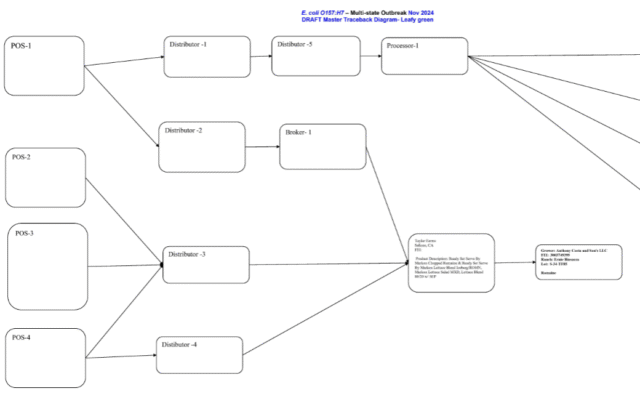
A traceback investigation was initiated in response to the E. coli O157 outbreak with leafy greens as the suspected vehicle. Each case included in the traceback investigation reported consumption of leafy greens prior to illness onset. Based on information available at the points of service (POS), the traceback focused on iceberg and romaine lettuce. The investigation consisted of three traceback legs representing 28 cases and five POS. The three traceback legs identified four distribution centers, one broker, two processors, one grower, and one ranch. The traceback investigation determined that a sole processer sourced romaine lettuce from a single grower that would have been available at all points of service during the timeframe of interest. Additionally, romaine lettuce supplied to four of the five POS was traced back to a common ranch and lot. Through analysis of records, four lots of romaine lettuce were implicated, resulting in confirmation of romaine lettuce as the vehicle.
Epidemiologic and traceback data supported the conclusion that romaine lettuce was the source of illnesses in this outbreak. CDC closed this investigation on January 15, 2025, following the elapsing of the surveillance reporting lag period and lack of new uploads. CDC closed this investigation as an outbreak with a confirmed vehicle of romaine lettuce. This outbreak was reported to NORS with NORS ID: 511856.
Based on the documents obtained from the FDA and in discovery, the processor of the contaminated subject lettuce was Taylor Farms, Salinas, CA, and the grower of the contaminated subject lettuce was Anthony Costa and Sons, LLC.
[1]U.S. Centers for Disease Control and Prevention (CDC), Multistate Outbreak of E. coli O145 Infections Linked to Shredded Romaine Lettuce (Final Update / 2010); J.M. Taylor et al., “Multistate Outbreak of Escherichia coli O145 Infections Associated with Romaine Lettuce Consumption, 2010,” Journal of Food Protection (2013), PubMed: pubmed.ncbi.nlm.nih.gov/23726187; U.S. Food and Drug Administration (FDA), Environmental Assessment of the Freshway Foods O145 outbreak.
[2]CDC, 2011 E. coli Outbreak Linked to Romaine Lettuce (posted Mar. 23, 2012), archived at archive.cdc.gov/…/ecoli/2011/romaine-lettace-3-23-12.html; R.B. Slayton et al., PLoS ONE (2013), DOI:10.1371/journal.pone.0055300.
[3]CDC, Update: Multistate Outbreak of E. coli O157:H7 Infections (Media Statement, Jan. 10, 2018), archived at archive.cdc.gov/…/media/releases/2018/s0110-update-ecoli.html. The Public Health Agency of Canada identified romaine lettuce as the source of the linked Canadian outbreak.
[4]CDC, 2018 E. coli Outbreak Linked to Romaine Lettuce (Yuma growing region) – Final Update (June 28, 2018), archived at archive.cdc.gov/…/ecoli/2018/o157h7-04-18/index.html; FDA, Investigated Multistate Outbreak of E. coli O157:H7 Linked to Romaine Lettuce from the Yuma Growing Region, fda.gov/…/romaine-lettuce-yuma-growing.
[5]CDC, 2018 E. coli Outbreak Linked to Romaine Lettuce (Central Coastal / Santa Maria, CA) – Final Update (Jan. 9, 2019), archived at archive.cdc.gov/…/ecoli/2018/o157h7-11-18/index.html; FDA, Investigation Summary: Factors Potentially Contributing to the Contamination of Romaine Lettuce Implicated in the Fall 2018 Multi-State Outbreak, fda.gov/…/implicated-fall.
[6]FDA, FDA, CDC and Other Health Partners Investigated Outbreak of E. coli O157:H7 Possibly Linked to Romaine Lettuce; Outbreak Appears to Be Over (FDA In Brief, Oct. 31, 2019), fda.gov/…/possibly-linked-romaine. This smaller outbreak was distinct from the November 2019 Salinas Valley outbreak and was disclosed after the product was past shelf life.
[7]CDC, 2019 E. coli Outbreak Linked to Romaine Lettuce (Salinas, CA) – Final Update (Jan. 15, 2020), archived at archive.cdc.gov/…/ecoli/2019/o157h7-11-19/index.html; FDA, Outbreak Investigation of E. coli O157:H7 – Romaine from Salinas (2019–2020).
[8]CDC, 2020 E. coli Outbreak Linked to Leafy Greens – Final Update (Dec. 22, 2020), archived at archive.cdc.gov/…/ecoli/2020/o157h7-10-20b/index.html; FDA, Outbreak Investigation of E. coli – Leafy Greens (December 2020), fda.gov/…/leafy-greens-december-2020. A specific type/brand was not confirmed, but the strain was genetically related to the 2019 romaine outbreak.
[9]CDC, 2020 E. coli Outbreak Linked to Unknown Source 3 – Final Update (Dec. 18, 2020), archived at archive.cdc.gov/…/ecoli/2020/o157h7-11-20/index.html. The outbreak strain was identified in a single-head package of Tanimura & Antle romaine lettuce, recalled Nov. 6, 2020.
[10]Uploaded outbreak memorandum re PulseNet code 2411MOEXH-2 / NORS ID 511856 (citing FDA Executive Incident Summary, Att. No. 18; FDA Additional Records re Romaine Lettuce Outbreak (Taylor Farms, unredacted), Att. No. 19; FDA Diagram TF00000163, Att. No. 20).
[11]FDA, CORE Outbreak Investigation Table, E. coli O157:H7 outbreak reference #1280 (“iceberg and romaine lettuce blend served at catering events, restaurants, and a school”), investigation opened Dec. 2024 and closed Feb. 2025 without a public final report naming a source; Food Safety News, “Publisher’s Platform: FDA closes romaine lettuce outbreak with 89 sick and says nothing more?” (Feb. 14, 2025), foodsafetynews.com.
[12]S. Chuck & A. Lozano, “A deadly E. coli outbreak hit 15 states, but the FDA chose not to make the details public,” NBC News (Apr. 17, 2025), nbcnews.com/news/us-news/ecoli-bacteria-lettuce-outbreak-rcna200236; “Uncovered: FDA Did Not Disclose Fatal E. coli Outbreak Linked to Lettuce in 2024,” Food Safety Magazine (Apr. 17, 2025), food-safety.com.
[13]Marler Clark, Inc., P.S. press release, reprinted in Food Poison Journal, “Marler Clark reports on 89 person E. coli Outbreak not reported by CDC and FDA” (Apr. 17, 2025), foodpoisonjournal.com; see also Marler Blog, billmarler.com.
[14]Marler Clark federal lawsuits and amended complaints naming Taylor Farms (Apr. 17, 2025); see NBC News (Apr. 17, 2025) and Salon, “The name of the grower behind a deadly E. coli lettuce outbreak has been disclosed” (Apr. 24, 2025), salon.com. Taylor Farms denies that its product was the source, stating its raw and finished-product testing found no evidence of contamination.