

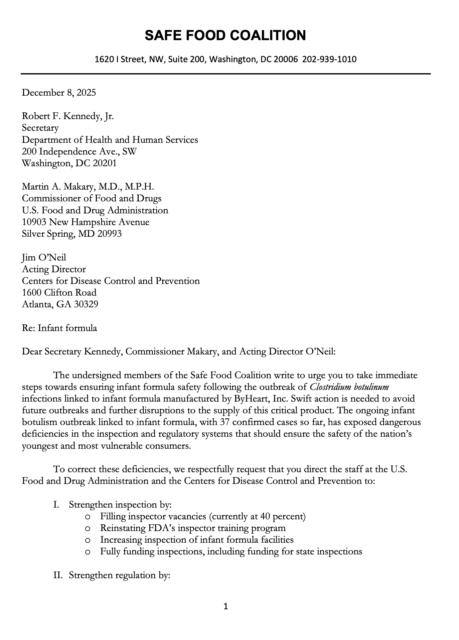
The Safe Food Coalition wants stronger oversight of infant formula production and the reinstatement of FDA food inspectors, citing the ongoing outbreak of botulism infections as a case in point.
The coalition includes the Center for Food Safety, Center for Science in the Public Interest (CSPI), Consumer Federation of America, Consumer Reports, Government Accountability Project, GWU Institute for Food Safety and Nutrition Security, and Stop Foodborne Illness.
Currently there are 39 confirmed cases of infant botulism traced to ByHeart powdered infant formula. Another 60 cases are under investigation. All of the sick infants were fed ByHeart formula. The company has recalled all of its formula, but according to the Food and Drug Administration it remains on sale at a variety of stores, including Walmart and Kroger.
The coalition has written a letter to Secretary of Health and Human Services Robert F. Kennedy Jr., Food and Drug Administration Commissioner Martin Makary, and Centers for Disease Control and Prevention Acting Director Jim O’Neil, urging the Trump Administration to strengthen the inspection and regulation of infant formula, and to declare Clostridium botulinum to be a hazard requiring controls to prevent contamination.
The coalition says greater scrutiny of ByHeart’s operations — including the Iowa production facility linked to the ongoing outbreak — may have prompted an earlier recall and avoided illnesses and could prevent future outbreaks of foodborne illnesses from infant formula.
To strengthen the formula inspection program, the Safe Food Coalition recommends filling vacant inspector positions — currently at 40 percent — and reinstating FDA’s inspector training program. The FDA should increase inspection of formula facilities, the coalition says, and fully fund the inspection program, including funding for state-level inspections.
“The nation’s food safety system is on the brink of collapse,” said CSPI director of regulatory affairs Sarah Sorscher. “Forty percent of the personnel who inspect infant formula and other critical foods are not at their posts. That means the FDA has less flexibility to deploy its resources in response to outbreaks like the current ByHeart outbreak.”
Besides declaring Clostridium botulinum contamination in infant formula to be a hazard, the coalition recommends the administration develop recommendations for best practices to avoid such contamination. It also wasn’t to see a sampling program for Clostridium botulinum in infant formula.
The administration should issue recommendations to companies on appropriate testing and facilitate swift recalls by promptly sharing information with state enforcement agencies, according to the coalition’s letter. And, the administration should fully fund chronically underfunded food safety work conducted within the CDC, including vital foodborne illness surveillance activities like FoodNet.
“Contaminated infant formula puts the nation’s most vulnerable consumers at risk, and it is an indictment of our food safety system as a whole,” said Thomas Gremillion, Director of Food Policy at Consumer Federation of America. “Over three years have passed since a Cronobacter outbreak linked to infant formula caused a nationwide shortage, and we see more inspector vacancies and less capacity for outbreak surveillance than ever.”
Full Letter
https://www.marlerblog.com/files/2025/12/Safe-Food-Coalition-letter-re-infant-formula-12-8-25.pdf