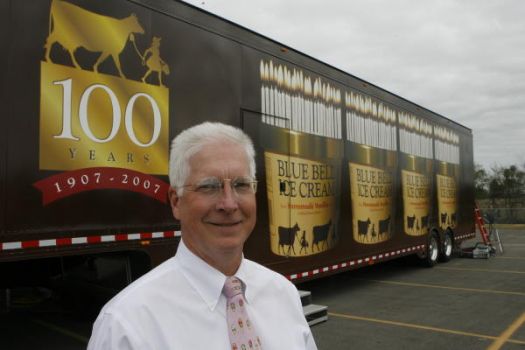
StupidIsAsStupidDoesAccording to ABC’s Gillian Mohney, some enterprising ice cream fans are now to turning to the black market to sell gallons of Blue Bell ice cream online after a listeria outbreak prompted a recall of the company’s products.

Multiple listings for Blue Bell ice cream were posted on Craigslist with a far higher price than the usual grocery shelves.

“Blue Bell vanilla ice cream tested by me and I’m still alive,” read one description from an eager seller on Craigslist. They were selling a half-gallon for $499. The post has since been flagged for removal and taken down.

The company recalled all of its products from stores on April 20 and hit reset on operations after its products were linked to a listeria outbreak that sent 10 people to the hospital, killing three of them.

Another person listed their pint of “Krazy Kookie Dough” for a whopping $10,000 on Craigslist.

“What we have here is one pint of unopened Bluebell [sic] goodness. Purchased just mere weeks ago, this is like an oasis in the desert for you ice cream lovers,” read the description on the post, which has also since been flagged for removal. “Buyer assumes all responsibility for transport, and or any Listeria contracted from product as well

Food safety attorney Bill Marler said that sellers would not face legal trouble, but were not abiding by “common sense.”

“I think they ought to follow the advice of the FDA and CDC, which is ‘When in doubt throw it out,'” Marler said.

After announcing the recall, Blue Bell said they are working on restarting production to ensure there are no cases of listeria in the new products.

Marler pointed out that even if someone ate tainted ice cream, the incubation period for listeria is between three to 70 days. As a result, someone might think the ice cream is bacteria-free, but actually tainted.

“The only rules they’re breaking are the rules of common sense,” said Marler of the sellers – and any buyers.

Frontline MarlerI was proud that many of my clients played a large role is telling this sad story – The first one below is the long version, but all the links below are worth the viewing.

The Trouble with Chicken

Are You Handling Raw Chicken The Wrong Way?

Can We Get to Zero Salmonella in Poultry

Two Agencies, Two Salmonella Standards. Would One Be Better?

What Happens After a Foodborne Illness Outbreak?

Why That Ground Chicken Burger May Not Be As Healthy As You Think

WATCH: When It Comes to Food Safety, How a Whole Chicken Differs From the Sum of Its Parts

Inside the Fast-Food Scandal That Changed How Beef Is Regulated

Is Our Food Safety Process Broken?

Lawmakers Push Two Food Safety Bills After FRONTLINE Investigation

It will be interesting to see if these reports move the food safety needle.

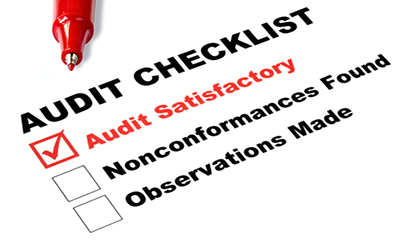
http://www.dreamstime.com/stock-image-audit-checklist-image6143351After rereading the FDA’s inspection reports (483’s) of the three Blue Bell ice cream plants this weekend, it made me wonder – other than the random inspections done by state departments of agriculture – if Blue Bell had been required to be inspected – audited – by a private auditor – the so-called third-party audit?

In nearly every major foodborne illness outbreak over the last decade – think Peanut Corporation of America Salmonella (714 sick, 9 dead) Outbreak, DeCoster Egg Salmonella Outbreak (nearly 2,000 sick) and the Jensen Farms Listeria Outbreak (147 sick, 33 dead) – retailers and/or purchasers of the peanut butter, eggs or cantaloupe required that private audits be performed – at the producer’s expense.  All three of these producers got glowing audits and were eventually charged criminally with shipping tainted product.

“Someone” should ask Blue Bell for its audits over the years Listeria seemed to be ever present in at least one of its plants.

“Someone” should also call a few of the major retailers – Walmart and Kroger – and ask for the same.

PastedGraphic-1Food Safety News writer Cookson Beecher won five awards, all of them in the daily news category, during the May 9 Washington Press Association awards banquet at the Museum of Flight in Seattle. Four of the awards came in first place and one came in third.

Here are the awards she took home:

First place, Health and Medicine, “A Mom and a Dairyman Plead: Don’t Feed Children Raw Milk.”

First place, Agriculture/Environment, “Farmworker Housing Linked to Consumer Demand for Safe Food.”

First place, Science and Technology, “The Search for Alternatives to Antibiotics.”

First place, Food, “Grocery Manufacturers Want Foods With GMOs to Be Labeled as ‘Natural’.”

Third place, Food, “Food Safety to the Rescue.”

Before coming onboard as a freelancer for Food Safety News.com, Beecher spent 12 years working as an agricultural and environmental reporter for Capital Press, a four-state newspaper that covers agricultural and forestry issues in the Pacific Northwest. Previous to her job with Capital Press, she was the editor of the Courier Times in Sedro-Woolley,  Wash. She received her B.A in political science from Hunter College in New York City, and, before moving West, she worked for publishing companies in midtown Manhattan. In the 1970s and 1980s, she and her family lived in North Idaho, where they built a log home and lived a “pioneer life.” She is currently co-owner of Pioneer Dahlias in Skagit County, Wash.

622x350After watching the Blue Bell Listeria Outbreak unfold over the last months – especially after reading the FDA’s 483’s, I think it is time for the President and CEO of Blue Bell to consult with criminal counsel.  True, perhaps he did not know that his Broken Arrow Plant had Listeria positives going back over years, but knowledge is not necessary for the FDA and a US Attorney to prosecute – just ask the Jensens and DeCosters.

Congress passed the Federal Food, Drug, and Cosmetic Act in 1938 in reaction to growing public safety demands.  The primary goal of the Act was to protect the health and safety of the public by preventing deleterious, adulterated or misbranded articles from entering interstate commerce.  Under section 402(a)(4) of the Act, a food product is deemed “adulterated” if the food was “prepared, packed, or held under insanitary conditions whereby it may have become contaminated with filth, or whereby it may have been rendered injurious to health.” A food product is also considered “adulterated” if it bears or contains any poisonous or deleterious substance, which may render it injurious to health.  The 1938 Act, and the recently signed Food Safety Modernization Act, stand today as the primary means by which the federal government enforces food safety standards.

Chapter III of the Act addresses prohibited acts, subjecting violators to both civil and criminal liability. Provisions for criminal sanctions are clear:

Felony violations include adulterating or misbranding a food, drug, or device, and putting an adulterated or misbranded food, drug, or device into interstate commerce.  Any person who commits a prohibited act violates the FDCA.  A person committing a prohibited act “with the intent to defraud or mislead” is guilty of a felony punishable by years in jail and millions in fines or both.

A misdemeanor conviction under the FDCA, unlike a felony conviction, does not require proof of fraudulent intent, or even of knowing or willful conduct.  Rather, a person may be convicted if he or she held a position of responsibility or authority in a firm such that the person could have prevented the violation.  Convictions under the misdemeanor provisions are punishable by not more than one year or fined not more than $250,000, or both.

The legal jargon aside, if you are a producer of food and knowingly or not sell adulterated food, you can (and should) face fines and jail time.  Mr. Kruse, I know you are a lawyer, but you should get another one.

The inspection observations of the most recent completed FDA inspections at the Blue Bell production facilities in Brenham, Texas, Broken Arrow, Okla., and Sylacauga, Ala. are available:

No_483The three Blue Bell “483’s” – Inspection Reports landed in my inbox an hour ago.  Here are the low lights:

Broken Arrow, OK

Observation #1:  Failure to manufacture and package foods under conditions and controls necessary to minimize the potential for growth of microorganisms and contamination.

Observation #2:  Failure to perform microbial testing where necessary to identify sanitation failures and possible food contamination.

Observation #3:  The procedure used for cleaning and sanitizing of equipment and utensils has not been shown to provide adequate cleaning and sanitizing treatment.

Observation #4:  Failure to provide running water at a suitable temperature for cleaning equipment, utensils and food-packaging materials.

Observation #5:  The plant is not constructed in such a manner as to prevent drip and condensate from contaminating food, food-contact surfaces, and food-packaging materials.

Observation #6:  Employees did not wash and sanitize hands thoroughly in an adequate hand-washing facility after each absence from the work station and at any time their hands may have become soiled or contaminated.

Observation #7:  Failure to store cleaned and sanitized portable equipment in a location and manner which protects food-contact surfaces from contamination.

Observation #8:  All reasonable precaution are not taken to ensure that production procedures do not contribute contamination from any source.

Observation #9:  The design of equipment does not allow proper cleaning and maintenance.

Observation #10: Failure to hold foods which can support the rapid growth of undesirable microorganisms at a temperature that prevents the food from becoming adulterated.

Observation #11: Failure to have smoothly bonded or well maintained seams on food contact surfaces, to minimize accumulation of food particles and organic matter and the opportunity for growth of microorganisms.

Observation #12: Failure to take apart equipment as necessary to ensure thorough cleaning.

Brenham, TX

Observation #1: Failure to manufacture foods under conditions and controls necessary to minimize the potential for growth of microorganisms.

Observation #2: The procedure used for cleaning and sanitizing of equipment has not been shown to provide adequate cleaning and sanitizing treatment.

Observation #3: The plant is not constructed in such a manner as to prevent condensate from contaminating food and food-contact surfaces.

Observation #4: Failure to clean food-contact surfaces as frequently as necessary to protect against contamination of food.

Observation #5: Failure to wear beard covers in an effective manner.

Observation #6: Failure to maintain buildings in repair sufficient to prevent food from becoming contaminated.

Sylacauga, AL

Observation #1: Failure to perform microbial testing where necessary to identify possible food contamination.

Observation #2: Suitable outer garments are not worn that protect against contamination of food and food contact surfaces.

Observation #3: Failure to maintain food contact surfaces to protect food from contamination by any source, including unlawful indirect food additives.

Observation #4: The design and materials of equipment and utensils does not allow proper cleaning.

Observation #5: All reasonable precautions are not taken to ensure that production procedures do not contribute contamination from any source.

Observation #6: Employees did not wash and sanitize hands thoroughly in an adequate hand-washing facility at any time their hands may have become soiled or contaminated.

Observation #7: The plaint is not constructed in such a manner as to prevent condensate from contaminating food-contact surfaces.

Observation #8: Non food-contact equipment in manufacturing areas is not constructed so that it can be kept in a clean condition.

There is little wonder why a Listeria outbreak happened and why Blue Bell’s plants are now shuttered.

ecoli-bacteriaThe Whatcom County Health Department (WCHD) is investigating an outbreak of shiga toxin-producing E. coliO157 associated with the Milk Makers Fest that was held at the Northwest Fairgrounds in Lynden on 4/21 –4/23/15.

Over a thousand primary school children from all of the school districts in Whatcom County attended the event. Most of the cases involve children who attended the event. Several older children involved with the event and some adults and close contacts of cases have also become ill.

WCHD is continuing to interview cases to determine if there was a common food or water source or activity, such as the petting zoo or other contact with livestock.

Washington State Department of Health Communicable Disease Epidemiology is assisting with the outbreak investigation. Cumulative total: 23 cases* (8 cases have been hospitalized), 22 probable cases **

Change since last report of 5/5/15: 1 new case +2 probable cases, +1 hospitalization

*Cases include those with positive labs (preliminary presumptive positive O157 and final confirmed positives), and clinical cases with close contact with a case with positive or presumptive positive labs.

** Probable cases are cases with clinical symptoms and were associated with the event, but lab results are not available or labs were not done.

o-E-COLI-ALBERTA-BEEF-RECALL-facebookThe Whatcom County Health Department (WCHD) is investigating an outbreak of shiga toxin-producing E. coli O157 associated with the Milk Makers Fest that was held at the Northwest Fairgrounds in Lynden on 4/21 –4/23/15.

Over a thousand primary school children from all of the school districts in Whatcom County attended the event. Most of the cases involve children who attended the event. Several older children involved with the event and some adults and close contacts of cases have also become ill.

WCHD is continuing to interview cases to determine if there was a common food or water source or activity, such as the petting zoo or other contact with livestock.

Washington State Department of Health Communicable Disease Epidemiology is assisting with the outbreak investigation.

Cumulative total: 22 cases* (7 cases have been hospitalized), 20 probable cases **

*Cases include those with positive labs (preliminary presumptive positive O157 and final confirmed positives), and clinical cases with close contact with a case with positive or presumptive positive labs. ** Probable cases are cases with clinical symptoms and were associated with the event, but lab results are not available or labs were not done.

All sound painfully familiar: