WireAP_03399c68dbe44899989ee8829f71ddbc_16x9_992Are U.S. food manufacturers more at risk today of criminal charges – misdemeanor or felony – for shipping tainted products knowingly or not?

AP reports today that ConAgra Foods is likely to face a misdemeanor criminal charge now that the U.S. government has completed its investigation of the company’s 2007 Salmonella outbreak and peanut butter recall.

ConAgra recalled all its peanut butter in 2007 after its Peter Pan and Great Value peanut butter was linked to a Salmonella outbreak that sickened at least 628 people in 47 states. The peanut butter was produced at ConAgra’s Sylvester, Georgia, plant.

A spokeswoman for the U.S. attorney’s office in Georgia, Pam Lightsey, said Tuesday that prosecutors plan to reveal details of the investigation Wednesday.

ConAgra spokeswoman Teresa Paulsen declined to comment Tuesday, but the company previously has said it was negotiating an end to the investigation that would likely include a misdemeanor charge of shipping tainted products.

At the time of ConAgra’s recall, it was unusual for peanut butter to be implicated in a disease outbreak. At the time of the recall, ConAgra officials blamed moisture in the production plant for helping Salmonella bacteria on the raw peanuts grow. The company said the roof leaked during a storm and the sprinkler system malfunctioned, which allowed the moisture in. The production plant was upgraded and ConAgra adopted new testing procedures.

If the Omaha, Nebraska, food-maker is charged criminally, the case would extend a recent string of high-profile food safety prosecutions.

  • Earlier this year, two former Iowa egg industry executives were sentenced to three months in jail for misdemeanor criminal charges and fined $7,000,000 stemming from a 2010 Salmonella outbreak.
  • Last year, two Colorado cantaloupe farmers were plead guilty to misdemeanor criminal charges and received five years probation in a deadly 2011 Listeria outbreak.
  • Also, Last year the former owners and executives of Peanut Corporation of America were convicted of felony charges of knowingly shipping Salmonella-tainted peanut butter in a 2009 Salmonella outbreak.

It does raise the question about why these companies have been charged, but others not?

Los-Corrales-300x200The Kenosha County Division of Health is currently investigating an outbreak of Salmonella in the community after receiving several reports of cases in the county. The Division of Health is investigating food purchased over Mother’s Day weekend (May 9-10, 2015) at Supermercado Los Corrales (3933 52nd Street, Kenosha 53144) in Kenosha County as a possible source of the outbreak. As of today, the source of the outbreak has not been confirmed. The Division of Health is currently working with the facility. The meat and food preparation area of the Supermercado is temporarily closed while the investigation is ongoing, but the remainder of the establishment is open.

The investigation began on May 15, 2015 when the Division of Health staff received positive Salmonella lab reports. Interviews with ill individuals are being conducted and laboratory testing is currently underway.

Yellowfin Tuna SushiAt least 50 people in the southwestern U.S. have been sickened with a rare strain of Salmonella that has been associated with consumption of raw tuna sushi in several states, according to the U.S. Centers for Disease Control and Prevention (CDC).

CDC said Monday that the agency is working with public health officials in nine states to investigate what it is now calling a multistate outbreak of Salmonella Paratyphi B variant L(+) tartrate(+).

The three main states known to be involved in the outbreak are California (29 cases from 6 counties as of May 15), Arizona (9 cases), and New Mexico (6 cases). A CDC spokesperson told Food Safety News that patients from the other six states traveled to the southwest, where they were most likely exposed to the outbreak strain.

Health officials in California, Arizona and New Mexico have said that many of the cases were connected to consumption of raw minced or ground tuna used in sushi.

The CDC spokesperson said that while many of the patients reported eating sushi, “the investigation has not conclusively identified a food source.”

Local and state health officials are continuing to interview patients to gather more information on the foods they ate in the week prior to their illnesses. Ten of 43 patients interviewed (23 percent) have been hospitalized.

thZYK Enterprises, Inc. a Duvall, WA establishment, is recalling 2,522 pounds of boneless veal trim and whole veal muscle cut products that may be contaminated with  E. coli O157:H7, the U.S. Department of Agriculture’s Food Safety and Inspection Service (FSIS) announced today.

The following boneless veal trim and whole veal muscle cuts produced from January 2-23, 2015, are subject to recall:

60 lb. bulk boxes of boneless veal trim with a package produced date of January 5, 2015.
60 lb. bulk boxes of boneless veal trim with a package produced date of January 20, 2015.
Various size bulk boxes ranging from 22 to 63 lb. of boneless veal trim and whole muscle cuts with multiple package dates from January 2-8 through January 23, 2015.

The products subject to recall bear the establishment number “EST. 9325” inside the USDA mark of inspection on the boxes.

The problem was discovered by FSIS personnel while reviewing records following a positive test for E. coli O157:H7 on May 15, 2015.  A subsequent review of test records indicated that the company failed to report positive tests on January 6, 2015 and January 20, 2015. Product from these lots was shipped for further processing to wholesale establishments in California, Massachusetts, and Washington state.

E. coli O157:H7 is a potentially deadly bacterium that can cause dehydration, bloody diarrhea and abdominal cramps 2–8 days (3–4 days, on average) after exposure the organism. While most people recover within a week, some develop a type of kidney failure called hemolytic uremic syndrome (HUS). This condition can occur among persons of any age but is most common in children under 5-years old and older adults. It is marked by easy bruising, pallor, and decreased urine output. Persons who experience these symptoms should seek emergency medical care immediately.

Screen Shot 2015-05-16 at 8.11.29 AMRemaining with reduced pay

A couple of questions:

1.  Regarding pay, does that include CEO Kruse?

2.  Will a U.S. Attorney in Texas, Oklahoma or Alabama file criminal charges – (see below)?

The Austin American Statesman reports this morning that Blue Bell Creameries is laying off 1,450 employees and furloughing 1,400 others (remaining workers will see their pay cut) in light of a Listeria outbreak that has idled operations at its four production facilities and sparked a nationwide recall of eight million gallons of its ice cream, frozen yogurt, sherbet and frozen snacks along with 10 Listeria illnesses – including three deaths.

Blue Bell will also have to deal with increased regulatory pressures in light of the revelation last week that the company knew listeria was present in its Broken Arrow, Oklahoma facility as far back as 2013. The U.S. Food and Drug Administration said it wasn’t told about the positive test results — 17 in all between 2013 and 2015 — until this year. In a deal reached Thursday with the Texas Department of State Health Services, Blue Bell agreed to stepped-up testing of its products. Any positive listeria test results will have to be reported to the state within 24 hours, among other new requirements. A similar agreement was reached with the state of Oklahoma, and talks are reportedly underway with state health officials in Alabama, where the company has a production line in Sylacauga.

Bill Marler, a Seattle-based food-borne illness lawyer who has been watching the Blue Bell case, said Friday’s announcement was another reminder of a mess that could have been averted. Marler said he believes that Kruse and his food safety workers are to blame.

“This is very sad all the way around,” Marler said. “I feel bad for these employees. I feel bad for the victims. I don’t feel bad for Mr. Kruse and his food safety people. They should have been on top of this. It’s a completely preventable disaster.”

Regarding criminal charges:  Congress passed the Federal Food, Drug, and Cosmetic Act in 1938 in reaction to growing public safety demands.  The primary goal of the Act was to protect the health and safety of the public by preventing deleterious, adulterated or misbranded articles from entering interstate commerce.  Under section 402(a)(4) of the Act, a food product is deemed “adulterated” if the food was “prepared, packed, or held under insanitary conditions whereby it may have become contaminated with filth, or whereby it may have been rendered injurious to health.” A food product is also considered “adulterated” if it bears or contains any poisonous or deleterious substance, which may render it injurious to health.  The 1938 Act, and the recently signed Food Safety Modernization Act, stand today as the primary means by which the federal government enforces food safety standards.

Chapter III of the Act addresses prohibited acts, subjecting violators to both civil and criminal liability. Provisions for criminal sanctions are clear:

Felony violations include adulterating or misbranding a food, drug, or device, and putting an adulterated or misbranded food, drug, or device into interstate commerce.  Any person who commits a prohibited act violates the FDCA.  A person committing a prohibited act “with the intent to defraud or mislead” is guilty of a felony punishable by years in jail and millions in fines or both.

A misdemeanor conviction under the FDCA, unlike a felony conviction, does not require proof of fraudulent intent, or even of knowing or willful conduct.  Rather, a person may be convicted if he or she held a position of responsibility or authority in a firm such that the person could have prevented the violation.  Convictions under the misdemeanor provisions are punishable by not more than one year or fined not more than $250,000, or both.

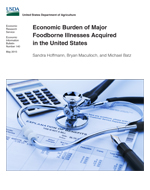
eib140_covertnFoodborne pathogens impose over $15.5 billion (2013 dollars) in economic burden on the U.S. public each year. Just five pathogens cause 90 percent of this burden. Estimates of economic burden per case vary greatly, ranging from $202 for Cyclospora cayetanensis to $3.3 million for Vibrio vulnificus.

  • Fifteen pathogens cause 95 percent or more of the foodborne illnesses, hospitalizations, and deaths in the United States for which a specific pathogen cause can be identified. They are Campylobacter spp., Clostridium perfringens, Cryptosporidium spp., Cyclospora cayetanensis, Listeria monocytogenes, Norovirus, Salmonella non-typhoidal species, Shigella spp., STEC O157, STEC non-O157, Toxoplasma gondii, Vibrio vulnificus, Vibrio parahaemolyticus, Vibrio other non-cholera species, and Yersinia enterocolitica.
  • Eighty-four percent of the economic burden from these 15 pathogens is due to deaths. This reflects both the importance the public places on preventing deaths and the fact that the measure of economic burden used for nonfatal illnesses (medical costs + productivity loss) is a conservative measure of willingness to pay to prevent nonfatal illness.
  • Pathogens’ rankings by total economic burden generally follow their rankings by economic burden due to pathogen-related deaths, with notable exceptions.  Campylobacter causes slightly more deaths per year than Norovirus, yet because of the very large number of nonfatal cases caused by Norovirus, its economic burden is higher than that of Campylobacter. The high medical costs and productivity losses caused by Clostridium perfringens contribute to its total economic burden exceeding those of three other pathogens with higher economic burden due to deaths (Vibrio vulnificus, Yersinia enterocolitica, and STEC O157).
  • Estimates of the incidence of foodborne disease acquired in the United States, and therefore economic burden estimates, are very uncertain. The U.S. Centers for Disease Control and Prevention (CDC) estimates that the foodborne disease incidence from these 15 pathogens could range from 4.6 million to 15.5 million cases in a typical year. Based on this range of incidence estimates, economic burden could range from $4.8 billion to $36.6 billion (2013 dollars).

Full Report

CDC-FoodNet2014-300x216According to the Foodborne Diseases Active Surveillance Network (FoodNet), there were a total of 19,542 infections, 4,445 hospitalizations and 71 deaths reported in 2014. Some types of infections declined, some increased, and some stayed the same. FoodNet is a collaboration between CDC, 10 state health departments, the U.S. Department of Agriculture’s Food Safety and Inspection Service (FSIS) and the Food and Drug Administration that tracks incidents of Campylobacter, Listeria, Salmonella, Shigella, Shiga toxin-producing E. coli (STEC) O157, STEC non-O157, Vibrio, Yersinia, Cryptosporidium and Cyclospora.

The number of laboratory-confirmed illnesses falls far below the actual number of people sickened by foodborne pathogens each year. CDC estimates that 48 million illnesses, 128,000 hospitalizations and 3,000 deaths are linked to foodborne illness annually.

Looking at the 2014 data, Salmonella was the most frequent cause of infection, accounting for 38 percent of them. Campylobacter was second with 33 percent, and E. coli caused 6 percent.

The good news is that the frequency of E. coli O157 infections have decreased, compared with both the baseline years of 2006-2008 and the previous three years.

CDC highlighted that the number of infections from the second most common strain of Salmonella — Typhimurium — continues to decrease, while there have been statistically significant increases over the baseline in two other serotypes. Javiana, the fourth most common serotype, was 131 percent higher, and Salmonella Infantis, the sixth most common, increased 160 percent compared to the baseline and was also “significantly higher” than in 2011-2013.

CDC also notes an increasing incidence of non-O157 STEC infections is attributable, in part, to an increase in the number of laboratories testing for Shiga toxin. The top non-O157 serogroups isolated from patients were O26, O103 and O111.

And compared with 2006-2008, FoodNet’s 2014 data showed a 52-percent increase for Vibrio and 13-percent increase for Campylobacter, trends also observed in 2013. Last year, it was noted that although Vibrio accounted for only 1.3 percent of the reported infections in 2013, its incidence increased 32 percent from 2010-2012.

Tuna-Sushi-Salmonella-Recall-300x195California, New Mexico and Arizona weigh in so far.

The New Mexico Department of Health, the City of Albuquerque Environmental Health Department, and the New Mexico Environment Department announced that they are jointly investigating a cluster of illness caused by Salmonella paratyphi. There have been six confirmed cases reported in New Mexico residents, with onsets of illness from April 4 to May 1, 2015. Five individuals reside in Bernalillo County and one resides in Sandoval County. The cases range in age from 23 to 68 years, and one individual was hospitalized as a result of the illness.

At this time, the investigation is still ongoing regarding the source of the outbreak. Five out of the six people reported eating sushi containing raw fish. The City of Albuquerque Environmental Health Department and the New Mexico Environment Department are investigating possible exposures linked to sushi. Federal agencies including the CDC and other states are also involved in the investigation following additional illnesses associated with the same Salmonella paratyphi strain in their respective jurisdictions.

Last month the Ventura County Public Health Department announced a Salmonella paratyphi outbreak. Eighteen cases have already been confirmed in Southern California with one case in Santa Barbara County and four in Ventura County. Seven other cases are from out-of-state, most of who had travel to Southern California. In a statement released to the media, the Ventura County Health Department said the cause of the outbreak remains under investigation. “As of April 17th, 10 out of 10 people who completed detailed food questionnaires stated they had consumed sushi, and over 80 percent reported having eaten raw tuna,” said the Health Department. Twenty percent of affected patients have been hospitalized.

This particular strain of Salmonella had never been seen before March 2015, but the Health Department said that a closely related strain was responsible for a Salmonella outbreak that occurred in California and Hawaii back in 2010. That outbreak was found to be linked to raw tuna imported from Indonesia. “This strain is genetically different from the 2010 strain, so it appears the two strains are unrelated at this time,” noted the Health Department.

Raw ground tuna in sushi rolls and other sushi dishes could be the cause of a Salmonella outbreak that has sickened at least nine people in Maricopa County, county health officials said.  Nine people have had the same, rare strain of Salmonella, and three of those individuals have been hospitalized. Those individuals fell ill with the same rare strain from April 3-16. No Arizona cases have been reported outside Maricopa County.

County health officials have interviewed eight of the nine people with the same rare strain, and all of them consumed ground tuna at multiple Maricopa County restaurants, said Dr. Bob England, director of Maricopa County Department of Public Health.  England said that the contaminated tuna is likely being shipped to area restaurants. That could mean that a food distributor of manufacturer is the source of contamination, but health and food safety investigators have not yet identified a source, England said.  Because health officials have not identified the source, England said people should be cautious about eating raw ground tuna commonly found in spicy tuna rolls or other sushi dishes.

Sounds a bit familiar – In 2012 a total of 425 persons infected with the outbreak strains of Salmonella Bareilly (410 persons) or Salmonella Nchanga (15 persons) were reported from 28 states and the District of Columbia.  55 ill persons were hospitalized, and no deaths were reported.  Collaborative investigation efforts of state, local, and federal public health agencies linked this outbreak to a frozen raw yellowfin tuna product, known as Nakaochi Scrape, from Moon Marine USA Corporation.

072612-map

622x350From a Blue Bell press release:

Due to the extended timeline required to ensure the highest quality and safety of Blue Bell’s products when the company resumes production, and because supply and distribution will be limited for some time to come, Blue Bell Creameries CEO and President Paul Kruse today announced “the agonizing decision” that the company will have to reduce the size of its work force and take other cost-cutting measures, including furloughs and salary reductions.

“The agonizing decision to lay off hundreds of our great workers and reduce hours and pay for others was the most difficult one I have had to make in my time as Blue Bell’s CEO and President,” Kruse said. “At Blue Bell, our employees are part of our family, and we did everything we could to keep people on our payroll for as long as possible. At the same time, we have an obligation to do what is necessary to bring Blue Bell back and ensure its viability in the future. This is a sad day for all of us at Blue Bell, and for me personally.”

The process of cleaning and improving Blue Bell’s four production plants is going to take longer than the company initially anticipated, especially at the main plant in Brenham where major repairs and equipment replacements are expected. There is no firm timeline for when Blue Bell will begin producing ice cream again. When production resumes, it will be limited and phased in over time.

Kruse said the employee actions affect three groups:

Employees who are essential to ongoing operations and cleaning and repair efforts will continue to work but have their pay reduced.
A second group of employees will be placed on partially paid furlough. They will be paid a substantial portion of their current pay, with the expectation that they will return to work as production resumes.
Because there is not a clear timeline for when production will resume, and because supply and distribution will be limited when it does, a third group of employees will be laid off.
Approximately 1,400 employees will be furloughed, and approximately 750 full-time and 700 part-time employees – or 37 percent of the total Blue Bell workforce of 3,900 – will be laid off, Kruse said.

Blue Bell also made the difficult decision to suspend operations and lay off employees at the following distribution centers: Phoenix (2 branches) and Tucson, Arizona; Denver, Colorado; Indianapolis, Indiana; Kansas City and Wichita, Kansas; Louisville, Kentucky; Albuquerque, New Mexico; Las Vegas, Nevada; Raleigh and Charlotte, North Carolina; Columbia, South Carolina; and, Richmond, Virginia.

blue-bellQuestion:  What will the Office of Criminal Investigations and the U.S. Attorneys in Texas, Oklahoma and Alabama do?

I really need to get more cynical – why would you risk a 108 year old company – not to mention jail time, fines, recall costs, business loss and customer lawsuits – by failing to follow simple food safety procedures?  Why would our government ignore the problem until at least 10 were sickened with 3 deaths?  Well, at least Texas and Oklahoma did something today.

Following a series of laboratory results indicating that there was Listeria monocytogenes (Lm) present in products and on equipment of the Blue Bell Creameries located in Brenham, Texas and Broken Arrow, Oklahoma (after being linked to 10 illnesses, including 3 deaths) the company “voluntarily” initiated a national recall of its entire product line and suspended production at the Texas, Oklahoma and Alabama facilities.

The company is also “voluntarily” engaged in comprehensive plant sanitation, employee training, and establishment of new or revised policies, procedures, and environmental and product testing programs to ensure that its products, when re-introduced into commerce, do not contain Lm.

As both the regulatory and state public health agency, it is incumbent that, before Blue Bell Creameries re-introduces food products into commerce that the company has:

  • thoroughly cleaned and sanitized the facilities, to include all equipment;
  • trained all employees on the subject;
  • developed and implemented new or revised policies, procedures, and processes to minimize the likelihood of producing any product containing Lm in the future;
  • completed a trial run of manufacturing an acceptable product as evidenced by negative product samples for Lm; and
  • notified state agencies at least 2 weeks in advance of their intent to re-introduce food products into commerce.

To achieve confirmation of the steps outlined above, Blue Bell Creameries, “voluntarily” agrees to:

1.  Retain an independent sanitation and/or microbiology expert qualified by background, education, training and experience to determine that the methods, facilities and controls necessary are in place that will prevent the introduction of contamination. This expert should also, to the extent possible based on the best science available, help the company assure that the plant and the equipment are properly prepared, maintained and operated to safely produce products that do not contain Lm.

2.  Preserve all environmental, product and ingredient testing results and make such results available to review upon request.

3.  Beginning with the trial run prior to product reintroduction, notify state agencies within 24 hours of receiving a laboratory report of any presumptive positive test result for Listeria monocytogenes found in ingredient or finished product samples from its facilities. If such test result is received by the company on a weekend or holiday, the 24- hour period would expire on the next business day. Such reporting shall continue for a period of 2 years from the date of initial market reintroduction, and may be extended as deemed necessary depending on the nature and extent of the test results reported to date.

4.  Provide full access to the facilities for purposes of collecting ingredient, finished product, or environmental samples. It is understood that state agencies would seek to take any presumptive positive test results for Listeria species through to final confirmation for Lm and maintain any confirmed Lm isolates.

5.  Conduct root cause analyses for the purposes of identifying potential or actual sources of contamination and allow state agencies to review the documentation.

6.  Ensure that the company’s Pathogen Monitoring Program (PMP) for Lm, includes plans on how the company will respond to presumptive positive tests for Listeria species when and where found.

7.  Make available for state agencies review upon request:

a.  Plant deep cleaning and on-going sanitation policies, procedures and records;

b.  Company staff training curriculum and records, along with plans for re-training of 
existing staff, new hire orientation, and ongoing training;

c. Plans for plant modifications made for the purpose of controlling potentially harmful bacteria within the plant operating environment and/or food handling machinery; and

d. Start-up procedures prior to initiating production runs for any purpose, up to and including the manufacture of product for entry into commerce.

8.  Beginning with the trial run prior to product reintroduction, institute a “test and hold” program for all finished product to be introduced into commerce for a period of one year, or such period as deemed necessary by state agencies in light of the nature and extent of the test results reported under paragraph 3 of this section.

In addition, the company “voluntarily” agrees that all future food processing and distribution activities will be undertaken pursuant to, or in reflection of, the following industry recognized standards for plant performance:

1.  Sanitation Standard Operating Procedures (SSOPs);

2.  Good Manufacturing Practices (GMPs);

3.  a Pathogen Monitoring Program (PMP) for Listeria Monocytogenes (Lm), which includes 
environmental, ingredient and finished product testing; and

4.  a Hazard Analysis and Critical Control Points (HACCP) plan and/or a written FoodSafety Plan, including sections on:

a.  verifiable product trace-back procedures and

b.  sufficient product recall practices.

Again, as a company in business for 108 years and the third largest ice cream maker in the U.S,, why are they doing all of this, and why is State and Federal health authorities jumping into action now?