
Watching the growing “rock melon” cantaloupe Listeria outbreak in Australia (at least 10 sick with 2 dead), brings back bad memories of the 2011 Jensen Farm Cantaloupe Listeria outbreak that sickened nearly 150 with over 30 killed.

Although food poisoning is a prevalent issue in Australia and New Zealand, both countries have taken major legislative efforts over the past decade to better regulate and enforce food and hygiene standards. Although both have similar food regulations, they have different legal regimes that treat food poisoning cases differently. In Australia, food law is dealt with mostly through tortious negligence and statutory claims. These claims were substantially altered through major tort reform in 2002, completed on a state/territory level. In New Zealand, tort law was largely abandoned in the 1970s, and food poisoning cases are mostly dealt with as a regulatory matter; with local health units investigating claims and rewarding small amounts of compensation to victims. Despite these differences in how victims pursue claims, Australia and New Zealand created a joint bilateral Food Standards Authority to develop and administer a common code of regulations, which have been incorporated into local law.

Australia’s Law and Regulatory Regime

Australia’s legal regime is similar to the United States in that there is a federal government and separate state/territory governments with their own autonomy. Historically, Australia’s tort system was made up of common law precedent and doctrines, like the US. However, following a major tort reform in 2002, Australia’s common law has mostly been overridden by statutes, especially in the areas of negligence and personal injury law.

In 2002, the various state and territory governments within Australia appointed a panel of experts to review the law of negligence, primarily to address the public’s growing concern over unaffordable and unsustainable public liability insurance premiums and damages awards. The panel sought to make key recommendations for legislative reform to tort law with the objective of limiting liability and quantum of damages arising from personal injury and death. A uniform tort scheme was suggested by the panel but was ultimately rejected by state and local governments. Instead, individualized legislation was thereafter enacted by each state/territory, which consequentially created locally nuanced law. These local nuances included slightly differing definitions for laws such as negligence, standards of care, and different food acts.

Although the uniform tort scheme was rejected, a ‘quasi-consistency’ scheme has developed, as states have generally all agreed to narrow the scope of potential liability and reduce damages to confine insurer’s exposure. The major resulting changes to the tort scheme included: (i) circumstances in which damages can be recovered negligence; (ii) the types and quantum of damage that can be recovered; and (iii) further increases in public liability insurance premiums.

Since the tort reform, there has been a major decline in personal injury claims, including a 70-80% reduction of Australian personal injury claims payments on business and household insurance policies. Advocates of the tort reform claim that it has reduced insurance premiums. Skeptics on the other hand claim that the new reform transfers the financial burden of reckless conduct from the at-fault party and its insurer onto the victim, and that there are no economic penalties for businesses that refuse to invest in injury avoidance, while those who invest are penalized by the increased costs.

The reform also covered state public liability laws that govern public liability compensation claims from insurers. As in the general tort reform, these laws differ between states, with slightly different processes required to establish public liability compensation. Compensation also differs from state to state, and damages usually include: lump sum compensation payment (up to $427,000), medical expenses, loss wages, future care requirements, and miscellaneous expenses. Further, victims can no longer receive compensation for mental anguish unless the injury was ‘serious’, which is determined by the courts.

With respect to food regulations specifically, the federal Agency in charge of food handling is administered by the Australia Department of Health and Aging, and is Australia’s version of the F.D.A. Furthermore, each state has its own authority and food act that is based mainly on federal standards. However, similar to the local nuances that have occurred in the general tort reform, certain unique legislation requirements are developing in different state/territory jurisdictions.

Currently, new legislation is springing up across Australia to make food regulation even more stringent than it already is. In Queensland and New South Whales for example, new regulations have come into force this year that include the controversial name and shame process and a mandatory accredited food safety adviser in every food-related business. First, name and shame regulation allows the local authorities to list the names of violators on its website for those premises that receive penalty notices from the local food authorities for serious food offenses within a year. Local authorities are made up of council regulatory officers who enforce the local food authorities’ mandate.

A second regulatory scheme can be seen in new amendments to Queensland’s Food Act, which include a mandatory employment of an accredited food safety adviser in every food-related business. These employed advisors will be fully trained and will have the responsibility of monitoring and training staff to ensure they meet acceptable standards. This strict legislation is still being investigated in New South Whales and is still voluntary at this point, given some concerns over whether local standards comport with federal standards. It is too early to tell how successful this legislation is as a deterrent to food violations, but it has been successful in Victoria, where businesses have been required to have such trained employees for years now.

To summarize, the 2002 tort reforms in Australia have had a major impact on food law and food poisoning cases in Australia, and although once a common law issue, food law is now codified into individualized legislations within each state/territory. Citizens can sue companies and businesses for food poisoning claims under civil liability laws, public liability insurance claims, and stator redress. Additionally, new legislation is being enacted to ensure greater compliance by local businesses to help reduce the likelihood that a business violates food codes.

Some Major Cases In Australia

Every year, Australian Government’s Department of Health and Ageing estimate that there are 5.4 million cases of food poisoning; mainly because people are eating out more, and new strains of food-borne illnesses have emerged. While most cases are relatively mild, there are near 40,000 cases with serious complications, with around 120 causing death annually. That being said, Australia was fourth in the world according to 2008 food safety rankings.

Garibaldi Case (1995): Fifteen years ago about 190 people experienced illnesses linked to eating mettwurst (a type of sausage) contaminated with E. coli O111. Twenty-three children were hospitalized, five children suffered long-term health consequences including transplants, and one child died. The victims sued Garibaldi in the Adelaide District Court for damages and for compensation from the company’s $10 million insurance package. Although most claims have settled, six remain unresolved. Two of the cases involve a disagreement about how much the settlement should be. The remaining four claims relate to children who got sick a month or two after the original cases and the insurance company is contesting damages claims because the strain they had differed slightly from the original victims. The case is adjourned until September.

The Oyster Case: Graham Barclay Oysters Pty Ltd v. Ryan (1996-7; decision 2003): A class action lawsuit was brought by consumers who had contracted Hepatitis A after eating oysters that were harvested in a New South Wales lake that was polluted by human fecal contamination. The applicants alleged that the grower of the oysters, the distributer, the local government authority, and the state government were all liable in negligence for the harm they suffered. The claimants also alleged that the distributers and growers were liable for breaching the Trade Practices Act 1974. The case made it all the way up to the High Court of Australia, which affirmed the appellate court’s finding that neither state nor local authorities owed a duty of care to the consumers. Also, the High Court found in accordance with the appellate court that the harvesting and distribution companies took reasonable care to ensure their oysters were safe, given the unreasonableness of the alternatives.

Cryptosporidium and Giardia parasites (1998): A three-month water supply contamination crisis affected Sydney and region following cases of illness caused by Cryptosporidium and Giardia parasites in some Sydney reservoirs. The final total estimated cost reported by Sydney Water Corporation was $75 million. A legal class action was taken by businesses for loss of business and one law firm reported that they took intake from a hundred individuals who believed they became sick as a result of the water contamination. All the claims have settled.

Dowdell v Knispel Fruit Juices Pty Ltd (2003): Between January and June, 1999 in South Australia, 507 cases of Salmonella Typhimurium phage type 135a (“ST 135a:”) infection seemed to be linked to the consumption of unpasteurized fruit juice sold by Nippy’s Fruit juices. The case became a class action lawsuit in the Federal Court of Australia against the juicer, the grower and the packer. Negligence and breaches in statutory duty were the main issues argued. The main statutory breaches involved provisions in the Trade Practices Act 1975. A settlement scheme was also agreed to providing a structured regime for settling various claims, supported by the juice company, without admitting fault. Over 425 claims were settled with this scheme, and the remaining claims were settled by the judge. The court found that the Defendants were negligent and were strict liable under the statutory charges. The Judge divided up the liability between the various at-fault parties including the interpretation of the insurer’s responsibilities.

Contaminated Pork Rolls in Melbourne (2003): Victims suffered food poisoning from eating pork rolls from Melbourne’ s Thanh Phu restaurant, and was one of Victoria’s biggest food poisoning outbreaks. The Victorian Supreme Court approved the agreed settlement for more than 200 people, who received compensation payouts totaling around $1 million.

The KFC Villawood Twister Case (2005): Kentucky Fried Chicken is in a court battle with two parents who are seeking $10 million, claiming that their healthy seven-year-old daughter became crippled and brain damaged from salmonella after eating a “Chicken Twister” from a KFC in New South Wales. The latest argument made by the Plaintiffs is that a certain staff at the KFC would drop chicken pieces on the floor, help themselves to food and throw chicken strips at each other as pranks. KFC is denying any links between the “Twister” and the condition of the injured girl, and also argue that there is no proof of purchase (receipt) of the twister being purchased by the plaintiffs. Furthermore, KFC contends that the father of the plaintiff told a local health official that he blamed the poisoning on another source. On a side note, this case came only weeks after other Australian KFC branches (in Miranda and West Hurstville) were given a large fine of $73,125 and convicted of 11 charges of breaches of food hygiene laws. This case is still in court being argued.

As of February 27, 2018, 10 people infected with the outbreak strain of Salmonella Montevideo were reported from 3 states. Illnesses started on dates ranging from December 20, 2017 to January 28, 2018. Ill people ranged in age from 26 to 56, with a median age of 42. All 10 (100%) were female. No hospitalizations and no deaths were reported.

In interviews, ill people answered questions about the foods they ate and other exposures in the week before they became ill. Eight (80%) of ten people interviewed reported eating at multiple Jimmy John’s restaurant locations. Of these eight people, all eight (100%) reported eating raw sprouts on a sandwich from Jimmy John’s in Illinois and Wisconsin. Two ill people in Wisconsin ate at a single Jimmy John’s location in that state. One ill person reported eating raw sprouts purchased from a grocery store in Minnesota.

This outbreak appears to be over. Any contaminated sprouts that made people sick in this outbreak would now be older than their recommended shelf life. FDA and state, and local regulatory officials conducted traceback investigations to help determine the source of the sprouts and their distribution chain. To date, no contamination source has been identified.

Regardless of where they are served or sold, raw and lightly cooked sprouts are a known source of foodborne illness and outbreaks. People who choose to eat sprouts should cook them thoroughly to reduce the risk of illness.

According to Australian press reports, two of the six who became ill in NSW subsequently died.

All states and territories are working together to investigate the outbreak and to date they have identified ten cases in elderly patients in NSW (six), Victoria (one) and Queensland (three) with onset of illness notification dates between 17 January and 9 February 2018. All 10 cases consumed rockmelon prior to their illness.

The outbreak has been linked to a grower (yet unnamed) in Nericon NSW. The company voluntarily ceased production on Friday 23 February 2018, shortly after being notified of a potential link to illness and is working proactively with the Authority to further investigate how any contamination could have occurred in order to get back into production as soon as possible.

The NSW Food Authority is advising consumers who are most vulnerable to Listeria infection such as older persons, and people who have weakened immune systems due to illness or pregnancy, to avoid eating rockmelon after a recent spike in listeriosis cases in elderly people has been linked to the fruit.

As a precaution, consumers particularly those who are elderly, pregnant or immune compromised who may have rockmelon already in their home are advised to discard it.

Listeria is found widely in the environment and rarely causes serious illness in the general population but for vulnerable people, such as those who are over 70, pregnant, or have diabetes, cancer or suppressed immune systems, it can be extremely serious or even life threatening.

Listeriosis starts with flu-like symptoms such as fever, chills, muscle aches, nausea, and sometimes diarrhea. The symptoms can take a few days or even up to six weeks to appear after eating contaminated produce.

People at risk should consult their local doctor as early as possible should symptoms appear.

Sounds much like the beginning of the US 2011 Multistate Outbreak of Listeria Linked to Whole Cantaloupes from Jensen Farms, Colorado. A total of 146 persons infected with any of the four outbreak-associated strains of Listeria monocytogenes were reported to CDC from 28 states. Thirty deaths were reported. In addition, one woman pregnant at the time of illness had a miscarriage.

In its continued efforts to protect consumers and ensure food safety, the U.S. Food and Drug Administration has begun testing fresh cilantro, parsley and basil, as well as processed avocado and guacamole, for certain microbial contaminants. These two large-scale sampling assignments will help the FDA assess the rates of bacterial contamination in these commodities, as well as help to identify possible common factors among the positive samples.

The FDA plans to collect 1,600 samples for each assignment. As of January 1, 2018, the agency had collected 35 domestic samples (4.6 percent) and 104 import samples (12.4 percent) of the total for fresh herbs. None of the domestic samples tested positive. Of the 104 import samples tested, 4 tested positive for Salmonella, 3 tested positive for Shiga toxin-producing E. coli, and none tested positive for E. coli 0157:H7.

As of January 1, 2018, the agency had collected 58 domestic samples (7.3 percent) and 49 import samples (6.1 percent) of the totals for processed avocado/guacamole. Of the 58 domestic samples tested, 3 tested positive for Listeria monocytogenes. Of the 49 imported samples, 1 tested positive for Listeria monocytogenes. It is important to note that no conclusions about overall contamination rates can be made until all of the data are collected, validated and analyzed.

If samples are found to be positive for microbial hazards, the FDA will pursue an appropriate regulatory and enforcement option, which may include encouraging a voluntary recall, ordering a mandatory recall, ordering administrative detention to prevent food from being distributed, issuing public warnings to alert consumers to the potential danger, or, in the case of imported products, refusing their entry into the United States and subjecting future shipments to an import alert. In the case of the positive samples identified in the first quarter of data collection, imported products capable of causing disease were prevented from entry into the United States and domestic products were voluntarily recalled.

The agency chose to sample fresh herbs because they are typically eaten without having undergone a ‘kill step,’ such as cooking, to reduce or eliminate bacteria. These herbs are also often eaten as part of multi-ingredient foods, and thus people may not report having eaten them when they become ill.

From 1996 to 2015, the FDA reported nine foodborne outbreaks linked to basil, parsley and cilantro, which resulted in 2,699 illnesses and 84 hospitalizations. Of the nine outbreaks, seven were attributed to Cyclospora cayetanensis; one was attributed to E. coli O157:H7; and one was attributed to Shigella sonnei. The FDA is seeking to obtain baseline estimates of the prevalence of Salmonella and Shiga toxin-producing E. coli (STEC) in cilantro, basil and parsley. The agency also intends to test for Cyclospora cayetanensis during the summer months, when  Cyclospora-related illnesses typically occur.

The agency chose to sample processed avocado because avocados have a high moisture content and a non-acidic pH level, conditions that can support the growth of harmful bacteria. Processed avocado products, including avocado that is fresh cut, refrigerated and frozen, may be packaged and eaten without having undergone a ‘kill step’ prior to consumption. According to the Centers for Disease Control and Prevention, there were 12 outbreaks of foodborne illness related to avocado, avocado products or guacamole products from 2005 to 2015. Of those 12 outbreaks, nine involved Salmonella and three involved E. coli, resulting in 525 illnesses and 23 hospitalizations. Though no Listeria outbreaks were reported in connection with avocados from 2005 to 2015, a recent sampling assignment by the FDA detected Listeria monocytogenes in samples collected from the fruit’s pulp and skin. The agency is seeking data on the prevalence of Salmonella and Listeria monocytogenes in processed avocado and processed avocado products.

The  assignments are anticipated to last 18 months. The agency will post results on a quarterly basis and also post a comprehensive report once sampling and analysis is complete.


The Weld County Department of Public Health and Environment (WCDPHE) is investigating an outbreak of Salmonella illness at Aims Community College. This illness may be associated with catered events held at Aims on February 9 and February 13, 2018. The February 9 event has 1confirmed Salmonella case that had about 70 people attend. The February 13 event has 2 confirmed cases that was attended by 400 people. Of the 10 confirmed Salmonella cases, 6 adults reside in Weld County, 1 in Larimer, and 1 in Boulder county. The events were catered by an outside restaurant, the Burrito Delight, located in Fort Lupton. The public is not at risk and the restaurant is now closed for the duration of the investigation.
Health officials said Thursday that they have confirmed all 10 illnesses are linked to food served by Burrito Delight at catered events, or at the restaurant between Feb. 9 and 12.

The restaurant failed the health inspection in the following areas: Temperature control, appropriate storage, proper storage of employee drinks, one instance of improper hand washing, and the presence of a rodent. The restaurant has received 12 critical violations in the past year.

“Salmonella is a bacteria that causes symptoms like diarrhea, upset stomach, fever, and occasionally vomiting,” said Mark E. Wallace, MD, MPH, Executive Director of the Weld County Health Department. “Symptoms typically last 4 to 7 days, and most people recover on their own. Anyone who suspects they became ill should contact their health care provider.” For some people, the diarrhea may become so severe that they require hospitalization. Symptoms typically appear 6-72 hours after eating contaminated food and will typically last for 4 to 7 days without treatment. However, in severe cases, the symptoms may last longer.

915 Sick with 172 Deaths.

According to the National Institute For Communicable Diseases:

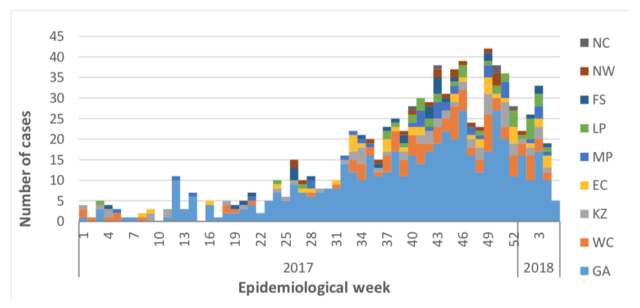
As of 20 February 2018, 915 laboratory-confirmed listeriosis cases have been reported to NICD since 01 January 2017 (Figure 1). Most cases have been reported from Gauteng Province (59%, 541/915) followed by Western Cape (12%, 112/915) and KwaZulu-Natal (7%, 66/915) provinces. Cases have been diagnosed in both public (64%, 587/915) and private (36%, 328/915) healthcare sectors. Diagnosis was based most commonly on the isolation of Listeria monocytogenes in blood culture (73%, 669/915), followed by CSF (22%, 198/915). Where age was reported (n=886), ages range from birth to 92 years (median 20 years) and 41% (361/886) are neonates aged ≤28 days (Figure 2). Of neonatal cases, 97% (351/361) had early-onset disease (birth to ≤6 days). Females account for 56% (499/886) of cases where gender is reported. Final outcome data is available for 67% (617/915) of cases, of which 28% (172/617) died.

My friend, Darin Detwiler, let me post this tonight for tomorrow.

Today marks the 25th anniversary of the day the last of four young children died during the landmark 1993 “Jack in the Box” E. coli outbreak

That child was 17-month-old Riley Edward Detwiler.

I learned about the reality of this foodborne pathogen on Riley’s death bed.  When he was only a few months old, I justified being out to sea on a Navy submarine by telling myself that I was making the world a safer place for him, and I thought that I would spend the rest of my life making up lost time with him when he was older.

Riley would now be older than I was during that outbreak.  I never got to see him grow older than he appeared in the few photos and videos from so long ago.  Over the years since his death, however, I have seen news of recalls and outbreaks and deaths on a far too regular basis.  I have also seen much improvement in food safety.

We have gained new federal food safety regulations and policies at the USDA and, most recently at the FDA.  We have witnessed advancements in science and data collection, and even a whole new “culture of food safety.” We have trainings, certifications, university programs, conferences, magazines, books, and even movies that serve to inform and motivate new generations of food safety experts.

Many of the changes in food safety policies came about through the hard work of victims, families, advocacy groups, and industry leaders. Statistics and charts alone achieve little without victim’s voices.  Facts rarely motivate policymakers as much as seeing the faces and stories. I am very proud of their efforts.  I am also proud to have stood with them and before them trying to prevent other parents from looking at their family table with one chair forever empty due to preventable illnesses and deaths from foodborne pathogens.

One thing that hits me hard lately is how the faces and stories of victims from mass shootings are seemingly not enough to bring about change in terms of gun control.  While no new policies will bring back the dead, they would bring hope and an increased safety for others.  I am saddened by the thought that so many parents will live with the belief that their child’s death did not result in some element of change.

Perhaps the reasons matter not as to why parents worry about making the world a safer place for their children.  Too many homes in this country include a chair forever empty at a family table due to reasons that could and should have been prevented.

Dr. Darin Detwiler is the Assistant Dean, the Lead Faculty of the MS in Regulatory Affairs of Food and Food Industry, and Professor of Food Policy at Northeastern University in Boston.  In addition to serving as the executive vice president for public health at the International Food Authenticity Assurance Organization, he is the founder and president of Detwiler Consulting Group, LLC. Detwiler and serves on numerous committees and advisory panels related to food science, nutrition, fraud, and policy. He is a sought-after speaker on key issues in food policy at corporate and regulatory training events, as well as national and international events. Detwiler holds a doctorate of Law and Policy.

As of 14 February 2018, 872 laboratory-confirmed listeriosis cases have been reported to NICD from all provinces since 01 January 2017 (Figure 1). Most cases have been reported from Gauteng Province (59%, 517/872) followed by Western Cape (13%, 111/872) and KwaZulu-Natal (7%, 62/872) provinces. Cases have been diagnosed in both public (64%, 559/872) and private (34%, 205/872) healthcare sectors. Diagnosis was based most commonly on the isolation of Listeria monocytogenes in blood culture (73%, 640/869), followed by CSF (22%, 183/869). Where age was reported (n=849), ages range from birth to 92 years (median 23 years) and 43% (352/829) are neonates aged ≤28 days (Figure 2). Of neonatal cases, 97% (342/346) had early-onset disease (birth to ≤6 days). Females account for 53% (466/868) of cases where gender is reported. Outcome is known for 597/872 (68%) patients of whom 164 (27%) have died.

No source has been determined – yet.

South Africa’s laws governing products liability closely parallel those found in many US jurisdictions. While the country has long-recognized that a manufacturer of unfit food can be held civilly liable in negligence, legislation introduced almost decade ago codified strict products liability principles applicable to every entity in a product’s supply chain. Further, South Africa also holds entities in a supply chain criminally liable for making contaminated or unfit food available to consumers.

Prior to enacting legislation in the early 2000’s, South African manufacturers of food could be held civilly liable under principles similar to those common in US tort law. Specifically, claimants alleging injury caused by unfit food could demonstrate that an entity was negligent in its manufacture of the product. The Muzik v. Cansone Del Mare case is a well-known example of a food-poisoning litigation where the court found in favor of a victim claiming a restaurant’s negligent preparation and service of seafood caused his serious injuries. The restaurant, Cansone Del Mare, served Muzik contaminated mussels which made him severely ill and led to his hospitalization. He subsequently sued the restaurant, and was awarded damages including his medical bills, lost wages, and loss of enjoyment of life because his fear of being poisoned again prevented him from enjoying a previously-loved food.

A few years after Muzik, South Africa provided foodborne illness claimants a powerful avenue of recovery when it enacted the Consumer Protection Act No. 68 of 2006 (CPA). Section 61 of the CPA establishes broad strict liability principles, specifically holding everyone in the supply chain of a product—manufacturers, importers, distributors, and retailers—liable for any harm their product causes, irrespective of whether or not they behaved negligently. The elements of strict products liability in South Africa is near-identical to the burden in the US: a claimant need only prove that their injury or illness was caused by (1) the supply of an unsafe product, (2) a product failure, defect, or hazard in the product, or (3) inadequate instructions or warnings. 61(1)(a)—(c).[1]

If a claimant prevails in demonstrating her burden, the responsible parties are held jointly and severally liable for, “the death of, or injury to, any natural person; an illness of any natural person…and any economic loss that results from,” that death, injury, or illness. 61(5)(a)—(d). While initially appearing to be broad-sweeping legislation, Section 61 may also limit the liability of so-called “passive retailers”—entities who merely obtain pre-prepared food to sell to consumers. The relevant language bars liability if, “it is unreasonable to expect the distributor or retailer to have discovered that the unsafe product characteristic, failure, defect or hazard, having regard to that person’s role in marketing the goods to consumers.” 61(4)(c).

Finally, despite its many similarities to US product liability laws, South Africa also holds entities criminally liable for making contaminated or unfit food available to the public. The Food, Cosmetics and Disinfectants Act 54 of 1972 makes it a criminal offense for any person to, “sell[], manufacture[] or import for sale, any foodstuff which is contaminated, impure or decayed, or is, in terms of any regulation deemed to be harmful or injurious to human health.” (2)(1)(b)(i). If the criminal offense is committed by an employee of a food service establishment, such liability attaches to the employer unless he can demonstrate that he took all reasonable measures to prevent the act or omission that led to the offense. (8)(1).[2]

__________

[1]           Section 53 of the CPA defines a “defect” as, “(i) any material imperfection in the manufacture of the goods or components, or in performance of the services, that renders the goods or results of the service less acceptable than persons generally would be reasonably entitled to expect in the circumstances; or (ii) any characteristic of the goods or components that renders the goods or components less useful, practicable or safe than persons generally would be reasonably entitled to expect in the circumstances.”

[2]           Simply forbidding the particular act or omission is insufficient to avoid liability. (8)(2).

94 Sick in Iowa, Chicken Salad sold at Fareway grocery stores in Iowa, as well as Illinois, Minnesota, Nebraska and South Dakota.

28 – Confirmed Case Definition:

Persons with Salmonella Typhimurium (confirmed or visual match to Pattern JPXX01.0275) with illness onset since January 1, 2018 reporting consumption of chicken salad from Fareway (any store) in the 7 days prior to illness onset.

66 – Probable Case Definition:

Persons that are epi linked to a confirmed case (all confirmed cases are laboratory confirmed), OR Persons who test positive by CIDT or culture (with serotype and PFGE pending) with illness onset since January 1, 2018 reporting consumption of chicken salad from Fareway (any store) in the 7 days prior to illness onset.

Minnesota has one case associated with this outbreak so far, in a Martin County resident.

The U.S. Department of Agriculture’s Food Safety and Inspection Service (FSIS) is issuing a public health alert out of an abundance of caution due to concerns about illnesses reported in the state of Iowa that may be caused by Salmonella associated with a chicken salad product. This product was sold at all Fareway grocery stores in Iowa, as well as Illinois, Minnesota, Nebraska and South Dakota.

The chicken salad item for this public health alert was produced between Dec. 15, 2017 and Feb. 13, 2018. The following product is subject to the public health alert:

  • Varying weights of “Fareway Chicken Salad” sold in plastic deli containers with a Fareway store deli label.

This product was shipped to all Fareway grocery stores in Iowa, Illinois, Minnesota, Nebraska and South Dakota and sold directly to consumers who shopped at Fareway.  The problem was discovered following reports of illness in Iowa.

On Feb. 9, 2018, the Iowa Department of Public Health notified FSIS of an investigation of Salmonella related illnesses, within the state of Iowa.  FSIS continues to work with public health partners at the Iowa Department of Public Health and Department of Inspections and Appeals on this investigation. Updated information will be provided as it becomes available.

FSIS is concerned that some product may be in consumers’ refrigerators or freezers.

Consumers who have purchased these products are urged not to consume them.

At least 872 sickened – no cause of outbreak yet discovered.

Wendy Knowler of the Johannesburg Sunday Times reports that the National Institute for Communicable Diseases (NICD) continues to try and pinpoint what has now become the largest Listeria death toll in the world.

The number of confirmed listeriosis cases is now 872, and 164 of those have died – up from 107 last week. The current mortality rate is a staggering 27%.

Of those confirmed cases, 43% were babies of less than a month old – pregnant women being 20 times more likely to get listeriosis than other healthy adults.

Contracted by eating food containing the listeria pathogen, listeriosis is by far the deadliest of foodborne diseases.

I got to speak today to the listeriosis workshop hosted by the South African Association of Food Science and Technology (SAAFoST) in Johannesburg via a webinar.  Here is the link to my speech outline:

https://www.slideshare.net/marlerclark/2018-south-africa-food-focus-webinar