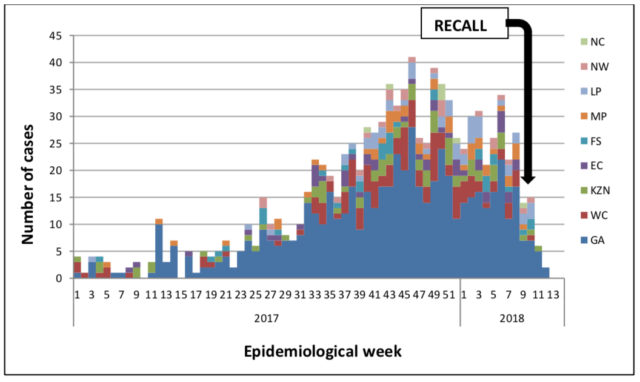
According to the NICD, Aas of 26 March 2018, a total of 982 laboratory-confirmed listeriosis cases have been reported to NICD since 01 January 2017 (Figure 1). Most cases have been reported from Gauteng Province (59%, 576/982) followed by Western Cape (12%, 121/982) and KwaZulu-Natal (7%, 71/982) provinces. Cases have been diagnosed in both public (65%, 634/982) and private (35%, 348/982) healthcare sectors.Listeria monocytogenes was most commonly isolated/detected on blood culture (72%, 711/982), followed by CSF (21%, 207/982). Where age was reported (n=943), ages range from birth to 93 years (median 22 years) and 41% (404/982) are neonates aged ≤28 days (Figure 2). Of neonatal cases, 96% (389/404) had early-onset disease (birth to ≤6 days). Females account for 56% (531/950) of cases where gender is reported. Final outcome data is available for 70% (687/982) of cases, of which 28% (189/687) died.

The recall of polony has turned the tide on illnesses.

But, what about the victims, where are their stories?

I am just not sure about this.  Should a grower responsible for illnesses and deaths and the devastation of the Australian rockmelon industry be allowed to start production of rockmelon months after an outbreak?
NWS Food Safety Authority announced yesterday the likely cause of 19 Listeria illnesses with sixth deaths.

What is Listeria and how do rockmelons become contaminated?

While rockmelons are grown off the ground on top of plastic sheeting, the fruit is grown in the open farm environment and subject to rain, wind and other natural contamination pathways. Listeria species, including Listeria monocytogenes, are soil bacteria that are naturally found in the environment, including farm paddocks. It is not unusual to find Listeria on the surfaces of any raw fruit and vegetable. Rockmelon skin is rough and irregular which allows more soil and bacteria like Listeria to be trapped.

How did this outbreak happen?

To reduce the risk of contamination farms usually wash and sanitise rockmelons. The investigation found that the contamination is likely to have occurred due to adverse weather (localised storm over the farm and subsequent dust storms during the season) increasing the levels of Listeria on the fruit prior to harvest. On this occasion and despite following industry best practice, the washing and sanitising at Rombola Family Farms was not able to remove all the trapped bacteria from the rockmelon surfaces, resulting in a low level of Listeria being present.

Inspections by the NSW Food Authority found there was also an opportunity for the introduction of Listeria after washing through contact with surfaces or equipment that may have had traces of Listeria monocytogenes. This includes dust blown from fans used to dry the fruit after washing, and from porous material on packing tables that was not able to be effectively cleaned at the time.

While Listeria monocytogenes is not an issue for healthy consumers, it poses a serious health risk for those vulnerable to infection, such as individuals who are immunocompromised or pregnant.

What are the results of the investigation?

The NSW Food Authority has completed extensive microbiological swabbing of the packing shed environment and equipment for Listeria. Listeria species and Listeria monocytogenes was found on the packing shed floor during the investigation, which is not surprising as Listeria are often found in soil.

Melons from boxed product at Flemington Markets tested positive for Listeria monocytogenes and a trade level recall was initiated on
28 February. That same day the NSW Food Authority issued a media release advising consumers to discard any rockmelon they may have purchased.

Melons obtained at retail, wholesale, and a swab of melons at the packing shed tested positive for Listeria monocytogenes. The genetic sequence of these Listeria isolates was an exact match with clinical cases. No rockmelons or swabs from other farms tested positive for Listeria monocytogenes.

During the investigation there was an allegation of raw organic fertiliser use on the rockmelon crop which was found to be incorrect. There is no reason to believe this played a role in the outbreak.

Why is the NSW Food Authority allowing the farm to pack rockmelons?

The production of rockmelons on the farm and packing shed environment has been investigated. During March 2018, further rockmelon packing trials and swabbing verified effective washing and sanitising is in place. The company has fully cooperated with the NSW Food Authority and has made significant line modifications to improve cleaning. They have also increased cleaning and sanitising of the packing line environment and increased the sanitiser concentration during the washing of melons. The company and the NSW Food Authority will continue to monitor the situation through inspections and product sampling. The NSW Food Authority is currently satisfied that the company has adequate steps in place to minimise the risk of foodborne illness, noting that immunocompromised people should avoid rockmelons.  No melons from the farm will be released for sale prior to testing for Listeria.

Will it happen again?

While rockmelons from Rombola are washed, sanitised and packed under hygienic conditions there is no absolute guarantee that any fresh produce item will be free from Listeria. The NSW Food Authority recommends that any farm produce eaten raw should be thoroughly washed before consumption. Consumers who are immunocompromised or pregnant are also advised to avoid high risk foods, including rockmelons.

What happens next?

The NSW Food Authority will continue to work with the industry and food regulatory agencies to share lessons learnt from this outbreak. This includes interstate businesses and food safety agencies so the industry as a whole can move forward with confidence in the future.

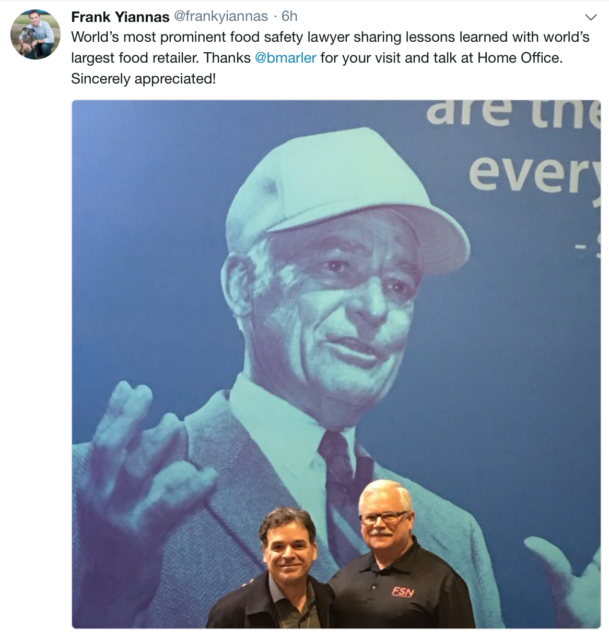
Over the last 20 plus years I have given countless talks to food industry groups on the moral and business reasons to “not poison your customers.”  However, it has only been a handful of companies who have allowed me behind the curtain (at no charge) to talk directly, candidly and forcefully about the role of litigation as a agent of change in our food system.  Today, I had the honor to talk with the leaders at Walmart whose jobs it is to protect their customers around the world from the ravages of E. coli, Salmonella, Listeria and Hepatitis A.

A commitment to a culture dedicated to safe food lessens the chances of a food poisoning event, litigation and brand damage – all under the watchful gaze of Mr. Walton.

Summary of Key Findings:

  • Of the 439 clinical isolates from case-patients sequenced to date, 92% belong to sequence type 6 (ST6) and are highly genetically related. This confirms that this single strain is causing the outbreak and is responsible for disease in the vast majority of patients with listeriosis.
  • As 86% of patients interviewed reported eating polony in the month before falling ill with listeriosis, ready-to-eat processed meat products became the focus of investigations.
  • The outbreak strain isolates from patients and from the Enterprise Foods’ Polokwane production facility (notably, the post-cooking area and the final product clips and casing) differ by only ≤7 single base pairs out of 3 million. This extremely high level of genetic relatedness (99.99% similarity) means there can be no doubt that these L. monocytogenes ST6 strains are all linked, and that there is certainty that products manufactured at Enterprise Polokwane are the source of the outbreak. This is much like paternity confirmation by DNA testing.
  • Seven samples of ready-to-eat processed meat products taken on 15 February 2018 tested positive for L. monocytogenes ST6 (outbreak strain). This means that the outbreak strain has been found inside the ready-to-eat processed meat products manufactured at Enterprise Foods’ Polokwane production facility, dispelling claims made to the contrary.

Issued by the National Institute for Communicable Diseases (NICD) of the National Health Laboratory Service (NHLS)

Date of release: 02 April 2018

The National Institute for Communicable Diseases (NICD) is concerned about recent developments and statements supposedly released as facts into the public domain about the listeriosis outbreak.

We are particularly worried about the confusion that emanated from statements made at the meeting called by the Parliamentary Portfolio Committee on Agriculture on 28 March 2018.

Of major concern are the claims that the primary source of the outbreak is still unknown, and that the Minister of Health has backed down on his previous announcement that the source had been identified, both of which we refute. The statements the Minister of Health has made have emanated from epidemiologic and scientific investigations conducted by the NICD. The implication that the NICD has misled the Minister of Health and the public is rejected. Furthermore, we condemn the statement made that the government prematurely scapegoated ‘Enterprise and Rainbow’ without sufficient evidence. We contend that this evidence has been amply provided by the NICD.*

We do not regard these claims as a small matter, because the NICD is not just a routine diagnostic laboratory with an impact localised to South Africa. The NICD’s work goes far beyond the borders of our country and has an international impact. In outbreaks of this nature, the NICD is obligated by the International Health Regulations to report findings through the National Department of Health to the World Health Organization, and cannot afford to, and does not mislead.

To serve its purpose, the NICD has specialised laboratories and public health and epidemiologic expertise. This expertise leads it to serve as a reference centre, not only for the public and private sectors in South Africa, but across Africa. It shares information and works together with the World Health Organization (WHO) and eminent international institutions (including the Centers for Disease Control and Prevention (CDC) and the National Institutes of Health (NIH) of the USA, the European Centre for Disease Control (ECDC) and Public Health England). The NICD is the co-ordinator of the prestigious PulseNet Africa network, within PulseNet International. PulseNet is a global network of laboratories dedicated to tracking foodborne infections (including listeriosis) world-wide, all of whose laboratories, including the NICD, utilise internationally-recognised standardised genotyping methods and share information in real-time.

Therefore, the work of the NICD is scientifically sound and evidence-based. For those who still have lingering doubts, this is how we arrived at the conclusions announced by the Minister of Health on 04 March 2018.

The search for the cause of the outbreak began with the isolates of Listeria monocytogenes bacteria from case-patients referred from National Health Laboratory Service (NHLS) and private sector clinical laboratories to the NICD, where they underwent confirmatory testing and whole genome sequencing (WGS). WGS is the most sensitive and specific molecular tool available to assess genetic relatedness of bacterial isolates. Of the 439 clinical isolates from case-patients sequenced to date, 92% belong to sequence type 6 (ST6) and are highly genetically related. This confirms that this single strain is causing the outbreak and is responsible for disease in the vast majority of patients with listeriosis.

At the same time, an intensive process of trying to identify the source of the outbreak was undertaken by the Departments of Health (DoH), Agriculture, Forestry and Fisheries (DAFF) and Trade and Industry (DTI), municipalities and the NICD. Epidemiological investigations included interviewing patients. As 86% of patients interviewed reported eating polony in the month before falling ill with listeriosis, ready-to-eat processed meat products became the focus of investigations. The key breakthrough came when a group of nine children attending the same crèche in Soweto developed febrile gastroenteritis in January 2018. The L. monocytogenes ST6 outbreak strain was identified in one child and in three samples of two brands of polony from the refrigerator at the crèche. This prompted further investigation of the production facilities manufacturing these polony products.

Enterprise Foods’ Polokwane production facility was visited on 2 February 2018 by a team, which included two WHO food safety experts. Extensive sampling was done. Polony production involves a number of steps: raw ingredients are mixed into an emulsion, the polony emulsion is poured into casings (the plastic wrapping) and clipped at either end of the casing, the polony is cooked in its casing, then finally it is cooled. Any Listeria that is present in the raw ingredients or emulsion should be killed during the cooking process. However, any L. monocytogenes found beyond the cooking stage poses the danger of contaminating the polony and causing disease, because polony is not usually cooked again before it is eaten. Of great concern was that the L. monocytogenes ST6 outbreak strain was found in the post-cooking processing environment, and also on the final polony products.

The whole genome sequencing (WGS) technology that identified the ST6 outbreak strain is the gold standard method for characterising which specific L. monocytogenes strain is causing an outbreak. This highly specialised test is performed at the NICD. WGS essentially shows the genetic fingerprint of the bacteria, by sequencing the chemical building blocks (nucleotides or base pairs) that make up its genome (the complete set of its DNA, including all of its genes). The L. monocytogenes genome has approximately 3 million base pairs. The outbreak strain isolates from patients and from the Enterprise Foods’ Polokwane production facility (notably, the post-cooking area and the final product clips and casing) differ by only ≤7 single base pairs out of 3 million. This extremely high level of genetic relatedness (99.99% similarity) means there can be no doubt that these L. monocytogenes ST6 strains are all linked, and that there is certainty that products manufactured at Enterprise Polokwane are the source of the outbreak. This is much like paternity confirmation by DNA testing.

From the evidence above, it is extremely misleading for anyone to claim that the primary cause of this listeriosis outbreak is unknown.

Since the first press conference held by the Minister of Health on 05 December 2017, it has been reiterated many times that L. monocytogenes is widely found in nature and can be found in water, soil, vegetation, and the faeces of some animals. Food can be contaminated from any of these sources throughout the food chain (farm, processing, packaging, retail and home food preparation). However, normal food production safety measures and water treatment procedures should deal with the risk of contamination. In addition, the WHO’s five keys to safer food should be practiced by all. These are:

• Wash hands and surfaces before, and regularly during food preparation.
•Separate raw and cooked food, and don’t mix utensils and surfaces when preparing
food
•Cook food thoroughly – all bacteria are killed above 70°C
•Keep food at safe temperatures – either simmering hot, or in the fridge
•Use safe water and safe ingredients to prepare food.

*We can report today that additional results from samples of products produced at the Enterprise Polokwane production facility and sold at the Enterprise Germiston factory shop are available. Seven samples of ready-to-eat processed meat products taken on 15 February 2018 tested positive for L. monocytogenes ST6 (outbreak strain). This means that the outbreak strain has been found inside the ready-to-eat processed meat products manufactured at Enterprise Foods’ Polokwane production facility, dispelling claims made to the contrary.

Food poisoning meets economics in this episode of the Food Chain. And it’s a toxic mix.

We’ll explore how an outbreak can bring down a company, badly damage an industry and shine a light on social and economicinequalities and our globalising food system. Emily Thomas talks to a top food poisoning lawyer in the US, who has won more than $600 million for clients in foodborne-illness cases. And a former banker explains why a dodgy sandwich inspired him to quit his day job for the cause. Plus, how do you prove where you got food poisoning from and what can you do to avoid it?

Listen here – https://www.bbc.co.uk/programmes/w3cswpm7 

“Richard Spoor, a lawyer in South Africa, has filed a $2 billion lawsuit against Tiger Brands. Nearly 70 victims and family members are part of the suit, according to William D. Marler, a Seattle-based food safety lawyer who is a consultant on the case.”
The New York Times reported today that the world’s largest known listeria outbreak has spread throughout South Africa for 15 months, killing 189 people. Health officials believe they have identified the source: bologna.

Since January last year, 982 confirmed cases of listeriosis had been recorded, the National Institute for Communicable Diseases in South Africa reported on Thursday. The infection, caused by food that has been contaminated with the bacterium Listeria monocytogenes, is often lethal.

A cluster of gastroenteritis cases among toddlers in a Johannesburg hospital this January led authorities to the sandwich meat in a day care center’s refrigerator — and in turn, to a meat production facility in the northern city of Polokwane. There, officials said they detected traces of LST6, the listeria strain identified in 91 percent of the outbreak’s cases.

The South African meat processor, Enterprise Foods, issued a recall of some of its processed products in early March. Food safety experts at the World Health Organization plan to review the company’s exports to 15 countries across Africa, many of which lack reliable disease surveillance systems and diagnostic tools. Namibia recently reported one listeriosis case; its link to South Africa’s outbreak is uncertain.

Tiger Brands, the parent company of Enterprise Foods, did not respond to requests for comment.

The highly processed meat, locally called “polony,” is known for its fluorescent artificial color. It is often consumed in low-income communities and sold by street vendors, making distribution difficult to track.

Recall effective, Epi Curve dropping – 982 sick with 189 dead

National Institute of Communicable Diseases reports this morning:

The source of the outbreak has been identified as ready-to-eat processed meat products manufactured at Enterprise Foods’ Polokwane production facility.

The recall of implicated food products was announced on 04 March 2018. However, it is expected that new outbreak-related cases will continue to be reported, for the following reasons:

  • the incubation period of listeriosis can be up to 70 days
  • the implicated food products have a long refrigeration shelf life, and it is possible that despite the recall some products were not removed from retail/home settings, and consumption might occur
  • the possibility of cross-contamination of other types of foods in the retail or home setting 
may result in additional cases

A total of 23 laboratory-confirmed cases are reported since the recall on 04 March 2018. Of 
these 23 cases, 17 persons have been interviewed; ten consumed implicated food products and two had direct contact with recalled food products. All exposures occurred prior to the recall.

Outcome data is now available for 70% (687/982) of cases, of which 28% (189/687) died.

As of 26 March 2018, a total of 982 laboratory-confirmed listeriosis cases have been reported to NICD since 01 January 2017. Most cases have been reported from Gauteng Province (59%, 576/982) followed by Western Cape (12%, 121/982) and KwaZulu-Natal (7%, 71/982) provinces. Cases have been diagnosed in both public (65%, 634/982) and private (35%, 348/982) healthcare sectors. Listeria monocytogenes was most commonly isolated/detected on blood culture (72%, 711/982), followed by CSF (21%, 207/982). Where age was reported (n=943), ages range from birth to 93 years (median 22 years) and 41% (404/982) are neonates aged ≤28 days. Of neonatal cases, 96% (389/404) had early-onset disease (birth to ≤6 days). Females account for 56% (531/950) of cases where gender is reported. Final outcome data is available for 70% (687/982) of cases, of which 28% (189/687) died.

NICD Situation update on listeriosis outbreak South Africa_29 March 2018

Employees at two local Louisville, Kentucky businesses have been diagnosed with Hepatitis A.

That has been a similar and common headline in newspapers across the country over the last several months.

One worker at Sarino (1030 Goss Avenue) was diagnosed. Customers who dined at the establishment from February 24 through March 15 may have been exposed to the virus. One worker from Kroger (520 N 35th Street) was diagnosed. Customers who shopped at the store from March 2 through March 19 may have been exposed to the virus.

Kentucky

Since Jan. 1, 2017, the Kentucky Department for Public Health (KDPH) has identified 198 confirmed cases of acute hepatitis A, a liver disease caused by hepatitis A virus. An increase in cases since Aug. 1, 2017, primarily among the homeless and drug users, prompted declaration of a statewide outbreak in Nov. 2017. Viral sequencing has linked several outbreak-associated cases in Kentucky with outbreaks in California and Utah.

KDPH is working closely with the Centers for Disease Control and Prevention and local health departments to provide guidance and education to health professionals and at-risk populations. Treatment for acute hepatitis A generally involves supportive care, with specific complications treated as appropriate. Hepatitis A is a vaccine-preventable disease.

Counts as of Mar. 17, 2018

  • Total Outbreak: 198
  • Hospitalizations: 142
  • Deaths: 1

Utah

Since January 1, 2017, Utah public health has identified 226 confirmed cases of hepatitis A virus (HAV) infection; many among persons who are homeless and/or using illicit drugs. Several cases have been linked by investigation and/or viral sequencing to a national outbreak of hepatitis A involving cases in California and Arizona. Hospitalization rates of less than 40% have been described in previous hepatitis A outbreaks; however, other jurisdictions associated with this outbreak are reporting case hospitalization rates approaching 70%.

California

On Jan. 23, 2018, the San Diego County ended the local health emergency, declared on September 1, 2017, in response to the local hepatitis A outbreak. The action does not mean the outbreak is over, and the County will continue efforts it has taken to control the spread of the disease.  There has been a total of 586 illnesses, 401 hospitalizations and 20 deaths.

Arizona

Arizona officials believe the local outbreak was mainly confined to homeless people in Maricopa County. The county recorded only 15 known cases and no deaths, and officials have detected no new Arizona cases since the end of May 2017.  The illnesses in Arizona were linked to a person who traveled from San Diego.

Michigan

Since the beginning of the outbreak in August 2016, the Michigan public health response has included increased healthcare awareness efforts, public notification and education, and outreach with vaccination clinics for high-risk populations. No common sources of food, beverages, or drugs have been identified as a potential source of infection. Transmission appears to be through direct person-to-person spread and illicit drug use. Those with history of injection and non-injection drug use, homelessness or transient housing, and incarceration are thought to be at greater risk in this outbreak setting. Notably, this outbreak has had a high hospitalization rate.  There has been a total of 789 illnesses, 635 hospitalizations and 25 deaths.

What about all the rest of the states?  What is the cause?  What is the source?  What can we do – in addition to vaccinations – to stop this?

My friends at CIDRAP did a great job of pouring over the recent FoodNet report (Mar 23 MMWR report) on the incidence of a variety of pathogens.  I will steal a bit from their work.

Good news: Salmonella Typhimurium and Heidelberg illnesses down which mirrors decrease in positives in chicken and a decreased incidence of hemolytic uremic syndrome from 2006 to 2016 which mirrors an STEC O157 decline in ground beef over the same timeframe.

A team from the US Centers for Disease Control and Prevention (CDC) and partners in 10 states that are part of the FoodNet surveillance network reported its findings today in the latest issue of Morbidity and Mortality Weekly Report (MMWR).

The group publishes an annual FoodNet report in early spring, and this year’s report sums up lab-confirmed infections from nine pathogens for 2017, detailing changes since 2006. The pathogens are Campylobacter, Cryptosporidium, Cyclospora, Listeria, Salmonella, Shiga toxin-producing E coli (STEC), Shigella, Vibrio, and Yersinia.

For 2017, the FoodNet system identified 24,484 foodborne illnesses, 5,677 hospitalizations, and 122 deaths. Highest incidences per 100,000 population were for CampylobacterSalmonella, and Shigella.

Growing use of culture-independent diagnostic tests (CIDTs) at public health labs is a useful tool for quickly identifying illnesses that might be missed by other lab tests, leading to more accurate incidence estimates, the authors write. They note, however, that their use can complicate the interpretation of estimates and that culturing isolates is still needed to reveal subtype information and test for antimicrobial susceptibility.

Regarding the infections only found on CIDT testing, percentages were highest for Yersinia (51%), Campylobacter (36%), Shigella (31%), Vibrio (29%), STEC (27%), Salmonella (9%), and Listeria (1%). Compared with findings from 2014 to 2016, incidence for 2017 was significantly higher for CyclosporaYersiniaVibrio, STEC, Listeria, and Campylobacter.

Given that the use of CIDT panels are rising, tests more often routinely detect CyclosporaYersiniaVibrio, and non-O157 STEC, the group said. “The increased incidence of these infections in 2017 was most likely driven by the increased use of CIDTs,” they wrote.

Of subtyped Salmonella isolates in 2017, the five most common were Enteritidis, Typhimurium, Newport, Javiana, and I 4,[5],12:i:-, a variant of Typhimurium. For 2017, the incidence of Heidelberg was 65% lower than from 2006 to 2008, with a similar decrease for Typhimurium over the same period.

When the scientists looked at STEC isolates, they found that the incidence of non-O157 STEC increased significantly in 2017 compared with 2014 to 2016. Though O157 STEC held steady, the incidence decreased 35% compared with 2006 to 2008.

According to the CDC, as of March 20, 2018, 13 people infected with the outbreak strain of Salmonella Typhimurium have been reported from 8 states. WGS performed on bacteria isolated from ill people showed that they were closely relatedly genetically. This means that people in this outbreak are more likely to share a common source of infection.

Illnesses started on dates ranging from September 22, 2017 to February 26, 2018. Ill people range in age from 1 to 73 years, with a median age of 40. Sixty-seven percent are female. Three hospitalizations have been reported. No deaths have been reported.

Epidemiologic, laboratory, and traceback evidence indicates that dried coconut is the likely source of this multistate outbreak.

In interviews, ill people answered questions about the foods they ate and other exposures in the week before they became ill. Seven (88%) of eight people interviewed reported eating dried coconut from grocery stores. Of the seven people who reported eating dried coconut, four people purchased the product at different Natural Grocers store locations. Public health officials continue to interview ill people to learn more about what they ate in the week before becoming sick.

FDA and state health and regulatory officials collected leftover dried coconut from ill people’s homes, as well as dried coconut from Natural Grocers store locations where ill people shopped and from the Natural Grocers’ Distribution Center. FDA testing identified the outbreak strain of Salmonella Typhimurium in an unopened sample of Natural Grocers Coconut Smiles Organic collected from Natural Grocers. The outbreak strain was also identified in an opened, leftover sample of Natural Grocers Coconut Smiles Organic collected from an ill person’s home.

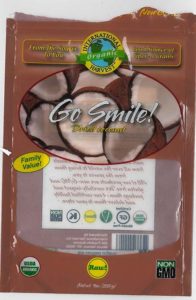
FDA also collected dried coconut from International Harvest, Inc. The outbreak strain of Salmonella Typhimurium was identified in samples of International Harvest Brand Organic Go Smile! Dried Coconut Raw and Go Smiles Dried Coconut Raw.

On March 16, 2018, International Harvest, Inc. recalled bags of Organic Go Smile! Raw Coconut and bulk packages of Go Smiles Dried Coconut Raw. The recalled Organic Go Smile! Raw Coconut was sold online and in stores in 9-ounce bags with sell-by dates from January 1, 2018 through March 1, 2019. Recalled bulk Go Smiles Dried Coconut Raw was sold in a 25-pound case labeled with batch/lot numbers OCSM-0010, OCSM-0011, and OCSM-0014. These products were sold in various grocery stores. Regulatory officials are working to determine where else Organic Go Smile! Raw Coconut and Go Smiles Dried Coconut Raw were sold.

On March 19, 2018, Vitamin Cottage Natural Food Markets, Inc. recalled packages of Natural Grocers Coconut Smiles Organic labeled with barcode 8034810 and packed-on numbers lower than 18-075. Recalled Natural Grocers Coconut Smiles Organic were sold in 10-ounce clear plastic bags with the Natural Grocers label. The packed-on number can be found in the bottom left-hand corner of the label.