
I have spoken to and been retained by, people in Idaho, Missouri, Montana, New Jersey, New York and Pennsylvania. Also, I have spoken to people in California and Utah that also may be linked to the outbreak.
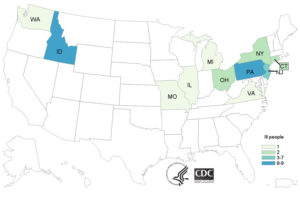
On Friday, according to the CDC, as of April 12, 2018, 35 people infected with the outbreak strain of E. coli O157:H7 have been reported from 11 states. Connecticut 2, Idaho 8, Illinois 1, Michigan 1, Missouri 1, New Jersey 7, New York 2, Ohio 2, Pennsylvania 9, Virginia 1 and Washington 1. Illnesses started on dates ranging from March 22, 2018 to March 31, 2018. Ill people range in age from 12 to 84 years, with a median age of 29. Sixty-nine percent of ill people are female. Twenty-two ill people have been hospitalized, including three people who developed hemolytic uremic syndrome, a type of kidney failure.

Today the Arizona Department of Health Services (ADHS) is advising residents to not eat and dispose of store-bought chopped romaine lettuce, including salads and salad mixes containing chopped romaine lettuce. The Centers for Disease Control and Prevention and the Food and Drug Administration indicated a multi-state outbreak of E. coli O157 is likely associated with chopped romaine lettuce from the Yuma, Arizona growing region. Three cases of E. coli in Arizona have been linked to this multistate outbreak.

Also, today the Montana Department of Health announced that there has been an increase in reports of STEC O157 cases in Montana, with onset dates between 3/28 and 4/7. These cases are linked to a multi-state outbreak of STEC O157 sickening at least 29 individuals in 11 states. This total includes three confirmed STEC O157 cases (2 in Missoula, 1 in Ravalli) with patterns matching the national outbreak strain. An additional five PCR positive cases are pending culture confirmation with the state laboratory (3 in Flathead, 1 in Lincoln, and 1 in Gallatin). Further analysis will be needed to determine if they part of the outbreak. Please see the information below for recommendations.

According to the CDC, epidemiologic evidence collected to date indicates that chopped romaine lettuce is the likely source of this outbreak. Most people reported eating a salad at a restaurant, and romaine lettuce was the only common ingredient identified among the salads eaten. The restaurants reported using bagged, chopped romaine lettuce to make salads.

Traceback investigations are ongoing to determine the source of chopped romaine lettuce supplied to restaurant locations where ill people ate. At this time, no common grower, supplier, distributor, or brand has been identified. However, preliminary information indicates that the chopped romaine lettuce was from the Yuma, Arizona growing region. Information collected to date indicates that chopped romaine lettuce from the Yuma, Arizona growing region could be contaminated with E. coli O157:H7 and could make people sick.

ADHS Advises Residents to Not Eat and Throw Away Chopped Romaine Lettuce
Three Arizona Residents Are Confirmed with E. coli Related to a Multi-State Outbreak

The Arizona Department of Health Services (ADHS) is advising residents to not eat and dispose of store-bought chopped romaine lettuce, including salads and salad mixes containing chopped romaine lettuce. The Centers for Disease Control and Prevention and the Food and Drug Administration indicated a multi-state outbreak of E. coli O157 is likely associated with chopped romaine lettuce from the Yuma, Arizona growing region. Three cases of E. coli in Arizona have been linked to this multistate outbreak.
E. coli can cause serious illness, so it is critical that everyone take precautions by not eating store-bought chopped romaine lettuce, even if you or someone from you family has consumed the product and did not get sick,” said Dr. Cara Christ, director of the Arizona Department of Health Services. “If you or someone from your family recently ate store-bought chopped romaine lettuce and are experiencing symptoms, please seek medical treatment immediately.”

Symptoms of E. coli O157 include diarrhea (sometimes bloody), and abdominal pain. E. coli O157 infection ranges from mild to severe, with symptoms lasting about five to seven days in most people. Young children, the elderly, and the immune-compromised are at risk of developing Hemolytic Uremic Syndrome (HUS), a potentially life-threatening illness that can cause kidney failure.

The CDC and the FDA are also advising people that before they eat lettuce from a restaurant to confirm that the product used to prepare the meal is not chopped romaine lettuce from the Yuma, Arizona growing region. ADHS is working with local health departments, the CDC, and the FDA to confirm the source of the E. coli O157 infections, to identify additional cases, and to prevent the spread of the disease.

To prevent foodborne illness, ADHS advises everyone to thoroughly wash hands with soap and water prior to food preparation or consumption, and after using the toilet. Wash fruits and vegetables before eating or handling. Avoid cross-contamination of food during preparation by washing hands, cutting boards, utensils, and any food preparation surfaces.

Advisory from the Montana Health Alert Network

Subject: Multi-state outbreak of E. coli O157:H7 (STEC O157), including Montana.

Background: There has been an increase in reports of STEC O157 cases in Montana, with onset dates between 3/28 and 4/7. These cases are linked to a multi-state outbreak of STEC O157 sickening at least 29 individuals in 11 states.

This total includes three confirmed STEC O157 cases (2 in Missoula, 1 in Ravalli) with patterns matching the national outbreak strain. An additional five PCR positive cases are pending culture confirmation with the state laboratory (3 in Flathead, 1 in Lincoln, and 1 in Gallatin). Further analysis will be needed to determine if they part of the outbreak. Please see the information below for recommendations.

Information for Clinicians

Clinicians are encouraged to consider E. coli infection in clinically compatible patients and order appropriate laboratory testing. Laboratories are reminded to submit specimens, as required by state rules, for surveillance purposes to the Montana Public Health Laboratory. Advanced testing will be conducted at no expense to the provider/patient that will enable us to compare the isolate to others at the state and national level.

Local public health officials will interview cases or proxies to assess exposures and the potential for additional transmission using a standardized data collection tool. Prompt reporting to local public health officials is essential.

Reporting: Reporting of suspected and confirmed cases of STEC (O157 and others) is required by state reporting rules. Prompt reporting by clinicians is essential to break the disease transmission cycle and identify potential sources.

Local Health Authorities

  • Please interview the patient using the general STEC investigation tool and outbreak specific tools distributed through a separate email. We request that the tools be used on any locally confirmed cases and returned via confidential fax to the CD/Epi program for analysis.
  • Review the information in this HAN with key surveillance partners, particularly laboratories, who may be processing enteric samples.

Resources

Rose Acre Farms of Seymour, Indiana is voluntarily recalling 206,749,248 eggs because they have the potential to be contaminated with Salmonella Braenderup, an organism which can cause serious and sometimes fatal infections in young children, frail or elderly people, and others with weakened immune systems. Healthy individuals infected with Salmonella Braenderup can experience fever, diarrhea, nausea, vomiting and abdominal pain. In rare circumstances, infection with Salmonella Braenderup can result in the organism getting into the bloodstream and producing more severe illnesses such as arterial infections (i.e., infected aneurysms), endocarditis and arthritis.

The eggs were distributed from the farm in Hyde County, North Carolina and reached consumers in the following states: Colorado, Florida, New Jersey, New York, North Carolina, Pennsylvania, South Carolina, Virginia, and West Virginia through retail stores and restaurants via direct delivery.

22 illnesses have been reported to date.

The affected eggs, from plant number P-1065 with the Julian date range of 011 through date of 102 printed on either the side portion or the principal side of the carton or package, as follows:

Lot Codes 011 – 102

Item Description Carton UPC
COUNTRY DAYBREAK A LARGE X 30 DOZEN 077236000302
COUNTRY DAYBREAK A LARGE X15 DOZEN 077236000302
COUNTRY DAYBREAK A JUMBO X24 DOZEN 077236000500
COUNTRY DAYBREAK A MEDIUM X30 DOZEN 077236000203
COUNTRY DAYBREAK A XLARGE X30 DOZEN 077236000401
COUNTRY DAYBREAK A JUMBO X12 DOZEN 077236000500
FOOD LION A JUMBO X 12 DOZEN 035826089618
FOOD LION A MEDIUM X15 DOZEN 035826089649
FOOD LION A XLARGE X 15 DOZEN 035826089625
FOOD LION A 18PK LARGE X15 DOZEN 035826089601
FOOD LION A LARGE X15 DOZEN 035826089588
FOOD LION A 6PK LARGE X 15 DOZEN 035826089632
LOOSE A USDA SMALL X 30 DOZEN N/A
LOOSE A USDA MEDIUM X 30 DOZEN N/A
LOOSE A XLARGE X15 DOZEN N/A
LOOSE A XLARGE X30 DOZEN N/A
LOOSE A MEDIUM X 15 DOZEN N/A
LOOSE A MEDIUM X30 DOZEN N/A
LOOSE USDA AA XLARGE X30 DOZEN N/A
LOOSE USDA AA XLARGE X15 DOZEN N/A
LOOSE USDA AA LARGE X30 DOZEN N/A
LOOSE USDA AA LARGE X15 DOZEN N/A
LOOSE USDA AA MEDIUM X30 DOZEN N/A
LOOSE AA XLARGE X30 DOZEN N/A
LOOSE USDA AA LARGE PFG X 30 DOZEN N/A
LOOSE USDA AA LARGE PFG X 15 DOZEN N/A
LOOSE USDA A XLARGE X30 DOZEN N/A
NELMS A JUMBO X24 634181000018
WAFFLE HOUSE LOOSE USDA A LARGE X 30 DOZEN N/A
CRYSTAL FARMS A MEDIUM X30 077236000203
CRYSTAL FARMS A 18PK MEDIUM X 30 077236000258
CRYSTAL FARMS A 2.5 DOZ MEDIUM X 25 077236000124
COUNTRY DAYBREAK A XLARGE X15 DOZEN 077236000401
COUNTRY DAYBREAK USDA GRADE A XLARGE X 240 DOZEN PULP 077236700400
COUNTRY DAYBREAK USDA GRADE A LARGE RACK X 240 DOZEN PULP 077236700301
COBURN FARMS A MEDIUM MP X 30 DOZEN 051933182608
COBURN FARMS A LARGE X 30 DOZEN 051933190801
COBURN FARMS A 18PK LARGE X 30 DOZEN 051933182509
SUNSHINE FARMS A JUMBO X 12 DOZEN 804879457336
GLENVIEW USDA AA LOOSE LARGE (6-2.5 FLATS) X 15 DOZEN N/A
GLENVIEW USDA AA LOOSE LARGE (12-2.5 FLATS) X 30 DOZEN N/A
GLENVIEW USDA AA LOOSE MEDIUM (6-2.5 FLATS) X 15 DOZEN N/A
GLENVIEW USDA AA LOOSE XLARGE (6-2.5 FLATS) X 15 DOZEN N/A
GLENVIEW USDA AA LOOSE MEDIUM (12-2.5 FLATS) X 30 DOZEN N/A
GLENVIEW USDA AA LOOSE XLARGE (12-2.5 FLATS) X 30 DOZEN N/A
GREAT VALUE GRADE A USDA 18PK XLARGE X 24 DOZEN RPC 078742127132
GREAT VALUE GRADE A USDA 12PK XLARGE X 24 DOZEN RPC 078742127128
GREAT VALUE GRADE A USDA TWIN 18PK LARGE X 24 DOZEN RPC 078742127101
GREAT VALUE GRADE A USDA 6PK LARGE X 15 DOZEN 078742127095
GREAT VALUE GRADE A USDA 12PK MEDIUM X 15 DOZEN 078742127224
GREAT VALUE GRADE A USDA 12PK LARGE X 24 DOZEN RPC 078742127071
GREAT VALUE GRADE A USDA 18PK LARGE X 24 DOZEN RPC 078742127088
GREAT VALUE GRADE A 12PK JUMBO X 22 DOZEN RPC 078742127149
GREAT VALUE GRADE A USDA 5DZ LARGE X 5 DOZEN 078742127118

The voluntary recall was a result of some illnesses reported on the U.S. East Coast, which led to extensive interviews and eventually a thorough FDA inspection of the Hyde County farm, which produces 2.3 million eggs a day. The facility includes 3 million laying hens with a USDA inspector on-site daily.

To put the dispute in context:  According to the CDC, a total of 265 people infected with the outbreak strains of Salmonella Typhimurium were reported from 8 states (Iowa, Minnesota, Nebraska, South Dakota, Wisconsin, Illinois, Indiana and Mississippi). WGS performed on bacteria isolated from ill people showed that they were closely related genetically. This means that people in this outbreak were more likely to share a common source of infection. Illnesses started on dates ranging from January 8, 2018, to March 20, 2018. Ill people ranged in age from less than 1 year to 89 years, with a median age of 57. Sixty-seven percent of people were female. Ninety-four hospitalizations were reported, including one person from Iowa who died.

Despite the overwhelming evidence from public health officials at the CDC and several states and the FDA and FSIS, this statement dribbled out this morning from the PR folks (assuming not the lawyers) from triple T Specialty Meats:

Triple T Specialty Meats Statement:  On behalf of the Heikens family and everyone at Triple T Specialty Meats, our deepest sympathy goes out to the individuals and families affected by the recent Fareway Chicken Salad incident. During our 22 years in business at Triple T Specialty Meats, consumer health and food safety has always been our number one priority; and will always be our number one priority!

After a thorough investigation and extensive testing by state of Iowa, USDA and FDA inspection teams, no salmonella was found at the Triple T Specialty Meats facility in Ackley. Further, no salmonella was found in any products tested at the Triple T Specialty Meats facility. Finally, all chicken salad produced by Triple T Specialty Meats; that remained in the original sealed packaging, tested negative for salmonella.

“We take this very seriously and will continue to work with all government agencies to assist in determining the source of the salmonella,” said Jolene Heikens, Co-Owner and CEO of Triple T Specialty Meats. “In the meantime, Triple T Specialty Meats is running business as usual and we appreciate our customer’s and the communities continued support. We will continue to provide only the highest quality product and services meeting all USDA and FDA regulations.”

All agency inspector’s reports showing “No Salmonella Found” have been provided to Triple T Specialty Meats and will be made available to customers or vendors upon request.

Triple T Specialty Meats is a family owned and operated specialty meat and food processor established in 1996 and operates in Ackley, Iowa by Greg and Jolene Heikens. The Heikens accredit much of their success to surrounding themselves with exceptional employees, but when you meet the Heikens and become acquainted with their brainstorming, get-after-it, fun-loving personalities, you will understand what makes Triple T Specialty Meats successful, but more importantly special.

I what could only be entitled “The Smack Down in Iowa,” Fareway set the record straight and stopped doing business with Triple T Specialty Meats.  The statement read:

Fareway Stores, Inc. Statement: Fareway Stores, Inc. wants to share information with our customers about the investigation of the outbreak of Salmonella illnesses linked to chicken salad made by Triple T Specialty Meats, Inc. State and federal investigators have concluded that Triple T Specialty Meats, Inc. was the source of the Salmonella Typhimurium in the chicken salad. The Iowa State Hygienic Laboratory found Salmonella Typhimurium in Triple T Specialty Meats, Inc. chicken salad collected from two different Fareway stores located 100 miles apart. One of those positive samples came from a sealed package of Triple T chicken salad that had never been opened by Fareway. 

As USDA’s Food Safety and Inspection Service reported, “the Iowa Department of Public Health, Iowa Department of Inspections and Appeals, and Iowa State Hygienic Laboratory determined that there is a link between the chicken salad from Triple T Specialty Meats, Inc. and this outbreak.” The U.S. Centers for Disease Control and Prevention has also confirmed that chicken salad produced by Triple T Specialty Meats, Inc. was the likely source of this multi-state illness outbreak.

In the course of these investigations, there have been no findings of any food safety issues in Fareway stores. Fareway has stopped doing business with Triple T Specialty Meats, Inc.

Body Slam!

Honestly, Triple T Specialty Meats is getting very bad PR advice, very bad business advice, but hopefully, not bad legal advice – We shall see.

As of  April 13, 2018, Marler Clark represents E. coli victims in Idaho, Missouri, New Jersey and Pennsylvania.

As of April 12, 2018, 35 people infected with the outbreak strain of E. coli O157:H7 have been reported from 11 states. Connecticut 2, Idaho 8, Illinois 1, Michigan 1, Missouri 1, New Jersey 7, New York 2, Ohio 2, Pennsylvania 9, Virginia 1 and Washington 1.  (CDC Report)

Illnesses started on dates ranging from March 22, 2018 to March 31, 2018. Ill people range in age from 12 to 84 years, with a median age of 29. Sixty-nine percent of ill people are female. Twenty-two ill people have been hospitalized, including three people who developed hemolytic uremic syndrome, a type of kidney failure. No deaths have been reported.

The current outbreak is not related to a recent multistate outbreak of E. coli O157:H7 infections linked to leafy greens. People in the previous outbreak were infected with a different DNA fingerprint of E. coli O157:H7 bacteria.

Epidemiologic evidence collected to date indicates that chopped romaine lettuce is the likely source of this outbreak. Most people reported eating a salad at a restaurant, and romaine lettuce was the only common ingredient identified among the salads eaten. The restaurants reported using bagged, chopped romaine lettuce to make salads.

Traceback investigations are ongoing to determine the source of chopped romaine lettuce supplied to restaurant locations where ill people ate. At this time, no common grower, supplier, distributor, or brand has been identified. However, preliminary information indicates that the chopped romaine lettuce was from the Yuma, Arizona growing region. Information collected to date indicates that chopped romaine lettuce from the Yuma, Arizona growing region could be contaminated with E. coli O157:H7 and could make people sick.

A vaccine for all employees is good for customers and good for business.

According to a press release, the Madison County Kentucky Health Department is investigating a single case of hepatitis A in a food handler who worked while infectious at McDonalds restaurant on Glades Road in Berea, KY on March 23, 2018. Hepatitis A is caused by a virus that is passed person to person through fecal-oral contact. The risk to patrons who ate at McDonalds is very low. However, individuals who ate there on March 23rd, should watch for signs and symptoms of hepatitis A from April 7th to May 12th.

Hepatitis A can be spread when: an infected person does not wash his or her hands properly after going to the bathroom and then touches objects or food; a caregiver does not properly wash his or her hands after changing diapers or cleaning up the stool of an infected person; someone engages in certain sexual activities. Hepatitis A can also be spread through food or water through an ill food handler or by using contaminated items.

Symptoms of infection usually appear 15 to 50 days after exposure and can include: fever, jaundice, grey-colored stools, dark urine, abdominal pain, vomiting, fatigue, loss of appetite, nausea and joint pain. Some people, especially children, may have no symptoms. This is why proper handwashing is critical. Symptoms usually resolve in 2 months but can last as long as 6 months. There is no treatment for Hepatitis A and some people require hospitalization. If you have these symptoms you should contact your primary care provider for testing.

Hepatitis A can be prevented by receiving the Hepatitis A vaccination. This vaccination is available to anyone 12 months of age or older and is given in two doses six months apart. Everyone is also reminded that handwashing is the best way to prevent infection. Handwashing should be emphasized especially after using the bathroom, changing a diaper or preparing and eating food.

And, then there is the impact on stock price:

272 with Hepatitis A in Kentucky – Full Report

The CDC, several states, the U.S. Food and Drug Administration, and the U.S. Department of Agriculture’s Food Safety and Inspection Service are investigating a multistate outbreak of Shiga toxin-producing E. coli O157:H7 infections. This investigation includes E. coli O157:H7 infections recently reported by the New Jersey Department of Health.  Illnesses reported by investigators in New Jersey also included ill people who had a diagnostic test showing they were infected with E. coli bacteria. Laboratory testing is ongoing to link their illnesses to the outbreak using DNA fingerprinting. Some people may not be included in CDC’s case count because no bacterial isolates are available for the DNA fingerprinting needed to link them to the outbreak.

As of April 9, 2018, 17 people infected with the outbreak strain of E. coli O157:H7 have been reported from 7 states. The 7 states are : Connecticut (2), Idaho (4), Missouri (1), New Jersey (6), Ohio (1), Pennsylvania (2), and Washington (1). Illnesses started on dates ranging from March 22, 2018 to March 31, 2018. Ill people range in age from 12 to 84 years, with a median age of 41. Among ill people, 65% are female. Six ill people have been hospitalized, including one person who developed hemolytic uremic syndrome, a type of kidney failure. No deaths have been reported.

The investigation is still ongoing, and a specific food item, grocery store, or restaurant chain has not been identified as the source of infections.  State and local public health officials are interviewing ill people to determine what they ate and other exposures in the week before their illness started.

Two Vancouver Island oyster farms have been closed following an outbreak of norovirus associated with eating the raw shellfish.

The British Columbia Centre for Disease Control says about 40 cases of acute gastrointestinal illness have been connected to the consumption of raw oysters since March. Testing has confirmed some of the cases were norovirus.

Federal officials with Fisheries and Oceans Canada (DFO) confirmed the affected farms are located on the east coast of Vancouver Island at Deep Bay and Denman Island.

While the two farms are no longer harvesting oysters for consumption, no recall of oysters has been issued by the Canadian Food Inspection Agency.

While the precise sources of contamination have not been identified, human sewage in the marine environment is currently believed to be the most plausible cause of shellfish contamination, according to BCCDC epidemiologist Marsha Taylor.

A total of 265 people infected with the outbreak strains of Salmonella Typhimurium were reported from South Dakota, Nebraska, Minnesota, Iowa, Wisconsin, Illinois, Indiana and Mississippi.

Illnesses started on dates ranging from January 8, 2018, to March 20, 2018. Ill people ranged in age from less than 1 year to 89 years, with a median age of 57. Sixty-seven percent of people were female. Ninety-four hospitalizations were reported, including one person from Iowa who died.

Epidemiologic, laboratory, and traceback evidence indicated that chicken salad produced by Triple T Specialty Meats, Inc. and sold at Fareway grocery stores was the likely source of this multistate outbreak.

Investigators in Iowa collected chicken salad from two Fareway grocery store locations in Iowa for laboratory testing. An outbreak strain of Salmonella Typhimurium was identified in both samples.

On February 21, 2018, Triple T Specialty Meats, Inc. recalled all chicken salad produced from January 2, 2018 to February 7, 2018. The recalled chicken salad was sold in containers of various weights from the deli at Fareway grocery stores in Iowa, Illinois, Minnesota, Nebraska, and South Dakota from January 4, 2018 to February 9, 2018.

As of April 6, 2018, this outbreak appears to be over.