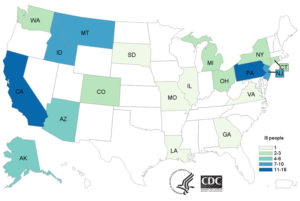
The CDC reports as of May 1, 2018, 121 people infected with the outbreak strain of E. coli O157:H7 have been reported from 25 states. A list of the states and the number of cases in each can be found on the Case Count Map page. Illnesses started on dates ranging from March 13, 2018 to April 21, 2018. Ill people range in age from 1 to 88 years, with a median age of 29. Sixty-three percent of ill people are female. Of 102 people with information available, 52 (51%) have been hospitalized, including 14 people who developed hemolytic uremic syndrome, a type of kidney failure. One death was reported from California.

Illnesses that occurred after April 11, 2018, might not yet be reported due to the time it takes between when a person becomes ill with E. coli and when the illness is reported. This takes an average of two to three weeks.

Do these ladies look like they might have hepatitis A?

According to Live Science, Kentucky Derby fans may need to take some extra precautions before heading off to the races.

The Indiana State Department of Health is recommending that its residents get vaccinated against hepatitis A and take other steps to protect themselves from the illness before traveling to Kentucky or Michigan, both of which are experiencing large outbreaks of the viral infection.

Kentucky has reported more than 300 cases of hepatitis A since November 2017, with 39 new cases reported in the first week of April, according to the Kentucky Department for Public Health. Most cases in the state have occurred around Louisville — the city where the Kentucky Derby is held. The famous horse race, which draws more than 150,000 people each year, takes place on the first Saturday in May.

According to the CDC, a total of 265 people infected with the outbreak strains of Salmonella Typhimurium were reported from 8 states. WGS performed on bacteria isolated from ill people showed that they were closely related genetically.  Illnesses started on dates ranging from January 8, 2018, to March 20, 2018. Ill people ranged in age from less than 1 year to 89 years, with a median age of 57. Sixty-seven percent of people were female. Ninety-four hospitalizations were reported, including one person from Iowa who died. Epidemiologic, laboratory, and traceback evidence indicated that chicken salad produced by Triple T Specialty Meats, Inc. and sold at Fareway grocery stores was the likely source of this multistate outbreak.

Yet, this in part is Triple T’s response to a lawsuit filed on behalf of 1 of the 265:

DEFENDANT TRIPLE T SPECIALTY MEATS, INC.’S ANSWER TO SECOND AMENDED COMPLAINT, JURY DEMAND AND AFFIRMATIVE DEFENSES

COMES NOW the Defendant, Triple T Specialty Meats, Inc. (hereinafter “Triple T”), by and through their attorneys, Betty, Neuman & McMahon, P.L.C., and for its Answer to Plaintiffs’ Second Amended Complaint, states as follows:

Admits that Triple T is a citizen of the State of Iowa. Triple T admits that it produced chicken salad for Fareway.

Admit that Triple T produced Fareway chicken salad at the times relevant to this petition.

Admits that Salmonella is unsafe but denies that the food contained Salmonella.

Fareway shoots back at Triple T with its own lawsuit:

DEFENDANT FAREWAY STORES, INC.’S ANSWER, AFFIRMATIVE DEFENSES, JURY DEMAND AND CROSS-CLAIMS AGAINST DEFENDANT TRIPLE T SPECIALTY MEATS, INC.

COME NOW Defendant Fareway Stores, Inc. (“Fareway”), by and through its attorneys, for its Answer to Plaintiffs’ Second Amended Complaint (“Complaint”) and for its Affirmative Defenses, states as follows:

Upon information and belief, Fareway admits that state and federal regulators have identified multiple confirmed or probable cases of Salmonella Typhimurium in multiple states related to adulterated chicken salad manufactured by Triple T and unknowingly sold by Fareway.

Fareway admits that on February 14, 2018, the U.S. Department of Agriculture’s Food Safety and Inspection Service (“FSIS”) issued a statement, which speaks for itself.

Fareway admits the chicken salad Fareway sold at times relevant to Plaintiffs’ Complaint was produced by Triple T in Ackley, Iowa.

Fareway admits that at times relevant to Plaintiffs’ Complaint, Triple T distributed its chicken salad to Fareway in five-pound bags, packed two to a sealed cardboard box. Fareway further admits it repackaged and sold Triple T chicken salad to consumers in various sized plastic deli containers.

Upon information and belief, Fareway admits it unknowingly sold to consumers adulterated chicken salad that was manufactured by Triple T.

Fareway admits that Triple T manufactured a food product, including chicken salad, that was intended for sale to the public.

Fareway admits that Triple T manufactured and distributed ready-to-eat chicken salad that was contaminated with Salmonella Typhimurium.

Fareway admits that if Plaintiff suffered damages from eating chicken salad adulterated with Salmonella Typhimurium, then Triple T is strictly liable for Plaintiffs’ Damages.

Fareway admits that Triple T owed a duty to consumers and Fareway to use reasonable care when making representations about the certifications its ready-to-eat chicken salad had undergone prior to its distribution and sale of product, and that Triple T breached this duty.

Fareway admits that Triple T had a duty to comply with all statutes, laws, regulations or safety codes pertaining to the manufacture, distribution, storage and sale of its food products, failed to do so, and were therefore negligent.

Fareway admits Triple T breached the duties it owed to consumers of its ready-to-eat chicken salad and Fareway by committing the negligent acts and omissions.

Fareway admits Triple T had a duty to comply with statutory and regulatory provisions that pertained or applied to the manufacture, distribution, storage, labeling and sale of its food products, and that Triple T breached these duties.

Fareway admits Triple T had a duty to use reasonable care in the manufacture, distribution, and sale of its food products to prevent adulteration with Salmonella, and that Triple T breached this duty.

Fareway admits that if Plaintiffs consumed Triple T ready-to-eat chicken salad adulterated with Salmonella Typhimurium, and suffered injuries as a result, then Plaintiffs’ injuries, if any, proximately and directly resulted from the negligence of Triple T and Triple T’s violations of statutes, laws, regulations and safety codes pertaining to the manufacture, distribution, storage, and sale of food.

CROSS-CLAIMS AGAINST DEFENDANT TRIPLE T SPECIALTY MEATS, INC.

Defendant Fareway Stores, Inc. (“Fareway”), by and through its attorneys, and for its Cross-Claims against Defendant Triple T Specialty Meats, Inc. (“Triple T”), Fareway, by its undersigned attorneys, and pleading in the alternative and without prejudice to its answer to Plaintiffs’ Complaint, states as follows:

Triple T produced ready to-eat chicken salad, which it sold to Fareway for sale for human consumption. Fareway then sold the ready-to-eat chicken salad produced by Triple T to Fareway’s customers, including, as alleged in their Complaint, Plaintiffs.

On February 9, 2018, the Iowa Department of Inspections and Appeals (“IDIA”) contacted Fareway about a potential link between ready-to-eat chicken salad produced by Triple T and sold by Fareway and a multi-state outbreak of illnesses from Salmonella Typhimurium. That same day, Fareway voluntarily stopped selling the ready-to-eat chicken salad in all its stores.

On February 13, 2018, the IDIA and the Iowa Department of Public Health (“IDPH”) issued a consumer advisory warning that the Triple T chicken salad sold at Fareway stores may be adulterated with Salmonella Typhimurium.

An epidemiological investigation and product testing conducted by IDIA and IDPH, along with the Centers for Disease Control (“CDC”) and the U.S. Department of Agriculture’s Food Safety and Inspection Service (“FSIS”), concluded, “Epidemiologic and laboratory evidence indicates that chicken salad produced by Triple T and sold at Fareway grocery stores is the likely source of this multistate outbreak.”

Specifically, FSIS stated, “The Iowa Department of Public Health, Iowa Department of Inspections and Appeals, and Iowa State Hygienic Laboratory determined that there is a link between the chicken salad from Triple T Specialty Meats, Inc. and this outbreak.”

On February 21, 2018, following this extensive investigation, Triple T recalled all ready-to-eat chicken salad that it produced between January 2, 2018, and February 7, 2018.

The ready-to-eat chicken salad was produced by Triple T, sold to Fareway, and shipped to Fareway stores in Iowa, Illinois, Minnesota, Nebraska, and South Dakota.

Triple T’s website represents that its meat processing facility in Ackley is “state- of-the-art” and “federally inspected.” Triple T’s website also states: “Our professional staff take pride in their work and providing you with the safest high-quality products available.” Triple T’s website goes on to state: “We go to great lengths to ensure that our customers receive nothing but the highest quality products. All products must pass our quality assurance inspection, meeting our customer’s specifications.”

Triple T also owed a duty to Fareway to use reasonable care to manufacture and distribute ready-to-eat chicken salad that was wholesome, free from adulteration and safe for human consumption.

Triple T breached these duties by manufacturing ready-to-eat chicken salad that was adulterated with Salmonella Typhimurium and was therefore defective as a matter of law under the Poultry Products Inspection Act, 21 U.S.C. § 458 and 9 CFR § 381 et seq. and was not safe for human consumption.

Triple T manufactured and distributed ready-to-eat chicken salad that was defective as a matter of law and not reasonably safe for human consumption because it was adulterated with Salmonella Typhimurium.

The chicken salad’s defective condition was present at the time Triple T sold the product to Fareway and Fareway then sold it to consumers.

Because Triple T sold a food product that was defective, due to contamination with Salmonella Typhimurium bacteria, Triple T is strictly liable to Fareway for the harm directly and proximately caused by the sale of the defective ready-to-eat chicken salad.

Triple T expressly warranted on its public website that Triple T provides customers such as Fareway with the “safest high-quality products available.” Triple T also represented on its website that, “We go to great lengths to ensure that our customers receive nothing but the highest quality products. All products must pass our quality assurance inspection, meeting our customer’s specifications.”

Fareway relied on these express warranties when purchasing chicken salad from Triple T.

By producing and selling ready-to-eat chicken salad that was adulterated with Salmonella Typhimurium at the time Triple T sold the chicken salad to Fareway, Triple T violated applicable laws and regulations, including the Poultry Products Inspection Act, 21 U.S.C. § 458 and 9 CFR § 381 et seq.

By producing and selling ready-to-eat chicken salad that was adulterated with Salmonella Typhimurium and violating applicable laws and regulations, Triple T failed to provide Fareway with food products that were of the safest quality; thereby breaching its express warranty.

By producing and selling ready-to-eat chicken salad that was adulterated with Salmonella Typhimurium and violating applicable laws and regulations, Triple T did not provide Fareway with the highest-quality products available; thereby breaching its express warranty.

This lawsuit will be entertaining.

There are 98 cases in 22 states: Alaska (8), Arizona (5), California (16), Colorado (2), Connecticut (2), Georgia (1), Idaho (10), Illinois (1), Louisiana (1), Michigan (3), Mississippi (1), Missouri (1), Montana (8), New Jersey (7), New York (2), Ohio (3), Pennsylvania (18), South Dakota (1), Tennessee (1), Virginia (1), Washington (5), and Wisconsin (1). The current outbreak is not related to a recent multistate outbreak of E. coli O157:H7 infections linked to leafy greens. People in the previous outbreak were infected with a different DNA fingerprint of E. coli O157:H7 bacteria.

The most recent information collected by the FDA, in conjunction with federal, state, and local partners, indicates that the romaine lettuce that ill people ate was likely grown or originated from the winter growing areas in or around the Yuma region. This region generally supplies romaine lettuce to the U.S. during November-March each year.

The FDA has identified Harrison Farms as the source of the whole-head romaine lettuce that made several people ill at a correctional facility in Alaska. However, the agency has not determined where in the supply chain the contamination occurred. The FDA is examining all possibilities, including that contamination may have occurred at any point along the growing, harvesting, packaging, and distribution chain before reaching the Alaska correctional facility where it was served.

It is likely that Harrison Farms is the source or one of the sources – we continue to dig and will get to the bottom of this.

Earlier this week the National Institute of Communicable Diseases (NICD) reported that 1019 Listeria illnesses with 199 deaths have been linked to Tiger Brands Enterprise polony.  Today, Tiger Brands provided to the public – through an announcement to its shareholders that it had confirmed the NICD’s findings the a specific type of Listeria – Listeria monocytogenes ST6 type – was found.

To Tiger Brands’ credit, it has been transparent with its test results.  Its transparency support of the NICD findings is hopeful for its customers that suffered as a result of the Listeria-tainted product.  Tiger Brands should be commended for its willingness to provide the results in a public forum.

Here is the Tiger Brands’ announcement in full:

Results of Independent Tests carried out in respect of the presence of Listeria monocytogenes ST6 type (“LST6”) Shareholders are referred to the SENS announcement issued by the Company on 5 March 2018, relating to an order issued by the National Consumer Commission for the Company to conduct a recall of certain identified Enterprise products. In that announcement, it was stated that in a batch of one of its products tested by the Company on 14 February 2018, the presence of the ST6 strain could not be confirmed and that the relevant samples had been sent to an external laboratory for the identification of the strain. The test results were received on 15 March 2018, but these had proved inconclusive and, as a result, the samples were sent for further re-testing.

The purpose of this announcement is to update shareholders on the results of the independent laboratory re-testing which was carried out in respect of the presence of LST6 in the above samples which were manufactured at the Enterprise Polokwane processing facility. On 24 April 2018, Tiger Brands received confirmation of the presence of LST6 in these samples. As reported previously, we have been actively engaging with the Department of Health and the National Institute of Communicable Diseases on our findings and will continue to collaborate with them on the actions taken to date to actively address our findings.

The Enterprise facilities in Polokwane, Pretoria and Germiston still remain closed while remedial work continues. An arrangement has been concluded between Pork Packers (which is based in Clayville) and our pig suppliers to contract slaughter on their behalf with effect from 2 May 2018.

We have been retained by over 40 individuals from Arizona,  California, Idaho, Montana, Missouri, Illinois, Ohio, Pennsylvania, New York and New Jersey.  This includes 2 HUS cases in New Jersey, 1 in New York, 1 in Idaho and 3 in California.  We have filed suit in Federal Court in New Jersey.

As of April 25, 2018, 84 people infected with the outbreak strain of E. coli O157:H7 have been reported from 19 states. Alaska 5, Arizona 5, California 13, Colorado 2, Connecticut 2, Georgia 1, Idaho 10, Illinois 1, Louisiana 1, Michigan 2, Missouri 1, Montana 7, New Jersey 7, New York 2, Ohio 3, Pennsylvania 18, South Dakota 1, Virginia 1, Washington 2.

Illnesses started on dates ranging from March 13, 2018 to April 12, 2018. Ill people range in age from 1 to 88 years, with a median age of 31. Sixty-five percent of ill people are female. Forty-two ill people have been hospitalized, including nine people who developed hemolytic uremic syndrome, a type of kidney failure.

Illnesses that occurred after April 5, 2018, might not yet be reported due to the time it takes between when a person becomes ill with E. coli and when the illness is reported. This takes an average of two to three weeks.

State and local health officials continue to interview ill people to ask about the foods they ate and other exposures before they became ill. Sixty-four (96%) of 67 people interviewed reported eating romaine lettuce in the week before their illness started.

Information collected to date indicates that romaine lettuce from the Yuma, Arizona growing region could be contaminated with E. coli O157:H7 and could make people sick.

The Numbers: As of Friday night, the CDC reported 53 people infected with the outbreak strain of E. coli O157:H7 being reported from 16 states.  However, the CDC reported only 1 case in Alaska while the Alaska Department of Public Health (ADPH) reported 8 ill from the Anvil Mountain Correctional Center in Nome.  In ADPH’s investigation it confirmed that the whole head romaine lettuce consumed by the Nome patients was grown in Yuma, Arizona. In addition, the CDC reported 6 ill in Montana while the Montana Department of Public Health reported 8 and the CDC reported 3 ill in Arizona while the Arizona Department of Health reported 5. The CDC further reported that 31 people have been hospitalized, including five people who have developed hemolytic uremic syndrome (HUS).  By my count that is 64, not 53.

The hardest hit states are Alaska with 8 ill, Idaho with 10 ill, Montana with 8 ill, New Jersey with 7 ill, and Pennsylvania with 12 – 5 states with 45 ill – 19 ill in the other 11 states.  By CDC count, here is a full list of states and illnesses reported:  Alaska 1, Arizona 3, California 1, Connecticut 2, Idaho, 10, Illinois 1, Louisiana 1, Michigan 2, Missouri 1, Montana 6, New Jersey 7, New York 2, Ohio 2, Pennsylvania, 12, Virginia 1 and Washington 1.

As of a few moments ago, I had been contacted by nearly 30 people, most of whom are clearly part of the CDC’s and states’ counts, some require a bit more investigation. However, some with E. coli O157:H7 are awaiting contact by health officials.  In addition, three patients (13-year-old from New York and a 6-year-old and 16-year-old from California) that I spoke to their families this last weekend, all developed HUS, and may not yet be counted in the CDC totals.  Given that I have also been retained by a 23-year-old HUS patient in Idaho and two adult HUS patients in New Jersey, I think the CDC count of five with HUS, is unfortunately low.

Counting the bodies in an outbreak can be the easy part; positive stool cultures for E. coli O157:H7 are genetically matched by PFGE (unclear if state and CDC labs are doing WGS yet) and people are interviewed to determine what they consumed in the 3-5 days before the onset of illness. That is how the state health authorities and the CDC have determined (thanks to the prisoners in Alaska) that whole head and chopped romaine from Yuma Arizona is the cause of this outbreak – that is likely to grow in number.  And, the counting at times takes weeks.

Tying the Chain Together:  What we know: there is a cluster of cases in the East – New Jersey and New York – that share a common exposure of eating salads with romaine lettuce at Panera Bread.  Panera received chopped-bagged romaine from processor Freshway Foods.  At this point, we cannot confirm where Freshway Foods, which services the Midwest and East,  sourced the romaine, but a subpoena in the lawsuit I filed last week will likely do the trick.

For Illnesses in the West, I have also found a common processor for cases in Montana and Idaho, but I do not – yet – have the evidence to file suit.  And, then there is Alaska; as noted above, the ADPH announced that whole head romaine lettuce consumed by the Nome patients was grown in Yuma, Arizona.  And, Food Safety News  has learned the romaine was likely delivered to the correctional facility during the final week of March. Prison officials believe it was all consumed during the first week of April. Inmates who became ill first experienced symptoms on April 5, 6, 9 and 15. Country Foods, located three hours from Nome by air, is the food supplier for the Anvil Mountain prison.

I have been told the name of the Yuma, Arizona grower X by at least three people who would know, but I will let the FDA announce the growers name today?

I assume also the CDC will update their body count today?

The bigger questions are the link between grower(s) X and all 64 – and growing illnesses – and why the broad geographical distribution of the illnesses?

The NICD published its most recent report on the deadly Listeria outbreak. Fortunately, it is winding down at the polony was pulled from shelves.  However, the NICD warns that not all polony has been recalled, and due to the long incubation period for Listeria, case could still be counted for some time.

It was a wide-spread outbreak.

The outbreak greatest impact was on babies less that 28 days of age and people in the 15 – 49 years of age.

Listeriosis outbreak situation report_22April 2018_fordistribution

I assume that the fellow that left this comment on my post of yesterday “Why I work weekends” is a real person who is actually in charge of “the Food Safety programs of two grower/shippers of fruit and produce.”  I bet your buyers – consumers, restaurants or retailers, feel great about the vote of confidence in your product.

Setting aside for a moment how Chad may feel about lawyers, do you really think the appropriate response to someone who buys a salad at a place like Panera or buys a package of “triple-washed” chopped, bagged romaine at a grocery store, and becomes sick due to E. coli O157:H7 and develops HUS is, sorry, “shit happens?’

Sorry, that is not acceptable.  If you put a defective product – yes, E. coli O157:H7 is a defective product – into commerce and you harm someone, you are responsible.  To suggest otherwise, especially in these circumstances is legally and morally wrong.

It is the attitude of it’s “Nature’s fault” that leads to complacent finger-pointing at consumers.  Are consumers supposed to wash the lettuce they are served at a restaurant?  Do we really expect a busy homemaker (man or woman) to wash the washed chopped bagged salad they picked up at the grocery store?

Here is his comment in full, unedited:

chad gress

“I promised the distraught father that I would take care of his kid and find the grower, shipper, processor and retailer (honestly, I know most of the chain already and the rest will flip shortly – perhaps I should offer a reward?) that did this to his daughter.“

NATURE did this to his daughter. Was it facilitated by a breakdown in safe growing, harvesting and/or processing practices by one or more companies in the chain of custody? Perhaps. But that is yet to be determined.

I am responsible for the Food Safety programs of two grower/shippers of fruit and produce. I hate hearing about people suffering because they made a healthy choice to eat fresh produce. And being a father, I sympathize with anyone who’s child becomes sick or dies as a result of exposure to a food-borne pathogen. But I am all too aware that, despite our best efforts to protect the consumer by proactively reducing the potential for cross contamination during the growing and harvesting stages, it is not possible to eliminate the potential for contamination. Without a kill step, fruits and vegetables have always and will always be susceptible to contamination.

To tell a father that you are going to find out who “did this to his daughter” without knowing all the facts is irresponsible and misleading. I support taking legal action against companies who demonstrate negligence in thier duties towards the health and safety of the public. It seems the only way to effect change is to go after their wallets. But for so many of us in the produce industry doing our reasonable best to grow and ship a product that is safe for human consumption, being portrayed as “villians” in these scenarios is just ethically wrong.

Produce is grown outdoors, in nature, exposed to countless sources of contamination, the most dangerous of which are microorganisms that are invisible to the human eye, extremely adaptable and likely more resilient than we currently understand them to be. We are constantly performing risk assessments to identify potential weak points in our Food Safety Programs, and modifying our procedures so they reflect the most current science-based metrics. We are conscientious and diligent. And yet, we will never be able to eliminate the risk of our produce being a source of food-borne illness.

And so we will continue to be the targets of litigation, and attorneys will continue to use the type of language that you did with thier clients and the public, encouraging them to file lawsuits against everyone who touched the product. Eveyone who “did this to thier daughter”.

If you can not make mass produced produce safely – don’t sell it.  If you sell it and sicken some 11 year old girl whose only crime was to order a salad at Panera, then step up and be responsible for what happened to her.

And Chad, since I posted “Why I work weekends” – I have been retained by the family of a 16-year-old girl with HUS who just was released from ICU and the mother of a 6-year-old boy who was just hospitalized in the last few days and has early stages of HUS.  Would you like to tell them, that is just nature’s way?