

Canada called the imported romaine lettuce E. coli outbreak over after eight people were sickened. It is expected that the CDC will update the US part of the outbreak in the morning. The numbers of ill are likely to be far above 200 and the number of deaths may likely rise as well. Those with long-term complications – (HUS) will still be extraordinary high, as will be the percent of hospitalizations.
Thus far the FDA has been “somewhat silent” on the chain of distribution and will unfortunately remain so. Here is what they have told the public as of the end of May:
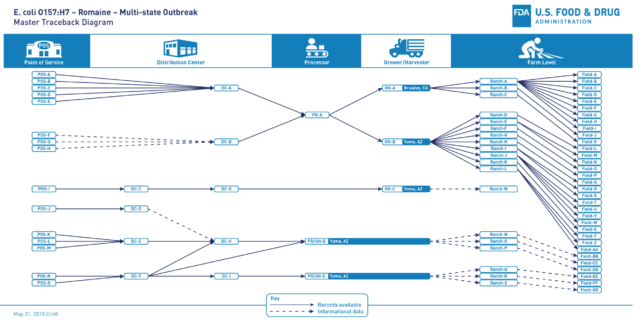
We have been busy doing both a trace forward and trace back. With over 100 clients, most can identify the specific place that they consumed romaine (point of service) in the 3-5 days before the onset of illness. Some have multiple purchases and consumptions, which for now, make linking the supply chain a challenge. But I like a challenge.
I expect that the various retailers (points of service) will continue to provide information on the supply chain (distribution center, processor, grower/harvester) – either willingly or by subpoena. And, once we have that information (trace back), we can than trace forward to eliminate situations where E. coli culture matched victims had multiple purchases in the incubation period.
Check back for more information.
Retailers above, please give me a call.
 The Mexican federal consumer protection agency has issued a warning about the possible presence of salmonella in boxes of Kellogg’s Honey Smacks cereal.
 As of June 14, 2018, 73 people infected with the outbreak strain of Salmonella Mbandaka have been reported from 31 states. A list of the states and the number of cases in each can be found on the
  I have no idea if this is a change of policy – but it should be. I have been complaining a bit over at
  After 25 years doing food litigation, I am seldom surprised by the announcement of a foodborne illness outbreak. It was no different last Friday when the Indiana Department of Health announced a multi-state Salmonella outbreak linked to cut fruit – mainly melons sold at large retailers in several states. People in government or in various parts of the food industry know that an outbreak is brewing weeks before the evidence becomes too overwhelming to ignore, so on more than a few occasions, when the delay between government and industry knowledge and a public announcement becomes too slow for concerned people and I get a call, text of email.
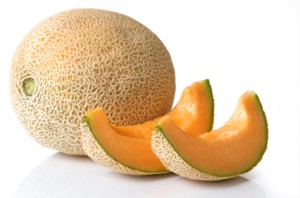 The Centers for Disease Control and Prevention (CDC) is reporting 60 cases from five states – Illinois, Indiana, Michigan, Missouri, and Ohio. The CDC investigation indicates pre-cut melons, including fruit salads, are a likely source of this multistate outbreak.
  Time to dust off
  As of May 30, 2018, there are 197 cases in 35 states: Alaska (8), Arkansas (1), Arizona (9), California (45), Colorado (3), Connecticut (2), Florida (1), Georgia (5), Idaho (11), Illinois (2), Iowa (1), Kentucky (1), Louisiana (1), Massachusetts (4), Michigan (5), Minnesota (12), Mississippi (1), Missouri (1), Montana (9), Nebraska (1), New Jersey (8), New York (10), North Carolina (1), North Dakota (3), Ohio (7), Oklahoma (1), Oregon (1), Pennsylvania (24), South Dakota (1), Tennessee (3), Texas (3), Utah (1), Virginia (1), Washington (7), and Wisconsin (3).
 As of 1 PM (ET) October 6, 2006, Friday, 199 persons infected with the outbreak strain of E. coli O157:H7 have been reported to CDC from 26 states.

