
Alison Graham wrote:

A Franklin County woman filed a lawsuit against Famous Anthony’s, alleging that she contracted hepatitis A from eating at one of the chain’s restaurants.

According to the lawsuit, Mindy Perdue ate a gravy biscuit combo on Aug. 21 at the Famous Anthony’s on Grandin Road in Roanoke. A few weeks later, she began experiencing migraines, fever, vomiting, jaundice and dark urine. She was ultimately hospitalized.

Perdue is seeking $500,000 in compensatory damages for her medical expenses and lost wages from her illness. Perdue’s complaint, filed Wednesday in Roanoke City Circuit Court, claims the restaurant acted negligently by serving contaminated food and violated the Virginia Consumer Protection Act.

Perdue’s infection is associated with a hepatitis A outbreak at three Famous Anthony’s locations. An employee who worked at the three restaurants — on Grandin Road, Crystal Spring Avenue and Williamson Road — was diagnosed with the virus, which causes liver inflammation.

So far, 30 cases have been reported to the Virginia Department of Health related to this outbreak. Health department spokesperson Christie Wills said the window for symptoms to appear is still ongoing, so the department may continue to hear of new cases for at least a few more weeks.

Hepatitis A symptoms typically begin 28 days after exposure to the virus but can begin as early as 15 days and as late as 50 days. Hepatitis A is preventable with a vaccine.

Perdue is represented by Bill Marler, a foodborne illness attorney based in Seattle. Marler said he has spent 30 years working on similar cases, including ones for hepatitis A outbreaks.

He said while most people exposed to hepatitis A have minor illnesses, it can cause serious stress on the liver that could require a transplant. He said some people are killed from the infection.

“It’s a lot more devastating than people realize,” Marler said. “I hope everyone gets a vaccine, but especially food service workers.”

Marler said he has been retained by another person who was hospitalized following this outbreak and there may be more plaintiffs in the coming weeks.

Health department officials said anyone who visited any of the three locations between Aug. 10 and Aug. 26 may have been exposed. People who are not vaccinated against the virus are encouraged to monitor for symptoms and seek medical care if any develop.

Symptoms include fever, fatigue, loss of appetite, nausea, vomiting, abdominal pain, dark urine, light-colored stools, and jaundice or yellowing of the skin or eyes.

Those with symptoms should stay home while recovering. Hepatitis A can be spread through direct contact with an infected person or by contaminated food or drink.

A spokesperson for Famous Anthony’s could not immediately be reached for comment late Friday afternoon.

I have lost track of how many times I have implored restaurants to offer Hepatitis A vaccines to their employees.  Here was my latest:

And, now here are the consequences:

Publisher’s Platform: Vaccinate restaurant employees against hepatitis A or suffer the consequences

PDF Complaint

The Virginia Department of Health says the number of total people linked to three Famous Anthony’s restaurants infected with hepatitis A has increased to 14.

According to press reports, Dr. Cynthia Morrow with the Roanoke City and Alleghany Health Districts (RCADH) spoke about the hepatitis A exposure situation during a Zoom meeting on Tuesday afternoon.

Dr. Morrow says they reported four more cases of the virus associated with Famous Anthony’s restaurant chain. At least three of the people have been hospitalized.

Health officials first reported the exposure outbreak on Friday, Sept. 24. VDH says that a person who worked at three different Famous Anthony’s locations tested positive for the highly contagious infection.

Health officials say that anyone who visited any of the following Famous Anthony’s locations between Aug. 10 and Aug. 26 could have been exposed:

  • 4913 Grandin Road
  • 6499 Williamson Road
  • 2221 Crystal Spring Avenue

According to the VDH, if you have been exposed and are not vaccinated against hepatitis A (vaccines most effective within two weeks of exposure, you should monitor yourself for the symptoms listed below:

  • jaundice: (yellowing of the skin or the eyes),
  • fever,
  • fatigue,
  • loss of appetite,
  • nausea,
  • vomiting,
  • abdominal pain,
  • dark urine, or
  • light-colored stools.

Symptoms can develop between 15 to 50 days following exposure. If you develop any of these systems seek medical care or let your healthcare provider know about your possible exposure.

The FDA is reporting today for the first time an active investigation to a Listeria Outbreak that has sickened 20.  The FDA continues to investigate a Salmonella Thompson outbreak that has sickened 93.  Both outbreaks have yet to be linked to a food product.

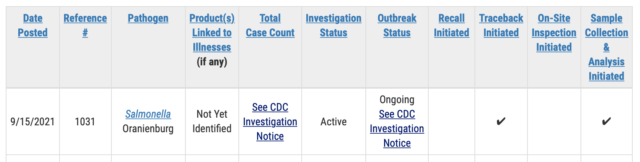
The FDA has not definitively determined what specific food has been the cause of a nationwide Salmonella Oranienburg outbreak – But, cilantro looks suspicious.

Since the last update on September 23, 2021, 140 more people were added to this outbreak. As of September 29, 2021, 419 people infected with the outbreak strain of Salmonella Oranienburg have been reported from 35 states. Illnesses started on dates ranging from June 19, 2021, to September 14, 2021.

Sick people range in age from less than 1 year to 91 years, with a median age of 37, and 56% are female. Of 214 people with information available, 66 (31%) have been hospitalized and no deaths have been reported.

The U.S. Food and Drug Administration today announced that, on behalf of the agency, the U.S. Marshals Service conducted a mass seizure of FDA-regulated spices and food additive products held for sale under insanitary conditions. Specifically, these food products were exposed to widespread rodent infestation as well as other pests, such as live and dead insects.

The seizure was completed today at Lyden Spice Corporation in Miami, Florida. The food products seized at the property include more than 25,000 boxes/bags of bulk ready-to-eat spices and food additives, such as monosodium glutamate, crushed red chili and sesame seeds.

“The FDA plays a critical role in safeguarding the U.S. food supply and helping to ensure that our food is not contaminated at any point during its journey along the supply chain,” said Acting FDA Commissioner Janet Woodcock, M.D. “We take our responsibility seriously and will continue to take action against those who threaten the safety and quality of the products we regulate as a necessary step to protect the public health and the safety of Americans. The widespread insanitary conditions found at the Lyden Spice Corporation are disturbing and won’t be tolerated.”

The U.S. Department of Justice filed the complaint on behalf of the FDA in the U.S. District Court for the Southern District of Florida, alleging that the food products at Lyden Spice Corporation’s facility are adulterated under the Federal Food, Drug, and Cosmetic Act and requesting that the food products be condemned and forfeited to the United States.

The complaint alleges that an inspection of Lyden Spice Corporation that the FDA conducted between June 8 and June 28, 2021, revealed insanitary conditions, including rodent feces too numerous to count on and around pallets with containers of food, evidence of rodent gnawing and urine on food containers, and rodent nesting material between food pallets. The FDA investigators also observed live and dead insects on food packaging, as well as apparent bird droppings in the food storage area.

September 29, 2021: Alianza Nacional de Campesinas welcomes the Biden-Harris administration’s multi-pronged approach to address heat stress, and emphasizes the need to rapidly implement these efforts in a manner that upholds the rights of workers and communities. This cross-agency initiative plans to begin the rulemaking process to create a federal heat standard, provide cooling assistance to households and communities, identify and address disproportionate heat impacts, and enhance heat illness data to improve local preparedness.

As temperatures continue to rise, so do heat related illnesses and injuries for millions of workers, and for Black, Indigenous, and people of color (BIPOC) communities across the country. Due to the worsening effects of climate change, this year has been the hottest on record, and farm and food system workers have been particularly impacted. According to the Center for Disease Control and Prevention (CDC), farmworkers are 20 times more likely to die from heat related illness compared to any other U.S civilian worker. Elevated body temperatures can cause long term health issues for farmworkers, which often include pregnant people and children as young as 12.

Elvira Carvajal, a lead organizer for Alianza Nacional de Campesinas, said, “farmworkers, including farmworker women like myself, deserve better protections and working conditions. We are thankful that this administration is taking our demands seriously and considering the needs of some of the most vulnerable.”

Alianza Nacional de Campesinas has long advocated for the Occupational Safety and Health Administration (OSHA) to adopt and implement a federal heat stress standard to protect farm and food system workers from heat-related injuries and illness. While we welcome the administration’s efforts, we are concerned by the involvement of the Department of Homeland Security (DHS), given the well-documented history of human rights abuses and civil rights violations by DHS, its components, and its private contractors. We call on the Biden-Harris administration to urgently address the dangerous effects of heat stress for workers within and beyond our food systems, and resoundingly reject any effort to expand immigration enforcement and detention operations as part of this initiative or any other.

“We continue to advocate for robust heat stress protections and other safeguards for farmworker women and families, and to move away from the racist, xenophobic detention and deportation systems that harm immigrant and migrant communities,” said María De Luna, Alianza’s National Policy & Advocacy Coordinator.

###

Alianza Nacional de Campesinas, Inc. (Alianza) is the first national farmworker women’s organization in the United States founded and led by farmworker women, and those who hail from farmworker families. A coalition of 15 grassroots, farmworker organizations across 11 states and the District of Columbia, Alianza Nacional de Campesinas advocates for the civil, constitutional, and human rights of our country’s more than 700,000 farmworker women, and other women workers, who form the backbone of our farm and food systems.

As of today 690,152, of our friends and neighbors have died from SARS-CoV-2 (COVID-19).  However, perhaps, at least in the foodborne illness space, there might be some good news?

The CDC reported today on the Decreased Incidence of Infections Caused by Pathogens Transmitted Commonly Through Food During the COVID-19 Pandemic — Foodborne Diseases Active Surveillance Network, 10 U.S. Sites, 2017–2020.

According to the CDC, there has been a 26% decrease in incidence of infections caused by pathogens transmitted commonly through food during 2020 which was the largest single-year variation in incidence during 25 years of FoodNet surveillance.

The questions posed by the CDC in part were answered and in part not.

1.     Did widespread public health interventions implemented to prevent SARS-CoV-2 transmission might have contributed to this decrease? For example, infections associated with international travel decreased markedly after pandemic-related travel restrictions were imposed. Other interventions, such as restaurant closures, might have contributed to declines in incidence.

2.     However, a higher than usual proportion of infections might have been undetected because factors such as changes in health care-seeking behaviors, and broader use of telehealth might have limited the number of stool specimens tested.

3.     Marked decreases in emergency department visits for abdominal pain and other digestive or abdominal signs and symptoms occurred early in the pandemic which would have decreased reports of foodborne illnesses.

4.     Of concern was the proportion of infections resulting in hospitalization increased slightly; possible explanations include disproportionate decreases in health care-seeking among those with milder illness or delayed health care-seeking resulting in more severe illness at the time of clinical presentation.

5.     Changes in clinical and public health laboratory capacity in response to the COVID-19 pandemic might have contributed to observed decreases in culturing. Before 2020, culture of specimens positive for CampylobacterSalmonellaShigella, and Yersinia increased in FoodNet sites, augmented by CDC funding. However, fewer cultures decrease the ability to detect and investigate outbreaks and sporadic cases of emerging pathogens, which relies on sequencing.

6.     The incidences of Salmonella Infantis, Cyclospora, and Yersinia infections, which had previously been increasing, did not change, possibly because of continuing prepandemic factors that led to rising incidences during previous years; the stable incidences despite the pandemic suggest that they might have increased otherwise.

7.     As pandemic-related restrictions are lifted, illnesses caused by these pathogens and by Hadar, the one Salmonella serotype with increasing incidence, should be closely monitored. Rising multidrug resistant Salmonella Infantis infections have been linked to consumption of chicken. Hadar infections have been linked to backyard flocks and to consumption of turkey. USDA-FSIS did not detect a significantly higher percentage of Salmonella Hadar in raw poultry samples collected in 2020 compared with 2017–2019. Typhimurium continued to decline in rank among Salmonella serotypes, dropping to fourth most common for the first time.

The CDC noted that the findings in this report are subject to at least three limitations. First, the pandemic and corresponding public health response make explaining changes in the observed incidences of infections challenging. Second, changes in health care-seeking behaviors and health care delivery during the pandemic likely limited ascertainment of cases. Finally, sites reported decreases that varied over time in the willingness of ill persons to be interviewed and in staff member capacity to conduct case interviews; these factors might have resulted in missing data and recall bias.

Thus far, neither the CDC nor the FDA has implicated a specific food item.

According to the CDC, n September 2, 2021, CDC identified an outbreak of 20 Salmonella Oranienburg infections. Since then, the outbreak has grown rapidly.

As of September 21, 2021, 284 people infected with the outbreak strain of Salmonella Oranienburg have been reported from 29 states. Illnesses started on dates ranging from August 3, 2021 to September 13, 2021.

Sick people range in age from less than 1 year to 89 years, with a median age of 35, and 59% are female. Of 86 people with information available, 26 have been hospitalized and no deaths have been reported.
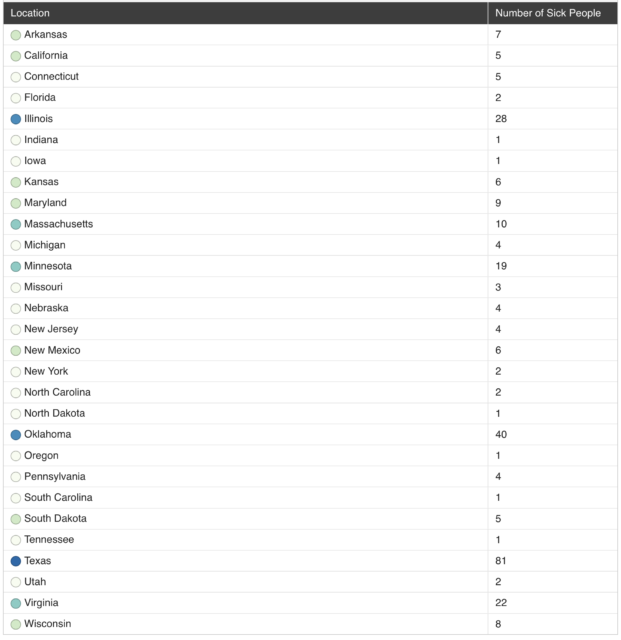
The true number of sick people in an outbreak is likely much higher than the number reported, and the outbreak may not be limited to the states with known illnesses. This is because many people recover without medical care and are not tested for Salmonella. In addition, recent illnesses may not yet be reported as it usually takes 3 to 4 weeks to determine if a sick person is part of an outbreak.

State and local public health officials are interviewing people about the foods they ate in the week before they got sick. CDC is analyzing the data and has not identified a specific food item as a potential source of this outbreak. Several groups of people (“subclusters”) at restaurants in multiple states have been identified. These subclusters are groups of people who do not know one another who ate at the same restaurant and got sick. Investigating these subclusters can sometimes help identify a food item eaten by all of the sick people that could be the source of the outbreak.

However, The National Center for Biotechnology Information (NCBI) shows that of the 275 Salmonella Oranienburg uploaded, 274 Whole Genome Sequence (WGS) “matches” are human and one is cilantro – so, what’s up public health?

In the next version of my life I want to be a CDC EIS officer chasing foodborne diseases in the footsteps of many of my heroes in the past and in the present who I have gotten to know since the Jack-in-the-Box E. coli Outbreak of 1993.

Being an Epi-wannabe, I do tend to look forward to my Morbidity and Mortality Weekly Reports and articles in Emerging Infectious Diseases.  A recent “novel” article caught my eye today – “Novel Outbreak-Associated Food Vehicles, United States” – here is the abstract – it is well worth the read:

Novel outbreak-associated food vehicles (i.e., foods not implicated in past outbreaks) can emerge as a result of evolving pathogens and changing consumption trends. To identify these foods, we examined data from the Centers for Disease Control and Prevention Foodborne Disease Outbreak Surveillance System and found 14,216 reported outbreaks with information on implicated foods. We compared foods implicated in outbreaks during 2007–2016 with those implicated in outbreaks during 1973–2006. We identified 28 novel food vehicles, of which the most common types were fish, nuts, fruits, and vegetables; one third were imported. Compared with other outbreaks, those associated with novel food vehicles were more likely to involve illnesses in multiple states and food recalls and were larger in terms of cases, hospitalizations, and deaths. Two thirds of novel foods did not require cooking after purchase. Prevention efforts targeting novel foods cannot rely solely on consumer education but require industry preventive measures.

I must admit, I blushed a bit to see Marler Clark, Food Poison Journal and Food Safety News cited as sources – I feel I have died and gone, well, perhaps to heaven:

We then conducted a secondary check of additional sources for all foods initially identified as novel (PubMed, online forums [e.g., Food Safety News, Food Poison Journal, and MarlerClark], and media reports). This check served to identify false-positive results from 2 scenarios: 1) the food had been implicated in an outbreak during 1973–2006, but the outbreak had not been reported to FDOSS; or 2) the food had been reported as part of an outbreak occurring during 1973–2006 with a more generic term. We reclassified foods only if the available information was sufficient to follow our criteria (i.e., there were >2 confirmed cases and an identified implicated food). 

CDC, public health and regulatory officials in several states, and the U.S. Food and Drug Administration (FDA) are collecting different types of data to investigate a multistate outbreak of E. coli O121 infections linked to cake mix.

As of July 27, 2021, 16 people infected with the outbreak strain of E. coli O121 have been reported from 12 states. Illnesses started on dates ranging from February 26, 2021 to June 21, 2021.

Sick people range in age from 2 to 73 years, with a median age of 13, and 100% are female. Of 16 people with information available, 7 have been hospitalized. One person has developed a type of kidney failure called hemolytic uremic syndrome (HUS), and no deaths have been reported.

The true number of sick people in an outbreak is likely much higher than the number reported, and the outbreak may not be limited to the states with known illnesses. This is because many people recover without medical care and are not tested for E. coli. In addition, recent illnesses may not yet be reported as it usually takes 3 to 4 weeks to determine if a sick person is part of an outbreak.

State and local public health officials are interviewing people about the foods they ate in the week before they got sick. Of the eight people interviewed, six (75%) reported tasting or eating raw batter made with a cake mix. People reported buying different varieties and brands of cake mix.

Public health investigators are using the PulseNet system to identify illnesses that may be part of this outbreak. CDC PulseNet manages a national database of DNA fingerprints of bacteria that cause foodborne illnesses. DNA fingerprinting is performed on bacteria using a method called whole genome sequencing (WGS). WGS showed that bacteria from sick people’s samples are closely related genetically. This means that people in this outbreak likely got sick from the same food.

FDA is conducting a traceback investigation using purchase records from locations where sick people bought cake mix to try to determine a common cake mix brand or production facility.

CDC advises people not to eat raw cake batter, whether made from a mix or homemade. Eating raw cake batter can make you sick. Raw cake batter can contain harmful bacteria. Bacteria are killed only when raw batter is baked or cooked.

Follow safe food handling practices when you are baking and cooking with cake mixes, flour, and other raw ingredients such as eggs.