Last week the USDA Food Safety and Inspection Service (FSIS) announced a recall of ground turkey products due to “possible” Salmonella contamination. According to the press release, “Cargill Meat Solutions Corporation, a Springdale, Ark. establishment, is recalling approximately 36 million pounds of ground turkey products that may be contaminated with a multi-drug resistant strain of Salmonella Heidelberg.”

The release goes on: “This recall follows a July 29, 2011 FSIS Public Health Alert that was initiated due to concerns about illnesses caused by Salmonella Heidelberg that may be associated with use and consumption of ground turkey. A total of 79 persons infected with the outbreak strain of Salmonella Heidelberg have been reported from 26 states between March 1 and August 3, 2011. The outbreak strain of Salmonella Heidelberg is resistant to several commonly prescribed antibiotics.”

This recall was, for me, surprising but positive news — surprising, and somewhat inexplicable, given the USDA’s long-held position that Salmonella is not an adulterant per se in raw meat. You see, the meat industry got a court to invalidate Salmonella performance standards that the USDA tried to implement as part of the Pathogen Reduction, HACCP regulations adopted in 1996.

So when I read about this recall, my first thought was to wonder why Cargill agreed to it. (Remember: USDA’s Food Safety and Inspection Service lacks the statutory authority to compel a recall.) And my second thought was: I wonder if the meat industry will sue the USDA to try to prevent the agency from seeking a recall in the future based on possible Salmonella contamination.

I obviously cannot answer either of these questions. But I can provide some useful background information about why this particular recall is so surprising, and so inexplicable. (And, by the way, by inexplicable I mean it is nearly impossible to explain how FSIS could take this action in light of 25 years worth of policy and court decisions that would appear to suggest it has no authority to do what it did. The recall is certainly NOT inexplicable from a public health and safety perspective, which is certainly ironic given the fact that the FSIS has the term “safety” in its name, and doing something in favor of safety should not be inexplicable.)

So now on to some history:

In 1971, the American Public Health Association (APHA) sued the USDA on the grounds that its mark of inspection (“inspected for wholesomeness”) was misleading because, even though the USDA had put its stamp of approval on meat — literally — it did not, for example, test the meat for bacteria. Moreover, APHA argued that raw meat was commonly contaminated with Salmonella, which posed a risk to the public health. According to APHA, the USDA should instead require that meat carry both a warning label and cooking instructions. The USDA opposed the APHA, helped ably (and predictably) by the meat industry. As quoted by Marion Nestle in her great book, “Safe Food,” the USDA’s position was that, given how many foods are contaminated with Salmonella, “it would be unjustified to single out the meat industry and ask that the [USDA] require it to identify its raw products as being hazardous to health.” (Note to readers: No, really, I am not making this up.)

In 1974, the D.C. Circuit Court of Appeals upheld the position of the USDA and the meat industry, doing so in a way that was as nonsensical as it was sexist. The court stated that: “The presence of salmonellae on meat does not constitute adulteration within this definition [of ‘adulterated,’ provided in 21 U.S.C. ¬ß 601 (m)]….As it said in its letter of August 18, 1971 ‘the American consumer knows that raw meat and poultry are not sterile and, if handled improperly, perhaps could cause illness.’ In other words, American housewives and cooks normally are not ignorant or stupid and their methods of preparing and cooking of food do not ordinarily result in salmonellosis.’” APHA v. Butz, 511 F.2d 331, 334 (1974).

This remained the position of the USDA and the meat industry until 1994 when, in an act of both commonsense and bravado, Michael Taylor, then FSIS Administrator, announced that E. coli O157:H7 would be deemed an adulterant in raw ground beef. The Agency did not, however, change its tune with regard to any other pathogens, especially Salmonella. Indeed, in 1999, when FSIS announced its inane distinction between E. coli O157:H7 in “intact” meat versus “non-intact” meat, the Agency continued to focus on how a given meat was “customarily cooked” as a chief determinant of whether the pathogen must be treated as an adulterant. Thus, for example, because it decided that “intact steaks and roasts are customarily cooked in a manner that ensures that these products are not contaminated with E. coli O157:H7,” there was no need to treat this deadly pathogen as an adulterant on intact cuts of meat. Of course, this FSIS policy is also one that appears to have been silently jettisoned by the Agency of late.

The Agency’s position on Salmonella and meat came back to haunt it in a big way when FSIS tried to shut down Supreme Beef Processors, Inc. for repeatedly failing Salmonella performance standards that, according to the Agency, were proof that the ground beef being made there was being processed under “insanitary conditions.” Supreme Beef sued the USDA and not only won an injunction, but it succeeded in having the Salmonella regulations struck down as being “beyond the authority granted the Secretary [of the USDA] by the Federal Meat Inspection Act.” Supreme Beef v. USDA, 275 F.3d 432, 434 (5th Cir. 2001).

Explaining its holding, the Court wrote:

The difficulty in this case arises, in part, because Salmonella, present in a substantial proportion of meat and poultry products, is not an adulterant per se, meaning its presence does not require the USDA to refuse to stamp such meat “inspected and passed.” This is because normal cooking practices for meat and poultry destroy the Salmonella organism, and therefore the presence of Salmonella in meat products does not render them “injurious to health” for purposes under the law. Salmonella-infected beef is thus routinely labeled “inspected and passed” by USDA inspectors and is legal to sell to the consumer.

Not surprisingly, the court in this case was quick to cite the decision in APHA v. Butz, and to note that even now the “USDA agrees that Salmonella is not an adulterant per se.”

In my view, the Supreme Beef decision is poorly reasoned and ill-informed. (For example, it is impossible for meat to be “infected” with Salmonella; the proper term here is “contaminated.”) But the real lesson of Supreme Beef is that the USDA was, and continues to be, an Agency that is unable to decide whose side it is on. Sometimes it puts on its public safety hat, and sometimes — actually, most often — it puts on its pro-meat industry hat. And, unfortunately, these roles are too often contradictory. That is why USDA policy, when it comes to meat safety, is also too often contradictory.

So how does the USDA square last week’s recall of Salmonella-contaminated meat with the last 25 years of Agency policy on meat adulteration standards? It cannot. But let us hope that if the meat industry decides to sue to scuttle what appears to be a new and better policy on Salmonella in meat, that this time the USDA decides to stand with the public on the side of meat safety.

Or, perhaps it is just time for the FSIS to take the position that all pathogens in meat that can kill are adulterants.  Let the meat industry sue you.  I know a good lawyer to defend you.

Or, as I have said before:

Personally, as I said to the Los Angeles Times some time ago, “I think that anything that can poison or kill a person should be listed as an adulterant [in food].”

Ignoring Salmonella in meat makes little, if any, sense. Even after the Court’s twisted opinion in Supreme Beef v. USDA, where it found Salmonella “not an adulterant per se, meaning its presence does not require the USDA to refuse to stamp such meat ‘inspected and passed’, ” our government’s failure to confront the reality of Salmonella, especially antibiotic-resistant Salmonella, is inexcusable.

The Wisconsin Supreme Court in Kriefall v Excel called it as it saw it:

The E. coli strain that killed Brianna and made the others sick is a “deleterious substance which may render [meat] injurious to health.” There is no dispute about this. Thus, under the first part of 21 U.S.C. § 601(m)(1), meat that either “bears or contains” E. coli O157:H7 (the “deleterious substance”) is “adulterated.” That E. coli O157:H7 contamination can be rendered non-“injurious to health” by cooking thoroughly, as discussed below, does not negate this; Congress used the phrase “may render,” not “in every circumstance renders.” Moreover, if the E. coli bacteria is not considered to be “an added substance,” because it comes from some of the animals themselves and is not either applied or supplied during the slaughtering process (although we do not decide this), it cannot be said that the E. coli strain “does not ordinarily render [the meat on or in which it appears] injurious to health.” Accordingly, meat contaminated by E. coli O157:H7 is also “adulterated” under the second part of § 601(m)(1).

Now, why would Salmonella be different? According to the CDC, it is estimated that 1.4 million cases of salmonellosis occur each year in the United States. Of those cases, 95 percent are related to foodborne causes. Approximately 220 of each 1,000 cases result in hospitalization, and 8 of every 1,000 cases result in death. About 500 to 1,000 deaths – 31 percent of all food-related deaths – are caused by Salmonella infections each year.

So, where do we stand with the existing USDA/FSIS law on adulteration?  Here is the law:

21 U.S.C. § 601(m)(4) – SUBCHAPTER I – INSPECTION REQUIREMENTS; ADULTERATION AND MISBRANDING – CHAPTER 12 – MEAT INSPECTION – TITLE 21—FOOD AND DRUGS

(m) The term “adulterated” shall apply to any carcass, part thereof, meat or meat food product under one or more of the following circumstances:

(1) if it bears or contains any poisonous or deleterious substance which may render it injurious to health; but in case the substance is not an added substance, such article shall not be considered adulterated under this clause if the quantity of such substance in or on such article does not ordinarily render it injurious to health; …

(3) if it consists in whole or in part of any filthyputrid, or decomposed substance or is for any other reason unsound, unhealthfulunwholesome, or otherwise unfit for human food;

(4) if it has been prepared, packed, or held under insanitary conditions whereby it may have become contaminated with filth, or whereby it may have been rendered injurious to health; …

Hmmm. It is hard to read the above and not think that the words in bold equate to all E. coli and Salmonella — frankly, all pathogens in food. I know, I am just a lawyer, but don’t ya think that when food with animal feces (and a dash of E. coli O157:H7) in it is considered an adulterant, that other animal feces (with dashes of other pathogens, like Salmonella) in them, should be considered adulterated too?  But, hey, that is just me. Another odd governmental fact is that the FDA does not seem to make a distinction between pathogens it considers adulterants or not. FDA’s enabling legislation – Sec. 402. [21 USC §342] of the Food, Drug & Cosmetic Act also defines “Adulterated Food” as food that is: 

(a) Poisonous, insanitary, or deleterious ingredients.

(1) If it bears or contains any poisonous or deleterious substance which may render it injurious to health; but in case the substance is not an added substance such food shall not be considered adulterated under this clause if the quantity of such substance in such food does not ordinarily render it injurious to health;

(2) If it bears or contains any added poisonous or added deleterious substance … that is unsafe within the meaning of section 406;

(3) if it consists in whole or in part of any filthy, putrid, or decomposed substance, or if it is otherwise unfit for food;

(4) if it has been prepared, packed, or held under insanitary conditions whereby it may have become contaminated with filth, or whereby it may have been rendered injurious to health …

It would be interesting, and perhaps entertaining, to have House and Senate hearings focusing on what should and should not be considered adulterants in our food. I can see panels of scientists from various fields, FDA, USDA and FSIS officials, beef and produce industry representatives, and consumers discussing this. I would pay to watch it.

Being in Washing D. C. for a week made me wonder – what the hell have we been doing for the last decade?

It is time to take the gloves off – FSIS, the petition to deem 31 Salmonella as adulterants is long past due – FSIS-2020-0007-0001_attachment_1

The alternative is a lawsuit that you will lose – Letter to Ms. Eskin 11.12.21 – FINAL

Well, my flight to DC was delayed – no pilots – and this press release landed in my inbox.  I have known Dr, Esteban for a long time and look forward to his leadership.

WASHINGTON, Nov. 12, 2021 — “Dr. Esteban has a deep understanding of USDA’s commitment to protect the health of the public by providing food safety. Having held several leadership roles in USDA’s Food Safety and Inspection Service (FSIS), he has a proven, and extensive, track record on this key issue.

Dr. Esteban started his tenure at USDA FSIS in 2001 and held the roles of Laboratory Director for the Western Laboratory, Scientific Advisor for Laboratory Services and Research Coordination, and Executive Associate for Laboratory Services. In 2018, he was appointed Chief Scientist of the Food Safety and Inspection Service. In his role, Dr. Esteban provides scientific advice to support Agency policies including the disciplines of microbiology, chemistry, and pathology. Prior to joining USDA, Dr. Esteban worked at the Centers for Disease Control and Prevention as an Epidemic Intelligence Service Officer, Staff Epidemiologist, and Assistant Director of the Food Safety Office.

He currently serves as the Chair for the Codex Alimentarius Commission Committee on Food Hygiene, the committee where international food hygiene standards are defined for international trade. He is also currently vice president of the International Association for Food Protection (IAFP).

Trained as a veterinarian in Mexico, Dr. Esteban supplemented his training with an MBA, a master’s degree in Preventive Veterinary Medicine, and a PhD in Epidemiology from University of California, Davis.

As we continue to push forward our commitment to create a safe, sustainable, competitive U.S. food and fiber system, Dr. Esteban’s leadership will be invaluable to our team.”

Dr. J. Emilio Esteban was appointed as Chief Scientist of the U.S. Department of Agriculture Food Safety and Inspection Service (FSIS) in August 2018. In this capacity, Dr. Esteban serves as the primary scientific advisor on matters of public health and food safety that affect the mission of the Agency, with primary responsibility for scientific initiatives within the Office of Public Health Science (OPHS). Dr. Esteban’s efforts directly support FSIS’ Strategic Goals 1: Prevent Foodborne Illness and Protect Public Health, and 2: Modernize Inspection Systems, Policies, and the Use of Scientific Approaches.

In 2002, Dr. Esteban joined OPHS as the Director of the Western Laboratory. In this role, he directed the implementation of the sampling program and was responsible for the physical plant, equipment and personnel infrastructure. In 2008, he was appointed as the FSIS Science Advisor for Laboratory Services, where he harmonized the operation of all three FSIS laboratories, maintained operations to meet with the ISO17025 standard and coordinated emergency response.

Prior to joining FSIS, Dr. Esteban worked in several positions at the Centers for Disease Control and Prevention (CDC). From 1994 to 2002, he was as an Epidemic Intelligence Service Officer; a Staff Epidemiologist in the National Center for Environmental Health; and an Assistant Director for the CDC Food Safety Office.

He received his Doctorate in Veterinary Medicine from Mexico’s National University, a Master of Business Administration Degree from the Panamerican Institute, and a Master of Preventive Veterinary Medicine Degree, as well as a Doctorate in Epidemiology from the University of California at Davis.

Alison Graham and the Roanoke Times told a story of an unnecessary hepatitis A outbreak.  Thanks for doing the story.

The Vests spent the last few weeks of their 40-year marriage in and out of the hospital.

At first, Larry Vest, 77, ran a low fever and felt tired. After a few tests at his doctor, he went to the emergency room and was diagnosed with hepatitis A. He stayed at Carilion Roanoke Memorial Hospital for 19 days while his wife Dianne, 78, visited him and cared for their home.

When Larry left the hospital, he spent one day with his wife before she started to experience the same symptoms and left for the hospital in an ambulance.

She went into a coma-like state within a few days and died Oct. 26.

“The family survived the pandemic with no major issues only to be devastated by a public health issue that could have just been avoided,” Dianne’s son Tim O’Leary said.

The Vests are just one local family affected by the recent hepatitis A outbreak in the Roanoke Valley, which has been linked to three Famous Anthony’s restaurants — on Grandin Road Extension, Williamson Road and Crystal Spring Avenue.

An employee who worked at all three locations tested positive for the virus. So far, there have been 52 confirmed cases, 31 hospitalizations and three deaths. James Hamlin, a Roanoke County man, died Oct. 8 from hepatitis A complications.

Like the Hamlins, Larry and Dianne Vest ate at Famous Anthony’s frequently. They visited the Williamson Road location, across the street from their church, two times during the period the employee was contagious.

Larry is currently recovering and doing well, but O’Leary said the family will be forever changed.

“What we had, two months ago, were two healthy parents enjoying their life together and doing the things they like to do,” he said. “And that all came to a screeching halt because someone did not want to practice basic hygiene.”

Disease spreads

Hepatitis A is a virus that causes liver inflammation, which can prevent the organ from functioning normally.

The liver is responsible for turning food and drink into energy and nutrients. It also removes harmful substances from the blood and helps fight off infections.

According to the American Liver Foundation, hepatitis A is most commonly spread by not washing hands before preparing or eating food or not washing hands after using the bathroom or changing a diaper.

The virus is spread through fecal to oral transmission, which means a person ingests fecal matter, usually in microscopic amounts invisible to the eye. People can also contract the virus from using drugs with others, certain types of sexual contact or caring for someone who has the virus.

When someone contracts hepatitis A, they can experience fatigue, nausea, vomiting, abdominal pain, clay-colored bowel movements, loss of appetite, low grade fever, dark urine, joint pain, intense itching and jaundice, or yellowing of the skin and eyes.

Symptoms can take weeks to develop after the initial exposure, which means people sometimes don’t know they are contagious or have the virus before spreading it. Roanoke City and Alleghany Health Districts director Cynthia Morrow said because of how long it takes for patients to show symptoms, the infectious period is often over before the health department is aware that someone is infected.

That happened in the case of Famous Anthony’s. Morrow said it’s hard to know for certain where any one individual was infected outside of an outbreak, but the department had no reason to believe that wherever the employee was initially exposed is a public threat.

She said once the department suspected the restaurant could be implicated in the transmission of the virus, officials completed an inspection. She said there was nothing that raised any alarms or would require a closure or cleaning.

Attorney Sean Workowski issued the following statement on behalf of Famous Anthony’s: “The Famous Anthony’s staff and employees wish to express their most heartfelt concern and sympathy to all the families and individuals in our community that have been affected by this unforeseen, lamentable event. Upon notification by the Roanoke and Alleghany Health District officials of a possible hepatitis A exposure … we have cooperated fully with the health department’s investigation and adhered to all recommendations to ensure the continued safe and healthy operation of all locations for our many loyal customers.”

Famous Anthony’s attorneys declined a request to interview the restaurant’s owner or answer any further questions due to pending litigation.

Hepatitis A is vaccine preventable. The U.S. Food and Drug Administration has licensed two hepatitis A vaccines and one combination vaccine that protects against both Hepatitis A and B. The first vaccine was licensed in 1995, and since then, rates of hepatitis A have declined dramatically in the U.S. Since 2006, the hepatitis A vaccine has been recommended for all children at age one and is sometimes required by schools. But this means many adults have not been vaccinated.

The Centers for Disease Control and Prevention identified unprecedented widespread outbreaks of hepatitis A in the U.S. in 2016. Since then, more than 40,000 cases have been reported and at least 400 deaths. Many of the cases have been among people who are the most at risk, including those who use drugs or people who are experiencing homelessness.

Morrow said the district has seen an uptick in vaccines since the local outbreak and vaccinated as many as 45 people in one day.

O’Leary said when his stepfather Larry Vest went to the hospital with symptoms, no one told his mother she should get vaccinated or asked if she was potentially exposed. He said he wished someone had asked her questions or told her to see a doctor. But soon enough, it was too late.

“This family has been wrecked,” he said. “It’s simple handwashing that has caused devastation to at least 50 families.”

Outbreaks across Virginia

Mindy Perdue, 40, made many memories at Famous Anthony’s. She and her parents used to eat at the Williamson Road location every Saturday before she went bowling. Occasionally, they hosted family gatherings there and on other days, she visited the restaurant with her husband of 13 years.

In August, she ordered a gravy biscuit combo from the Famous Anthony’s on Grandin Road Extension. Within a few weeks, a migraine and fever set in. She started to throw up and went to the emergency room. They suspected it might be COVID-19, gave her fluids and sent her home.

Eventually, she threw up again and saw blood. She went to work and her temperature hit 100 degrees. She went home and spent a few days resting, but when she returned, her coworkers said she looked yellow. She drove herself straight to the emergency room and spent four days in the hospital.

Perdue became the first person to file a lawsuit with Seattle attorney Bill Marler, who is now representing 25 families, including the Vests and the Hamlins.

Perdue said she was out of work for weeks and has hospital and lab bills stacking up that she needs to pay. She has since returned to work, but still experiences residual pain and is waiting for her body to return to normal.

“I didn’t have to get sick,” Perdue said. “I almost died because of it. It changed my life and it still has.”

Marler has represented hundreds of people across the country in hepatitis A outbreaks. He represented about 50 people, some from Virginia, in an outbreak linked to strawberries at a Tropical Smoothie Café in 2016. The frozen strawberries, imported from Egypt, infected 143 people in nine states. More than 50 were hospitalized, but there were no deaths, according to the Centers for Disease Control and Prevention. Virginia accounted for the majority of cases with 109 people infected.

The Mount Rogers Health District, which includes Galax and Carroll, Grayson, Bland and Wythe counties in southwestern Virginia, has reported the most hepatitis A cases in the state — more than 150 cases since January 2019.

In 2019, an employee at Cheddar’s Scratch Kitchen in Bristol was diagnosed with hepatitis A. And in 2020, an employee at Taco Bell in Chilhowie was also diagnosed with the virus.

Breanne Forbes Hubbard, population health manager at the health district, said those two restaurant-related outbreaks caused many cases in her district, but there have also been increases among the substance use community. The area has been hit hard by the opioid epidemic and the department has worked to do contact tracing in that population.

The health district offered vaccine clinics and worked with local restaurants on proper protocols to stop the spread.

She said food service workers are not at a greater risk of contracting the virus, but they are at a higher risk of spreading it. She said handwashing is the best way to stop the spread beyond vaccination.

“We were telling people you shouldn’t eat at a restaurant if you’re not vaccinated against hepatitis A,” she said. “All it takes is one time of someone not washing their hands well.”

Slow recovery

LouAnn and Harvey Howell set out on a mission to get healthier. They joined Weight Watchers and started going to Famous Anthony’s every week to order salads.

They ate at the restaurant seven Fridays in a row — three times during the period when the employee was contagious. LouAnn ordered a taco salad and Harvey ordered a chef salad.

In mid-September, Harvey ran a high fever and felt incredibly sick. He went to an urgent care clinic and they gave him a COVID-19 test, which came back negative. A few days later, his fever still raged on and he started dry heaving. He called his wife to come home from work and they went to the hospital.

By then, Harvey’s eyes and skin had turned yellow and the hospital staff issued a sepsis alert and rushed him into the emergency room, he said. Within a few hours, they had diagnosed him with hepatitis A and made plans to transfer him to another hospital where he could get a liver transplant.

“There’s not much I could focus on, but when I heard that it scared me,” he said. “That’s when I realized this is really serious.”

For days, Harvey hallucinated. He insisted to the doctors that he had previously had a lung transplant, which is not true. And in one case, he thought he saw a bug on the wall that wasn’t there and was adamant when his wife and the nurses told him he was wrong.

His wife LouAnn packed a bag and kept it in her car in case he was transferred to a different hospital for an organ transplant. But eventually, he started to stabilize and a transplant was no longer necessary. He spent a week in the hospital before he returned home.

Since then, his recovery has been slow. Even small tasks take all of his energy and he can hardly eat anything. He’s on short term disability while he waits out the symptoms and for his liver to fully recover. He lost almost 40 pounds in a matter of weeks.

“I feel like I’ve been sick for seven months, not seven weeks,” he said. “It’s incredibly depressing and weighs heavy on you. You think about all the stuff you’re supposed to be doing, need to be doing, but you can’t do any of it.”

His doctor said he might have long-term scarring or damage to his liver, but he will eventually be able to carry on a normal life. LouAnn said she spends most of her days making sure he continues to eat, stay hydrated and gets to his doctor appointments.

Every two weeks, he goes to get blood drawn and they hold their breath waiting for the results. They’ve been told that a full recovery could take six to nine months.

“I’m nothing like I was before this,” Harvey said. “It’s just gonna be different from now on. Lord willing I will recover and get back to some semblance of life someday.”

The National Center for Biotechnology Information (NCBI) shows:

Seafood

168 Isolates (155 clinical, 13 “seafood manufacturer”)

Distance between selected isolates: minimum = 0 SNPs, maximum = 4 SNPs, average = 1 SNPs

Target creation date range: 2020-07-07 to 2021-11-08

seafood 11_10_2021 – Full Tree

Onions

872 isolates (871 clinical, 1 “mixed produce”)

Group: PDG000000002.2326

Cluster: PDS000094913.38

Distance between selected isolates: minimum = 0 SNPs, maximum = 8 SNPs, average = 1 SNPs

Target creation date range: 2021-08-20 to 2021-11-08

mixed produce – Full Tree

This afternoon, the Roanoke City and Alleghany Health Districts (RCAHD) announced that RCAHD has identified a total of 50 confirmed primary cases and 2 secondary cases.  There have been at least 31 hospitalizations and unfortunately 3 deaths.

RCAHD stresses that hepatitis A is a preventable disease. RCAHD urges everyone to consistently practice good hand washing and to consider getting vaccinated, especially if they fall into a high-risk population.

Marler Clark is representing 27 individuals and the families of 2 who died.

Hepatitis A:  Marler Clark, The Food Safety Law Firm, is the nation’s leading law firm representing victims of Hepatitis A outbreaks. The Hepatitis A lawyers of Marler Clark have represented thousands of victims of Hepatitis A and other foodborne illness outbreaks and have recovered over $800 million for clients.  Marler Clark is the only law firm in the nation with a practice focused exclusively on foodborne illness litigation.  Our Hepatitis A lawyers have litigated Hepatitis A cases stemming from outbreaks traced to a variety of sources, such as green onions, lettuce and restaurant food.  The law firm has brought Hepatitis A lawsuits against such companies as Costco, Subway, McDonald’s, Red Robin, Chipotle, Quiznos and Carl’s Jr.  We proudly represented the family of Donald Rockwell, who died after consuming Hepatitis A tainted food and Richard Miller, who required a liver transplant after eating food at a Chi-Chi’s restaurant.

If you or a family member became ill with a Hepatitis A infection after consuming food and you’re interested in pursuing a legal claim, contact the Marler Clark Hepatitis A attorneys for a free case evaluation.

Additional Resources

I will spare you the list of hepatitis A cases that I have been involved with since 1998 when I represented 30 people exposed in a Seattle, Washington Subway restaurant, including one child who suffered acute liver failure requiring an emergency liver transplant.

There have been dozens in the last 23 years, many with tragic consequences.  Yet, here we are once again.

Now, according to Roanoke Virginia health officials, as of today at least three people are dead in connection with an outbreak of hepatitis A that has been linked to the Famous Anthony’s restaurant chain. Health officials have also confirmed at least 49 cases of the illness, with at least 31 people requiring hospitalization for acute liver failure.  There will likely be additional, secondary cases, in those who cared for close family members.

Health officials have confirmed that one person with hepatitis A worked at three separate Roanoke locations of the Famous Anthony’s chain and exposed patrons to this human fecal virus.

Hepatitis A is considered preventable via good personal hygiene practices such as thorough handwashing and glove wearing. Hepatitis A is the only vaccine preventable foodborne illness. Hepatitis A vaccines are available, and nationwide are given out free by local health departments, or at a cost of less than $100.

The first known fatality in the Famous Anthony’s outbreak was identified as Roanoke County resident James Hamlin, 75, who died October 8th from hepatitis A complications after eating at one of the Famous Anthony’s. I represent James’s widow and the Hamlin family. Two more deaths were confirmed Friday. One of the families will be speaking publicly in the following days.

James Hamlin’s family told local news that the U.S. Army veteran, who served as a Green Beret during the Vietnam War era, seemed strong and healthy until suddenly feeling nauseous and fatigued one day in August. After his symptoms persisted, he was admitted to a hospital and died 10 days later of acute liver failure.

He survived Vietnam but dies due to exposure to an unvaccinated food handler who did not properly was his or her hands or wear gloves.

Here is what the CDC continues to say about vaccinating food handlers:

Why does CDC not recommend all food handlers be vaccinated if an infected food handler can spread disease during outbreaks?

CDC does not recommend vaccinating all food handlers because doing so would not prevent or stop the ongoing outbreaks primarily affecting individuals who report using or injecting drugs and people experiencing homelessness. Food handlers are not at increased risk for hepatitis A because of their occupation. During ongoing outbreaks, transmission from food handlers to restaurant patrons has been extremely rare because standard sanitation practices of food handlers help prevent the spread of the virus. Individuals who live in a household with an infected person or who participate in risk behaviors previously described are at greater risk for hepatitis A infection.

CDC, you miss the point, granted food service workers are not more at risk of getting hepatitis A because of their occupation, but they are a risk for spreading it to customers. Also, food service are low paid jobs that certainly have the likelihood of being filled by people who are immigrants, where hepatitis A might be endemic, or people who have been recently homeless.

What should I do if I have eaten at a restaurant that has reportedly had a hepatitis A-infected food handler?

If you have any questions about potential exposure to hepatitis A, call your health professional or your local or state health department who can help you to learn if you were recently exposed to hepatitis A virus at that restaurant, have not been vaccinated against hepatitis A, and might benefit from either hepatitis A vaccine or an injection of immune globulin. However, the vaccine or immune globulin are only effective if given within the first 2 weeks after exposure. A health professional can decide what is best based on your age and overall health.

The problem here is that the Famous Anthony’s employee worked while infectious during the last half of August.  There was no announcement that there had been a risk of exposure until the end of September – two weeks too late for vaccine or immune globulin to be effective.

I will also spare you the numerous times I pleaded with the CDC, local and state health officials, and restaurants to require hepatitis A vaccinations for food handlers.  Let’s be clear, had the food handler who exposed patrons of three Famous Anthony’s restaurants been vaccinated against hepatitis A, we would not be having this discussion, and I would not be representing over two dozen people hospitalized and two that lost loved ones.  I would also not be suing Famous Anthony’s which will likely cost millions of dollars and/or drive them into bankruptcy.

My guess is that the cost of a hepatitis A vaccine looks very appetizing at this point?

Thank you ProPublica for the searing story about industry’s and government’s failures: “America’s Food Safety System Failed to Stop a Salmonella Epidemic. It’s Still Making People Sick”

I filed the petition more than a year ago, on Jan. 19, 2020, with USDA’s Food Safety and Inspection Service (FSIS), on behalf of Rick Schiller, Steven Romes, the Porter family, Food & Water Watch, Consumer Federation of America, and Consumer Reports.

The petition asks FSIS to declare the following Salmonella “outbreak serotypes” as per se contaminants in meat and poultry products:

Salmonella Agona, Anatum, Berta, Blockely, Braenderup, Derby, Dublin, Enteritidis, Hadar, Heidelberg, I 4,[5],12:i:-, Infantis, Javiana, Litchfield, Mbandaka, Mississippi, Montevideo, Muenchen, Newport, Oranienburg, Panama, Poona, Reading, Saintpaul, Sandiego, Schwarzengrund, Senftenberg, Stanley, Thompson, Typhi, and Typhimurium.

Reducing salmonellosis from meat and poultry “demands bold action” beyond that yet taken by FSIS. Salmonella is a leading cause of foodborne illness in the United States, causing 1.35 million illnesses, 26,500 hospitalizations, 130 outbreaks, and 420 deaths each year.

Here is the original petition – FSIS-2020-0007-0001_attachment_1

Ya gotta love science.

The National Center for Biotechnology Information (NCBI) shows:

Sushi

163 Isolates (150 clinical, 13 “environmental swab from seafood manufacturer”)

Distance between selected isolates: minimum = 0 SNPs, maximum = 5 SNPs, average = 1 SNPs

Target creation date range: 2019-01-28 to 2021-10-15

The sushi outbreak cluster is within a much larger cluster of 4,457 isolates

Group  PDG000000002.2320

Cluster  PDS000032705.704

Onions

798 isolates (797 clinical, 1 “mixed produce”)

Group PDG000000002.2320

Cluster  PDS000094913.33

Distance between selected isolates: minimum = 0 SNPs, maximum = 8 SNPs, average = 1 SNPs

Target creation date range: 2021-08-20 to 2021-10-26

49 cases and 1 secondary case of Hepatitis-A have been connected to an outbreak that started with the diagnosis of a restaurant employee.  There has been at least 31 hospitalized and 1 reported death.  Unfortunately, another death will be reported shortly.  We are now representing 23 Roanoke residents.

But according to the Roanoke City and Alleghany Health Districts director, Dr. Cynthia Morrow, the incubation window ended back on October 15, and there have not been any new cases since that date.

There is no ongoing concern about eating at Famous Anthony’s restaurant locations, according to Dr. Cynthia Morrow with the Roanoke City and Alleghany Health Districts, saying the exposure period has passed.

The Virginia Department of Health alerted the community last week to watch for symptoms after the diagnosis. Morrow says the restaurant chain has cooperated with health investigators.

The employee worked at three locations, at 4913 Grandin Road, 6499 Williamson Road and Crystal Spring Avenue.

Anyone who is not vaccinated against hepatitis A and was at any of those locations between August 10 and 27 could have been exposed and should watch for the following symptoms, according to VDH:

· jaundice: yellowing of the skin or the eyes,
· fever,
· fatigue,
· loss of appetite,
· nausea,
· vomiting,
· abdominal pain,
· dark urine, or
· light-colored stools.

McKinley Strother’s report from WSLS story today was stunning:

It was an uneventful breakfast trip that changed a Roanoke County family forever. James Hamlin and his wife of 55 years ate one of their favorite local breakfast spots: Famous Anthony’s.

“She has a hard time cooking now and my dad liked to treat her,” said daughter Dana Heston. “It was the one thing they would go do together.”

No one would have imagined it would become one of his last meals.

“He said that he hadn’t been eating much, so he wasn’t feeling well,” explained Heston.

Both Hamlin and his wife fell ill, later testing positive for hepatitis A.

Heston described her father’s symptoms as “nausea, fatigue, and loss of appetite.” She says no one knew he was sick at first because he wasn’t one to complain.

She knew it was serious when he suggested going to the emergency room. At the time, it was assumed he likely caught a cold from his grandchildren, whom he often drove to their various activities and had recently been sick.

After a one-night stay in the ER at Carilion Roanoke Memorial Hospital, Hamlin was sent home. The doctors advised him to see his primary care physician, Heston says. However, Hamlin’s doctor wasn’t available for another week. Hamlin and his family knew he needed medical attention sooner.

A few days later he returned to the emergency room.

“I was working and my mom called and she’s like, ‘Dana, we have to take dad in,’” said Heston.

After about 10 days in the hospital, the 75-year-old husband, father, runner, lover of his grandchildren and his country as a veteran died Oct. 8 from hepatitis A complications.

The Roanoke City & Alleghany Health District and Heston, Hamlin’s daughter, linked his death to the hepatitis A outbreak at three Famous Anthony’s locations on Grandin Road, Williamson Road, and Crystal Spring Avenue. An employee who worked at the three locations was diagnosed with the virus, according to the health district.

As of Tuesday, the health department says 49 cases have been associated with this outbreak; 31 people have been hospitalized and one has died.

“None of my family wants to eat out again,” stated Heston. “Everybody is scared to go anywhere because you never know what’s going to happen.”

Heston says her final conversation with her dad was about getting his car inspected. Busy with work, she was unable to visit that evening. The next morning he could no longer speak.

Despite his age, Heston says her father was healthy.

“He was a 75-year-old man, but he was at the gym at least three times a week,” said Heston. He would lift weights and was a marathoner. He had no serious medical conditions.

Heston says her mom continues to recover but is on the mend, saying “She’s finally feeling better. Last week I was scared we were going to lose her too. She was very sick.”

“COVID is not the only dangerous thing out there,” said Heston. “We all have a responsibility to take care of each other, especially in foodservice.”

The family has hired attorney Bill Marler, who represents several families affected by the outbreak. A Franklin County woman is suing the Roanoke restaurant chain, claiming she’s a part of its recent hepatitis A outbreak.

Heston encourages simple practices like washing your hands and sanitizing workstations and getting vaccinated.

The Roanoke Times Alison Graham wrote an earlier story:
Roanoke County residents James Hamlin and his wife Victoria ate breakfast together at Famous Anthony’s a couple of times every month. After 55 years of marriage, they enjoyed spending time together at their favorite breakfast place.

But after their most recent visit in August, they both fell ill.

James Hamlin felt nauseous and tired, but he wasn’t one to complain about being sick. He assumed he caught a cold from one of his grandchildren, whom he often drove to sports practices and music recitals.

Soon enough, he asked his family to take him to the emergency room at Carilion Roanoke Memorial Hospital. He was sent home, but his family took him back a few days later when he started to feel worse. After about 10 days in the hospital, the 75-year-old died Oct. 8 from hepatitis A complications.

His daughter, Dana Heston, said the Roanoke City and Alleghany Health Districts have linked Hamlin’s death to a hepatitis A outbreak at three Famous Anthony’s locations — on Grandin Road, Crystal Spring Avenue and Williamson Road. An employee who worked at all three locations was diagnosed with the virus.

As of Wednesday, the health department identified 44 cases with at least 26 hospitalizations and one death.

Heston, of Cave Spring, said her father was a strong and healthy man. He worked out three times per week — lifting weights, riding a stationary bike and walking. He did not have any serious medical conditions.

“The hepatitis A caused his death,” she said. “He had no idea it was something this serious. By the time we knew it was really serious, he was asking to go to the emergency room.”

Heston visited him in the hospital between work and caring for her children. At first, he seemed tired but was still doing well. He told her he needed to get his car’s state inspection renewed and she told him not to worry about it. The next morning, he was too weak to talk.

“That was the last conversation we had,” she said. “He got sick very suddenly. The doctors kept saying there was nothing else they could do and it was really hard to watch him suffer.”

Hamlin and his wife moved to the Roanoke area in 2017 to help Heston and be close to her seven children. The Hamlins’ son, Jim Hamlin, and his daughter Samantha live in Minnesota.

Heston said her father attended all of her children’s sports games, practices and school events, just like he did when she and her brother were kids.

Jim Hamlin said his father stood at an empty track every Saturday in the summer as Jim practiced for his races in high school. His father recorded every split and critiqued his son’s form. Eventually, Jim Hamlin ran track at California State University, Chico, and said he wouldn’t have accomplished it without his dad.

Heston experienced something similar when she went back to college in her 30s. She remembers sitting with her father as they struggled through her physics class together. She juggled school, work and her family, and he helped her manage it all.

“I ended up passing that class and I don’t think I could have done it without his help,” she said. “He was a really giving person. You could always count on him to be there.”

Heston said her mother, 78, still feels ill, but they monitor her closely to make sure her condition isn’t worsening. The suddenness of her dad’s illness makes the situation all the more scary and devastating.

The family has hired Seattle attorney Bill Marler, who is now representing multiple families affected by the outbreak. A Franklin County woman has filed a lawsuit against the restaurant chain for the severe illness she suffered from hepatitis A exposure, according to the lawsuit.

The loss of their father will leave a huge hole in the family, Jim Hamlin said. Their dad sacrificed for all of his kids and grandkids and helped support everyone. The Heston family recently welcomed James Hamlin’s great-granddaughter, whom he will never meet.

“What happened to my dad was preventable,” Jim Hamlin said. “I understand the person wasn’t aware that they were sick, but my dad is still gone. I would just ask that people not make assumptions. Wash your hands, wear your gloves because you just never know what could happen.”

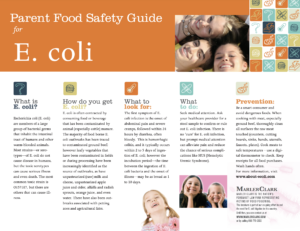
Here are guides – especially for parents – of the four food borne pathogens I see most frequently.

E. coli

E. coli are bacteria that can cause serious, sometimes fatal, infections in humans. The Centers for Disease Control and Prevention (CDC) estimates that E. coli causes 2,000 hospitalizations in the United States each year.Ten percent of E. coli victims develop hemolytic uremic syndrome (HUS), which can cause kidney failure, damage to the central nervous system, and ultimately death.

Click to enlarge: https://marlerclark.com/pdfs/ecoliBrochure.pdf

Hepatitis A

Hepatitis A is one of five human hepatitis viruses (hepatitis A, B, C, D, and E) that primarily infect the liver and cause illness. It is a communicable (or contagious) disease that spreads from person-to-person through fecal-oral contact, often from an infected food handler contaminating food.

Click to enlarge: https://marlerclark.com/pdfs/hepatitisBrochure.pdf

Listeria

Listeria monocytogenes (Listeria) is a foodborne disease-causing bacteria; the disease caused by the ingestion of Listeria bacteria is called listeriosis. Listeria can invade the body through a normal and intact gastrointestinal track. Once in the body, Listeria can travel through the blood stream; it invades and grows best in the central nervous system among immune compromised persons, causing meningitis and/or encephalitis (brain infection). In pregnant women, the fetus can become infected with Listeria, leading to spontaneous abortion, stillbirths, or sepsis (blood infection) in infancy.

Click to enlarge: https://marlerclark.com/pdfs/ListeriaFINALbrochure.pdf

Salmonella

Salmonella is one of the most common intestinal infections in the United States. Salmonellosis (the disease caused by Salmonella) is the second most common foodborne illness. Salmonella infection occurs when the bacteria are ingested, typically from food derived from infected food-animals, but it can also occur by ingesting the feces of an infected animal or person. Food sources include raw or undercooked eggs/egg products, raw milk or raw milk products, contaminated water, meat and meat products, and poultry. Raw fruits and vegetables contaminated during slicing have been implicated in several Salmonella outbreaks.

Click to enlarge: https://marlerclark.com/pdfs/salmonella_brochure.pdf