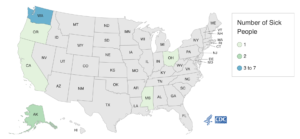
Washington – 7, Alaska – 2, California – 1, Mississippi – 1, Ohio – 1, Oregon – 1

Simple Truth Organic Power Greens and Nature’s Basket Organic Power Greens sold at grocery stores and supermarkets, including Fred Meyer, QFC, and Giant Eagle – no recall as of yet.

As of December 29, 2021, 13 people infected with the outbreak strain of E. coli O157:H7 have been reported from six states. Illnesses started on dates ranging from November 27, 2021, to December 9, 2021.

Sick people range in age from 4 to 79 years, with a median age of 54, and 92% are female. Of 12 people with information available, four have been hospitalized and one person developed a type of kidney failure called hemolytic uremic syndrome (HUS). No deaths have been reported.

State and local public health officials are interviewing people about the foods they ate in the week before they got sick. Of 12 people interviewed, all reported eating packaged salads. Of 10 people who provided brand information, 6 ate or bought Simple Truth Organic Power Greens and 1 ate Nature’s Basket Organic Power Greens. Both Organic Power Greens salads have the same mix of leafy greens: organic spinach, mizuna, kale, and chard. Several sick people reported using these salads in smoothies.

Public health investigators are using the PulseNet system to identify illnesses that may be part of this outbreak. CDC PulseNet manages a national database of DNA fingerprints of bacteria that cause foodborne illnesses. DNA fingerprinting is performed on bacteria using a method called whole genome sequencing (WGS).

WGS showed that bacteria from sick people’s samples are closely related genetically. This suggests that people in this outbreak got sick from the same food.

CDC is advising not to eat Simple Truth Organic Power Greens and Nature’s Basket Organic Power Greens with “best if used by” dates through December 20, 2021. Investigators are working to determine if additional products may be contaminated.
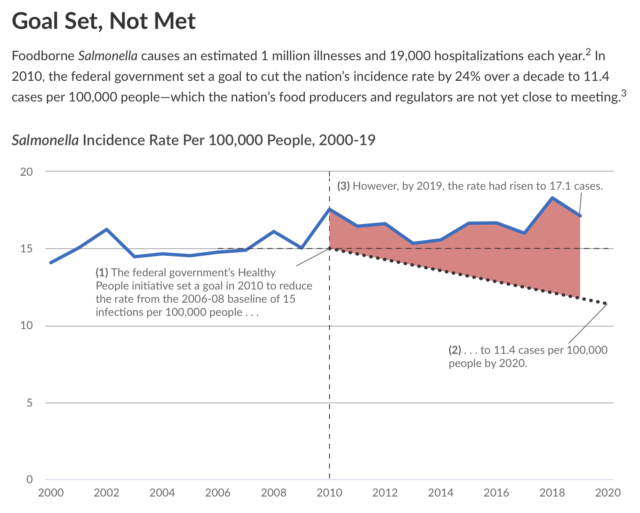
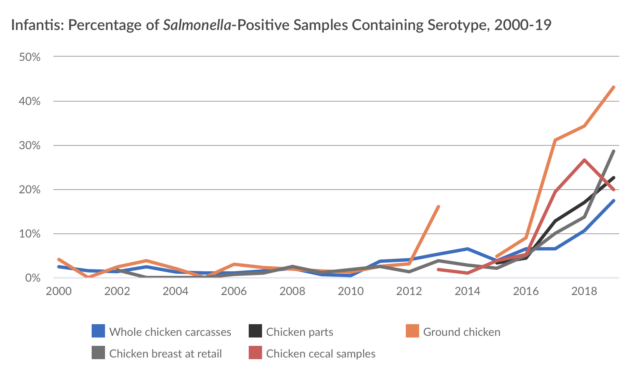
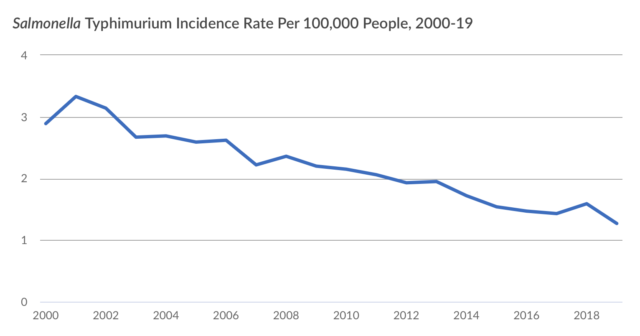
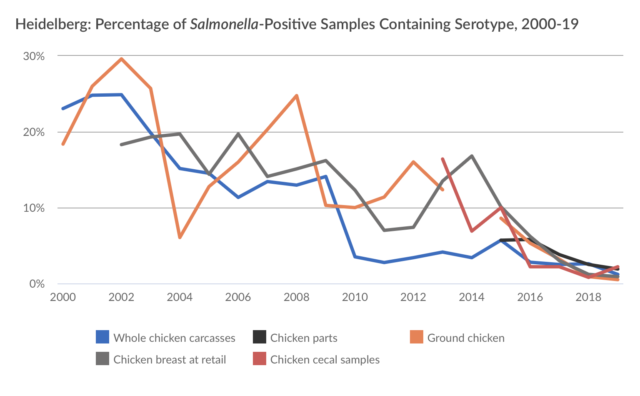
I could not have said it better and PEW’s conclusion is spot on:

Current poultry policies and regulations treat all Salmonella serotypes and strains as if they pose equal risks to people, despite science showing this is not the case. Food safety interventions on farms, such as vaccines targeting harmful serotypes, have likely contributed to meaningful reductions in product contamination and human illness. FSIS should revise its rules to focus more intensively on the serotypes causing more frequent or severe infections, and implement other policies to prompt poultry operations to adopt on-farm practices that control these hazards. Such a risk-based approach would help prevent illnesses and outbreaks linked to poultry products and drive down the nation’s unacceptably high number of Salmonella illnesses.

Here is the story visually:

I agree with PEW’s concern, as I recently noted in a letter to USDA/FSIS:

Marler Clark LLP, PS submits this letter requesting a definitive and prompt response to the above-referenced docket, Docket No. FSIS-2020-0007; Document ID FSIS-2020-0007-0001 – Petition for an Interpretive Rule declaring ‘Outbreak’ Serotypes of Salmonella enterica subspecies enterica to be Adulterants Within the Meanings of 21 U.S.C. § 601(m)(1) and 21 U.S.C. § 453(g)(1) (hereinafter “Salmonella Petition” or “Petition”).

As stated in our November 12, 2021, letter, nearly two years have elapsed since the submission of our SalmonellaPetition on behalf of Rick Schiller, Steven Romes, the Porter family, Food & Water Watch, Consumer Federation of America, and Consumer Reports, requesting that FSIS declare the following “Outbreak Serotypes” to be per seadulterants in meat and poultry products:

Salmonella Agona, Anatum, Berta, Blockely, Braenderup, Derby, Dublin, Enteritidis, Hadar, Heidelberg, I 4,[5],12:i:-, Infantis, Javiana, Litchfield, Mbandaka, Mississippi, Montevideo, Muenchen, Newport, Oranienburg, Panama, Poona, Reading, Saintpaul, Sandiego, Schwarzengrund, Senftenberg, Stanley, Thompson, Typhi, and Typhimurium[1].

Since then—although FSIS is required by the Administrative Procedure Act[2] and the courts[3] to, at the very least, respond to the merits of a petition for rulemaking—we have yet to receive a clear response as to when or how FSIS intends to address our Petition.

We write to supplement the November 12, 2021, letter with new research. In their newly published review paper[4], O’Bryan et al. explain that, although the current USDA qualitative performance standards have lowered the prevalence of Salmonella found on raw poultry products, progress has stalled on lowering the cases of salmonellosis associated with poultry. They write, “the incidence of salmonellosis (most recent data indicates 15.3 cases per 100,000) is still well above CDC’s Healthy People 2030 objective of 11.5 cases per 100,0000 population and has not experienced substantial reductions in the last two decades, despite the prevalence data exhibiting a steady decline[5].”

The authors list several reasons for this standstill, many of which are further detailed in the Marler Clark Petition: there are numerous means for birds to be contaminated by Salmonella during the production cycle, especially within the processing environment (e.g., during picking, evisceration, and immersion in the chiller tanks); there is a high prevalence of unsafe behaviors[6] (e.g., undercooking and poor handwashing technique) when cooking poultry, as well as a lack of consumer education; and the current routine monitoring of Salmonella occurrence in poultry processing is seriously lacking. To remedy the latter, they suggest that “the food and poultry industry … undertake a more proactive stance” and develop “a much more complete evaluation of Salmonella population concentrations on a carcass testing positive for Salmonella[7].”

Despite its confirmation of the continuing food safety crisis caused by the failure of the USDA to adequately address the contamination of poultry with Salmonella outbreak strains, the authors still make a glaring error in critiquing the position taken by the Petition. Specifically, the authors assert “that the inherent presence of Salmonella in poultry means it cannot be an ‘added substance’ and it therefore should not be considered an adulterant[8].” The FMIA unambiguously defines an adulteration standard for substances that are “not added” and a different standard for those that are “added[9].” Further, the USDA has itself repeatedly rejected the argument that a bacterial pathogen cannot be deemed an adulterant “because the organism may be inherent in raw meat and poultry when produced under current technology[10].” Indeed, in rejecting this argument, the USDA cited to its own court victory in defending its decision to treat E. coli O157:H7 as an adulterant, despite vociferous industry objections[11]. Thus, having rejected these arguments before, the USDA must do so again. And, finally, the USDA would lack the authority to seek the recall of Salmonella-contaminated ground beef and poultry—recalls that it has done repeatedly—if there was no basis under the FMIA to treat Salmonella, in those instances, as an adulterant.

The other arguments made against the Petition are no better than the inherency one[12]. Although there are no serotype-specific interventions, each of the 31 Outbreak Serotypes of Salmonella we seek be deemed adulterants has a demonstrable history associated with either an illness outbreak or a product recall and are proven to be injurious to human health. Altogether, these 31 Outbreak Serotypes currently account for the greatest number of Salmonella illnesses[13]. As Salmonella evolve, however, serotypes of public concern could be added (as was the case with the “Big Six” non-O157 strains of STEC E. coli) or subtracted from a variable list of outbreak serotypes.

Each year, CDC’s Interagency Food Safety Analytics Collaboration (IFSAC) generates a report that uses outbreak data to produce annual estimates for foods responsible for foodborne illnesses caused by four pathogens, including Salmonella[14]. In its latest publication[15], IFSAC, using data from 1,532 foodborne disease outbreaks that occurred from 1998 through 2019, reported that chicken is responsible for 16.8% of all Salmonella illnesses, making it the single most important source of Salmonella illnesses of any food category. Chicken and turkey, taken together, account for over 23% of those illnesses.

The percentage of Salmonella illnesses associated with poultry has increased year-over-year. In 2015[16], IFSAC reported that chicken was the second largest source of Salmonella illnesses, responsible for 11.8% of Salmonella illnesses. The following year, IFSAC reported that chicken was responsible for 12.7% of Salmonella illnesses[17]. In 2017, chicken was linked to 14% of foodborne illnesses attributed to Salmonella[18]. The following year, in 2018[19], chicken became the number one source of Salmonella illnesses (dethroning seeded vegetables), responsible for 14.3% of illnesses.
In its October 19, 2021, press release, the USDA announced that “it is mobilizing a stronger, and more comprehensive effort to reduce Salmonella illnesses associated with poultry products,” with the goal of “mov[ing] closer to the national target of a 25% reduction in Salmonella illnesses[20].” In doing so, “FSIS will focus on the Salmonellaserotypes and the virulence factors that pose the greatest public health risk.” Although we support the USDA’s efforts, we do not consider this announcement to be responsive to our Petition.

To protect the public, FSIS needs to acknowledge that certain Salmonella serotypes pose an unacceptable risk to consumers and make rules to keep adulterated products contaminated by these serotypes off the shelves. Accordingly, we again urge you to grant our Petition. If we do not receive a definitive response within 140 days, we will assume that you have denied our petition and proceed with judicial remedies.

_______________________
[1]           Thirty of these 31 serotypes are from the Centers for Disease Control and Prevention’s (CDC) Salmonella Atlas, which contains 42 years of laboratory-confirmed research. See Salmonella Atlas at https://www.cdc.gov/salmonella/reportspubs/salmonella-atlas/serotype-reports.html. The only exception, Salmonella Dublin, was added to Petitioners’ list because it is a serotype of increasing public health concern that was recently involved in a foodborne illness outbreak linked to ground beef.
[2]           In addition to 5 USC § 553(e)’s requirement that each agency “shall give an interested person the right to petition for the issuance, amendment, or repeal of a rule,” the Administrative Procedure Act also requires agencies to provide “prompt notice…of the denial in whole or in part of a written application, petition, or other request of an interested person made in connection with any agency proceeding,”5 USC §555(e).
[3]           Horne v. USDA, 494 Fed. Appx. 774 (9th Cir. 2012) (“USDA responded to the Hornes’ rulemaking petition—as it must under the Administrative Procedure Act”); WWHT, Inc. v. F.C.C., 656 F.2d 807, 813 (D.C. Cir. 1981) (“an agency must receive and respond to petitions for rulemaking”); Nat’l Parks Conserv. Ass’n v. Interior, 794 F.Supp.2d 39, 44-45 (D.D.C. 2011) (“[A]n agency ‘is required to at least definitively respond to . . . [a] petition—that is, to either deny or grant the petition.’”); Families for Freedom v. Napolitano, 628 F.Supp.2d 535,540 (S.D.N.Y 2009) (concluding the same and noting “DHS conceded this point at oral argument”); but see Brown v. FBI, 793 F.Supp.2d 368, 375 (D.C. Cir. 2011) (observing, in the context of reviewing petitioner’s standing, that “the APA is less than crystal-clear on plaintiff’s statutory right to a response,” though simultaneously citing WWHT, “an agency must receive and respond”). See also Richard J. Pierce, Administrative Law Treatise 517 (5th ed. 2013) (“At a minimum, the right to petition for rulemaking entitles a petitioning party to a response to the merits of the petition.”).
[4]           O’Bryan, C. A., S. C. Ricke, J. A. Marcy (2021). Public health impact of Salmonella spp. on raw poultry: Current concepts and future prospects in the United States. Food Control. 132:108539. https://doi.org/10.1016/j.foodcont.2021.108539
[5]           Id.
[6]           See, e.g., Kirchner, M. K., R. M. Goulter, B. J. Chapman, J. Clayton, L. Jaykus. (2021). Cross-Contamination on Atypical Surfaces and Venues in Food Service Environments. J Food Prot. 84(7):1239-51.Verrill, L., et al. (2021). Hand Washing Observations in Fast-Food and Full-Service Restaurants: Results from the 2014 U.S. Food and Drug Administration Retail Food Risk Factors Study. J Food Prot. 84(6):1016-22.Cardoso, M. J., V. Ferreira, M. Truninger, R. Maia, P. Teixeira. (2021). Cross-contamination events of Campylobacter spp. in domestic kitchens associated with consumer handling practices of raw poultry. Int J Food Microbiol. 338:108984.Mihalache O. A., D. Borda, C. Neagu, P. Teixeira, S. Langsrud, A. I. Nicolau. (2021). Efficacy of Removing Bacteria and Organic Dirt from Hands—A Study Based on Bioluminescence Measurements for Evaluation of Hand Hygiene When Cooking. Int J Environ Res Public Health. 18(16): 8828.Cohen, N. L., R. B. Olson. (2016). Compliance With Recommended Food Safety Practices in Television Cooking Shows. J Nutr Educ Behav. 48(10): 730-34.Oscar, T. P. (2013). Initial contamination of chicken parts with Salmonella at retail and cross-contamination of cooked chicken with Salmonella from raw chicken during meal preparation. J Food Prot. 76(1):33-9.Carrasco, E., A. Morales-Rueda, R. M. Garcia-Gimeno. (2012). Cross-contamination and recontamination by Salmonella in foods: A review. Food Res Int. 45(2):545-56.
[7]           O’Bryan, C. A., S. C. Ricke, J. A. Marcy (2021). Public health impact of Salmonella spp. on raw poultry: Current concepts and future prospects in the United States. Food Control. 132:108539. https://doi.org/10.1016/j.foodcont.2021.108539
[8]           Id.
[9]           21 U.S.C. § 601(m)(1); see also Young v. Community Nutrition Institute, 476 U.S. 974, 977 (1986) (addressing regulatory requirements for “adulterants,” like aflatoxins, that are “not added,” and noting the requirements are more strict for substances that are added)
[10]         USDA, Recent Developments Regarding Beef Products Contaminated with E. coli O157:H7, 65 Fed. Reg. 6881, 6884 (Feb. 11, 2000)
[11]         Id. (citing Texas Food Industry Ass’n v. Espy, 870 F. Supp. 143 (WD Tex. 1994)).
[12]         “There are no serotype-specific interventions for Salmonella, and there are no practical or reliable ways to rapidly identify serotypes in-plant, much less to have a high degree of confidence that all serotypes present in a flock have been identified. Furthermore, it would also be impractical to declare 31 serotypes of Salmonella as adulterants while ignoring the other roughly 2,500 serotypes. The evolution in Salmonella over time would suggest that this would not remain a static list of Salmonella serovars but would likely change the number of distinctive strains for a given serotype over time and the pathogenesis characteristics in different serovars could evolve over time.”
[13]         We explain this point further on page 14 of the Petition: “According to a recent report by the National Advisory Committee on Microbiological Criteria for Foods (NACMCF), highly virulent strains are virtually indistinguishable from non-virulent ones because ‘virulence markers for gastroenteritis are not serotype specific.’ Nevertheless, certain serotypes of NTS (Heidelberg, Sandiego, Schwarzengrund, Panama, Poona, Oranienburg) are ‘more likely to escape the gastrointestinal tract and cause systemic disease.’ Moreover, according to the report, a few serotypes are ‘consistently associated with the greatest incidence of human disease,’ including Salmonella enterica serotypes Newport, Enteritidis, Javiana, Typhimurium, Infantis, Muenchen, and I 4,[5],12:i:-. These serotypes (and others) are thoroughly documented in CDC’s Salmonella Atlas and are readily identifiable using Whole Genome Sequencing (WGS).”
[14]         See IFSAC’s reports at https://www.cdc.gov/foodsafety/ifsac/annual-reports.html
[15]         “Foodborne illness source attribution estimates for 2019 for Salmonella, Escherichia coli O157, Listeria monocytogenes, and Campylobacter using multi-year outbreak surveillance data, United States.” IFSAC, October 2021. https://www.cdc.gov/foodsafety/ifsac/pdf/P19-2019-report-TriAgency-508.pdf
[16]         “Foodborne illness source attribution estimates for 2015 for Salmonella, Escherichia coli O157, Listeria monocytogenes, and Campylobacter using multi-year outbreak surveillance data, United States.” IFSAC, November 2018. https://www.cdc.gov/foodsafety/ifsac/pdf/P19-2015-report-TriAgency-508.pdf
[17]         “Foodborne illness source attribution estimates for 2016 for Salmonella, Escherichia coli O157, Listeria monocytogenes, and Campylobacter using multi-year outbreak surveillance data, United States.” IFSAC, November 2018. https://www.cdc.gov/foodsafety/ifsac/pdf/P19-2016-report-TriAgency-508.pdf
[18]         “Foodborne illness source attribution estimates for 2017 for Salmonella, Escherichia coli O157, Listeria monocytogenes, and Campylobacter using multi-year outbreak surveillance data, United States.” IFSAC, September 2019. https://www.cdc.gov/foodsafety/ifsac/pdf/P19-2017-report-TriAgency-508-revised.pdf
[19]         “Foodborne illness source attribution estimates for 2018 for Salmonella, Escherichia coli O157, Listeria monocytogenes, and Campylobacter using multi-year outbreak surveillance data, United States.” IFSAC, December 2020. https://www.cdc.gov/foodsafety/ifsac/pdf/P19-2018-report-TriAgency-508.pdf
[20]         “USDA Launches New Effort to Reduce Salmonella Illnesses Linked to Poultry.” USDA, October 19, 2021. https://www.usda.gov/media/press-releases/2021/10/19/usda-launches-new-effort-reduce-salmonella-illnesses-linked-poultry

I got this not from former client on Christmas Day:

Merry Christmas Bill! It’s been 5 years since getting sick and this time of year I’m reminded of how thankful I am for all the good people I met since then, including you and your team. Words truly can’t do justice to how I feel. I hope your Christmas was wonderful- you deserve it

Best gift ever. Thank you.

Wishing all a happy holiday season and looking forward to the best New Year.

Congress passed the Federal Food, Drug, and Cosmetic Act in 1938 in reaction to growing public safety demands.  The primary goal of the Act was to protect the health and safety of the public by preventing deleterious, adulterated or misbranded articles from entering interstate commerce.  Under section 402(a)(4) of the Act, a food product is deemed “adulterated” if the food was “prepared, packed, or held under insanitary conditions whereby it may have become contaminated with filth, or whereby it may have been rendered injurious to health.” A food product is also considered “adulterated” if it bears or contains any poisonous or deleterious substance, which may render it injurious to health.  The 1938 Act, and the recently signed Food Safety Modernization Act, stand today as the primary means by which the federal government enforces food safety standards.

Chapter III of the Act addresses prohibited acts, subjecting violators to both civil and criminal liability. Provisions for criminal sanctions are clear:

Felony violations include adulterating or misbranding a food, drug, or device, and putting an adulterated or misbranded food, drug, or device into interstate commerce.  Any person who commits a prohibited act violates the FDCA.  A person committing a prohibited act “with the intent to defraud or mislead” is guilty of a felony punishable by years in jail and millions in fines or both.

A misdemeanor conviction under the FDCA, unlike a felony conviction, does not require proof of fraudulent intent, or even of knowing or willful conduct.  Rather, a person may be convicted if he or she held a position of responsibility or authority in a firm such that the person could have prevented the violation.  Convictions under the misdemeanor provisions are punishable by not more than one year or fined not more than $250,000, or both.

Fresh Express Lettuce – 10 sick with 1 death in 8 states – 2021

Illnesses: As of December 21, 2021, 10 people infected with the outbreak strain of Listeria monocytogenes have been reported from eight states: Illinois, Massachusetts, Michigan, New Jersey, New York, Ohio, Pennsylvania and Virginia. Illnesses started on dates ranging from July 26, 2016 through October 19, 2021. Sick people range in age from 44 to 95 years, with a median age of 80, and 60% are female. All 10 people have been hospitalized. One death has been reported from Pennsylvania. WGS showed that bacteria from sick people’s samples are closely related genetically. This means that people in this outbreak likely got sick from the same food.

Traceback and Recall: On December 16, 2021, the Michigan Department of Agriculture identified the outbreak strain of Listeria in a bag of Fresh Express Sweet Hearts packaged salad. On December 20, 2021, Fresh Express recalled several brands of packaged salad products. The recall includes all Use-By Dates with product codes Z324 through Z350.

Dole Lettuce – 16 sick with 2 deaths in 13 states – 2021

Illnesses: As of December 17, 2021, 16 people infected with the outbreak strain of Listeria monocytogenes have been reported from 13 states: Idaho, Iowa, Maryland, Michigan, Minnesota, Nevada, North Carolina, Ohio, Oregon, Pennsylvania, Texas, Utah and Wisconsin. Illnesses started on dates ranging from August 16, 2014, to October 17, 2021. Sick people range in age from 50 to 94 years, with a median age of 76, and 81% are female. Of 14 people with information available, 12 have been hospitalized. Two deaths have been reported from Michigan and Wisconsin. WGS showed that bacteria from sick people’s samples are closely related genetically. This suggests that people in this outbreak got sick from the same food.

Traceback and Recall: In October 2021, the Georgia Department of Agriculture identified the outbreak strain of Listeria in a Dole brand garden salad as part of a routine sampling program of food at grocery stores. As a result, Dole recalled some of their garden salad products that are now past their “best if used by” dates. This sampling was not part of this outbreak investigation, but WGS later showed that the Listeria bacteria in the garden salad were closely related to the outbreak strain. After CDC reopened this outbreak investigation, Michigan Department of Agriculture and Rural Development collected samples of packaged salads from retail stores for testing and identified the outbreak strain of Listeria in a Marketside brand package of shredded iceberg that was produced by Dole. On December 22, 2021, Dole recalled all Dole-branded and private label packaged salads processed at the two facilities that produced the contaminated packaged salads.

The legal jargon aside, if you are a producer of food and knowingly or not sell adulterated food, you can (and should) face fines and jail time.  Mr. Dole, Mr. Fresh Express, I might suggest a good lawyer.

Here are some recent cases where prosecutors brought criminal charges:

  • In 2012 Eric Jensen, age 37, and Ryan Jensen, age 33, brothers who owned and operated Jensen Farms, a fourth generation cantaloupe operation, located in Colorado, presented themselves to U.S. marshals in Denver and were taken into custody on federal charges brought by the U.S. Attorney’s Office with the Food and Drug Administration – Office of Criminal Investigation. According to the six-count indictment, Eric and Ryan Jensen unknowingly introduced adulterated (Listeria-tainted) cantaloupe into interstate commerce. The indictment further stated that the cantaloupe was prepared, packed and held under conditions, which rendered it injurious to health.  The outbreak sickened over 147, killing over 33 in 28 states in the fall of 2011.  The Jensen’s faced up to six years in jail and $1,500,000 in fines each. They eventually pleaded guilty and were sentenced to five years probation.
  • In 2013 Austin “Jack” DeCoster and his son, Peter DeCoster, both faced charges stemming from a Salmonella outbreak caused by their Iowa egg farms in 2010.  The Salmonella outbreak ran from May 1 to November 30, 2010, and prompted the recall of more than a half-billion eggs. And, while there were 1,939 confirmed infections, statistical models used to account for Salmonella illnesses in the U.S. suggested that the eggs might have sickened more than 62,000 people. The family business, known as Quality Egg LLC, pleaded guilty in 2015 to a federal felony count of bribing a USDA egg inspector and to two misdemeanors of unknowingly introducing adulterated food into interstate commerce. As part of the plea agreement, Quality Egg paid a $6.8-million fine and the DeCosters $100,000 each, for a total of $7 million.  Both DeCosters were sentenced to three months in jail.
  • In 2014 former Peanut Corporation of America owner Stewart Parnell, his brother and one-time peanut broker, Michael Parnell, and Mary Wilkerson, former quality control manager at the company’s Blakely, Georgia, plant, faced a federal jury in Albany, Georgia. The 12-member jury found Stewart Parnell guilty on 67 federal felony counts, Michael Parnell was found guilty on 30 counts, and Wilkerson was found guilty of one of the two counts of obstruction of justice charged against her. Two other PCA employees earlier pleaded guilty. The felony charges of introducing adulterated food into interstate commerce, “with the intent to defraud or mislead,” stemmed from a 2008 to 2009 Salmonella outbreak that sickened 714 and left nine dead. Stewart Parnell, Michael Parnell, and Mary Wilkerson were all found guilty on multiple charges.  Stewart and Michael are spending decades in prison.
  • In 2015 ConAgra Foods agreed to plead guilty and pay $11.2 million in connection with the shipment of Salmonella contaminated peanut butter linked to a 2006 through 2007 nationwide outbreak of that sickened over 700. ConAgra signed a plea agreement admitting that it unknowingly introduced Peter Pan and private label peanut butter contaminated with Salmonella into interstate commerce during the 2006 through 2007 outbreak.
  • In 2020 Chipotle was ordered to pay $25 million to resolve criminal charges related to the company’s involvement in foodborne illness outbreaks that sickened more than 1,100 people between 2015 and 2018. Chipotle was implicated in at least five foodborne illness outbreaks between 2015 and 2018 connected to restaurants in the Los Angeles area, Boston, Virginia, and Ohio.  These incidents primarily stemmed from store-level employees’ failure to follow company food safety protocols at company-owned restaurants, including a Chipotle policy requiring the exclusion of employees who were sick or recently had been sick. For example, in August 2015, 234 consumers and employees of a Chipotle restaurant in Simi Valley, California reported becoming ill.  Although company policies required the restaurant to report certain employee illnesses to Chipotle safety officials and to implement enhanced food safety procedures, the restaurant did not pass along information regarding an ill employee until multiple consumers already had reported being sick. In December 2015, a norovirus incident at a Chipotle restaurant in Boston sickened 141 people.  According to the DPA, that outbreak likely was the result of an ill apprentice manager who was ordered to continue working in violation of company policy after vomiting in the restaurant.  Two days later, the same employee helped package a catering order for a Boston College basketball team, whose members were among the consumers sickened by the outbreak. In July 2018, approximately 647 people who dined at a Chipotle restaurant in Powell, Ohio reported illness related to Clostridium perfringens, a pathogen that grows rapidly when food is not held at appropriate temperatures.  The local health department found critical violations of local food regulations, including those specific to time and temperature controls for lettuce and beans.
  • In 2020 Blue Bell pleaded guilty in May 2020 to two misdemeanor counts of distributing adulterated ice cream products.  The sentence, imposed by U.S. District Judge Robert Pitman in Austin, Texas, was consistent with the terms of a plea agreement previously filed in the case.  The $17.25 million fine and forfeiture amount is the largest-ever criminal penalty following a conviction in a food safety case. In March 2015, tests conducted by the Food and Drug Administration (FDA) and Centers for Disease Control and Prevention (CDC) linked the strain of Listeria in one of the Blue Bell ice cream products to a strain that sickened five patients at a Kansas hospital with listeriosis, the severe illness caused by ingestion of Listeria-contaminated food.  The FDA, CDC, and Blue Bell all issued public recall notifications on March 13, 2015.  Subsequent tests confirmed Listeria contamination in a product made at another Blue Bell facility in Broken Arrow, Oklahoma, which led to a second recall announcement on March 23, 2015. According to the plea agreement with the company, FDA inspections in March and April 2015 revealed sanitation issues at the Brenham and Broken Arrow facilities, including problems with the hot water supply needed to properly clean equipment and deteriorating factory conditions that could lead to insanitary water dripping into product mix during the manufacturing process.  Blue Bell temporarily closed all of its plants in late April 2015 to clean and update the facilities. Since re-opening its facilities in late 2015, Blue Bell has taken significant steps to enhance sanitation processes and enact a program to test products for Listeria prior to shipment. Paul Kruse, President and CEO of Blue Bell Ice Cream, is facing a felony trial in 2022.

Over the last week both the CDC and FDA, along with various State Departments of Health and Agriculture, have been investigating two Listeria outbreaks linked to the consumption of various leafy greens.  Using Whole Genome Sequencing (WGS), product testing and clinical (human) sampling, health authorities have both determined that the source of the infection is Fresh Express and Dole and that the outbreaks are linked to illness that have been occurring since 2014.

A common question is why did it take so long to link all the illnesses?

It is likely that there have been low-level, but persistent Listeria contamination in both processing facilities that was not being picked up in the first epidemiological investigations.  It is most likely that the outbreaks were noticed, and the illnesses linked – both past and present – when product samples from various states were uploaded to CDC PulseNet.

I must admit that I am familiar with both Fresh Express and Dole:

Fresh Express Lettuce – 10 sick with 1 death in 8 states – 2021

Illnesses: As of December 21, 2021, 10 people infected with the outbreak strain of Listeria monocytogenes have been reported from eight states: Illinois, Massachusetts, Michigan, New Jersey, New York, Ohio, Pennsylvania and Virginia. Illnesses started on dates ranging from July 26, 2016 through October 19, 2021. Sick people range in age from 44 to 95 years, with a median age of 80, and 60% are female. All 10 people have been hospitalized. One death has been reported from Pennsylvania. WGS showed that bacteria from sick people’s samples are closely related genetically. This means that people in this outbreak likely got sick from the same food.

Traceback and Recall: On December 16, 2021, the Michigan Department of Agriculture identified the outbreak strain of Listeria in a bag of Fresh Express Sweet Hearts packaged salad. On December 20, 2021, Fresh Express recalled several brands of packaged salad products. The recall includes all Use-By Dates with product codes Z324 through Z350.

Dole Lettuce – 16 sick with 2 deaths in 13 states – 2021

Illnesses: As of December 17, 2021, 16 people infected with the outbreak strain of Listeria monocytogenes have been reported from 13 states: Idaho, Iowa, Maryland, Michigan, Minnesota, Nevada, North Carolina, Ohio, Oregon, Pennsylvania, Texas, Utah and Wisconsin. Illnesses started on dates ranging from August 16, 2014, to October 17, 2021. Sick people range in age from 50 to 94 years, with a median age of 76, and 81% are female. Of 14 people with information available, 12 have been hospitalized. Two deaths have been reported from Michigan and Wisconsin. WGS showed that bacteria from sick people’s samples are closely related genetically. This suggests that people in this outbreak got sick from the same food.

Traceback and Recall: In October 2021, the Georgia Department of Agriculture identified the outbreak strain of Listeria in a Dole brand garden salad as part of a routine sampling program of food at grocery stores. As a result, Dole recalled some of their garden salad products that are now past their “best if used by” dates. This sampling was not part of this outbreak investigation, but WGS later showed that the Listeria bacteria in the garden salad were closely related to the outbreak strain. After CDC reopened this outbreak investigation, Michigan Department of Agriculture and Rural Development collected samples of packaged salads from retail stores for testing and identified the outbreak strain of Listeria in a Marketside brand package of shredded iceberg that was produced by Dole. On December 22, 2021, Dole recalled all Dole-branded and private label packaged salads processed at the two facilities that produced the contaminated packaged salads.

Listeria Information:

Listeria Website

Listeria video

Marler Clark Listeria Litigation: 

Abbot Cheese

Jensen Farms Cantaloupe

Dole Lettuce

Marte Brand Cheese 

Sangar Produce 

Whittier Farms Milk

Vulto Creamery Cheese

Blue Bell Ice Cream

South Africa Tiger Brand Polony

The following quote is attributed to Frank Yiannas, FDA Deputy Commissioner for Food Policy and Response

“The FDA, along with the CDC and our state and local partners, is working to investigate a multistate outbreak of Listeria monocytogenes infections. To date, a positive sample of Fresh Express Sweet Hearts salad mix has been reported to match the outbreak strain. Fresh Express has voluntarily recalled products and consumers are advised not to eat, sell or serve any recalled products. Our investigation is ongoing, and we will continue to communicate should additional products be implicated.

“Ten people infected with the outbreak strain have been reported from eight states. A sample of Fresh Express prepackaged romaine and sweet butter lettuce was collected by the Michigan Department of Agriculture and Rural Development as part of their routine sampling efforts. The sample tested positive for Listeria monocytogenes and was a match to the outbreak strain. Given this, Fresh Express voluntarily ceased production at their Streamwood, Illinois, facility and initiated a recall of certain varieties of its branded and private label salads produced in that facility.

“We will continue to work with our partners and with Fresh Express to determine the source of this outbreak. We remain committed to transparency and providing updates as we learn more during our continuing traceback investigation.”

Additional Information:

  • The U.S. Food and Drug Administration, along with the U.S. Centers for Disease Control and Prevention and our state and local partners, is working to investigate a multistate outbreak of Listeria monocytogenes infections associated with the consumption of packaged salad.
  • To date, this outbreak has been associated with 10 illnesses, 10 hospitalizations and one death spanning the following states: IL, MA, MI, NJ, NY, OH, PA and VA. Illnesses started on dates ranging from July 26, 2016, to Oct. 19, 2021.
  • Consumers who have symptoms of listeriosis infection should contact their health care provider. Most people with listeriosis include a fever, muscle aches, nausea, vomiting and diarrhea. If the more severe form of listeriosis develops, symptoms may include headache, stiff neck, confusion, loss of balance and convulsions. For the very young, the elderly and the immune-compromised, listeriosis can result in death.
  • Fresh Express voluntarily ceased production at their Streamwood, Illinois, facility and initiated a recall of certain varieties of its branded and private label salad products produced at the company’s Streamwood, Illinois, facility. The recall includes all Use-By Dates of fresh salad items with product codes Z324 through Z350.
  • Consumers, restaurants and retailers, should not eat, sell or serve recalled packaged salads. A full list of recalled products is available on the FDA’s website.
  • The FDA recommends that anyone who received recalled products use extra vigilance in cleaning and sanitizing any surfaces and containers that may have come in contact with these products to reduce the risk of cross-contamination. Listeria can survive in refrigerated temperatures and can easily spread to other foods and surfaces.
  • This is an ongoing investigation, and additional information will be provided as it becomes available.

This review is part of FDA’s “New Era of Smarter Food Safety: FDA’s Foodborne Outbreak Response Improvement Plan” that also requires a hard look and the support by those concerned about improving the safety of our food and driving the numbers of ill consumers down.

Thanks to the deep dive by Craig Hedberg.  Here is the Full Report: NewEra-OutbreakResponseIndependentReview-102621

Here are some of my takeaways from the review and my thoughts:

  1. Surveillance – we need to use the power of Whole Genome Sequencing (WGS) of food products and environmental testing to help prevent and identify outbreaks.With WGS the ability of scientifically linking pathogens and people will allow government, the food industry, and consumers more certainly to know what the most likely cause of a foodborne illness was. I am certain that genetically linking illnesses to products – and possibly the environment – will allow for a common understanding of the likely cause of an outbreak.
  2. There is an ongoing need for coordination of outbreak response within the FDA and with other federal and state agencies that touch on food safety.There is clearly an ongoing need to more effectively coordinated the multiple acronyms that make up governmental food safety responses at the federal, state, and local levels.  This one is well “above my pay grade” to figure out.
  3. Traceback – The technology does exist to track food products from “farm to fork.” The real question is when it will be implemented so a pathogen tainted product can be traced quickly and accurately to the likely source.  Electronic records and Block Chain are coming.  We just need to speed it up.
  4. Transparency – FDA and other acronyms need to rethink what should and should not be made public.Other that patient identities, in my experience reading years of governmental redacted reports, there is frankly little that should not be made public.  Being transparent build trust between all the people that grow, manufacture, ship, sell and consume food.
  5. Root Cause Analysis – “Root cause analysis (RCA) is a method of problem-solving used to isolate the central “how” and “why” a given event occurred. While root cause analysis is used in various industries already, it has strong implications for helping researchers and investigators understand the central causes of events like food contamination and foodborne illness outbreaks. RCA is also useful for clarifying steps needed to correct the cause of a problem to prevent recurrence.”FDA need to be able to fully assess the “root cause” of an outbreak without limitations.  A concern noted in Dr. Hedberg’s review:

“Efforts are made to identify farm sources, or production sources depending on the commodity, so that farm or facility visits, and environmental assessments can be made to identify the source of the contamination event.”

“Farm visits and sample collections have become an increasing part of outbreak investigations involving REP strains and recurrent settings. Getting to farms while produce is still being grown and harvested has been a challenge.”

“Given the challenges inherent in identifying farms and fields during the course of outbreak investigations, it is not reasonable to expect to be able to link every case to a specific source, or to isolate the outbreak-associated strains from product or environmental samples collected from the farms. The biology of the organisms and ecology of the fields challenges the limits of our laboratory methods. This is compounded by the lack of access to animal and environmental samples from adjacent fields managed by different owners.”

Question – does anyone know why FDA can’t go on adjoining land – especially during an outbreak investigation?  Does another acronym have access – EPA?  Has there ever been any proposed legislation to allow access?  Not being allowed to search for the root cause dooms the process from ever finding the root cause.

Here is the Executive Summary:

As the federal food regulatory agency with oversight for the large majority of commercially distributed foods, FDA plays a key role in conducting multistate outbreak investigations and in translating investigation results into prevention activities. The importance of this role is highlighted in the development of FDA’s blueprint for the future, the “New Era of Smarter Food Safety.”

The development of whole genome sequencing (WGS) has improved foodborne illness surveillance and led to the recognition that some pathogenic strains are causing reoccurring, emerging, and persisting (REP) food safety problems. Outbreaks of shigatoxin-producing E. coli associated with leafy green vegetables have been a particular concern in recent years.

FDA established the Coordinated Outbreak Response and Evaluation (CORE) Network to coordinate its outbreak response efforts with subject matter experts from the Center for Food Safety and Applied Nutrition (CFSAN), the Office of Regulatory Affairs (ORA) and Centers for Disease Prevention and Control (CDC). CORE Teams take food exposure information from CDC, make assignments for record and sample collection by ORA field staff, and identify outbreak sources through the convergence of product distributions across multiple legs of a traceback, supported by epidemiology and laboratory data. Tracebacks are time and labor intensive and frequently limited by inadequate records and comingling of product in distribution. Efforts are made to identify farm sources, or production sources depending on the commodity, so that farm or facility visits, and environmental assessments can be made to identify the source of the contamination event. In some outbreak response efforts, root cause investigations are conducted to collect information that can be used “to develop and recommend risk mitigation strategies for industry to reduce the risk of repeated food contamination events.” (FDA, Office of Regulatory Affairs, Procedure Manual for Fresh Produce Root Cause Investigation).

A review of FDA’s outbreak response activities was conducted to explore the dynamics of FDA’s relationships with federal, state and industry partners during and after these investigations. The review included documents related to outbreak investigation procedures, policies, and outcomes with interviews of key stakeholders identified by FDA.

Findings and recommendations presented in the report were related to the following areas:

  • Initiation of the outbreak investigation and assignment of investigation tasks.
  • Role of CORE in traceback activities.
  • Factors used to determine whether or not to conduct a root cause investigation.
  • Translation of outbreak investigation findings to prevention activities.
  • Evaluation activities and systems improvement.

The report reached the following conclusions:

FDA has made considerable investments in recent years to improve its outbreak investigation processes with the establishment of CORE. Its integration of activities through an incident command system has provided a structure for coordinating traceback activities across FDA. The process of making record collection assignments involves multiple steps that must be coordinated across different parts of the agency, with inherent delays built into the process.

Technological and operational innovations provide opportunities to shorten response times. In particular, the identification of REP strains and reoccurring outbreak settings provide investigators with ready hypotheses to test at first recognition of the outbreak.

Improvements in outbreak detection will continue to advance with application of WGS to surveillance of pathogens by public health agencies. Turn-around times in public health laboratories have limited the speed of outbreak detection, but these have decreased in states with adequate resources to perform WGS in real time. Improving the capacity of state and local public health epidemiologists to conduct detailed exposure interviews may depend on additional support through CDC’s epidemiology and laboratory capacity (ELC) grants. While ELC grants are not within FDA’s jurisdiction, helping to ensure the effective coordination of federal outbreak response resources is.

Because tracebacks require exposure assessments conducted by state and local health departments, the speed and effectiveness of FDA activities will always depend on the capacity of the public health system. Expanding the number and distribution of FDA-supported Rapid Response Teams (RRTs) to enhance coordination of investigation activities between FDA and state partners is warranted.

A complementary method of outbreak identification, through environmental and food product sampling by FDA or a federal or state regulatory partner, is becoming more common. When a reportable foodborne pathogen is identified, a search of PulseNet data for matching human isolates may indicate the occurrence of a foodborne outbreak. Investigation of the human case exposures is needed to confirm the source of such a “retrospective” outbreak. This depends on the same public health resources needed for conventional surveillance activities.

A key implication of the expanding use of WGS for foodborne illness surveillance will be the need to investigate more frequent but smaller clusters of cases. Prioritizing traceback of small clusters can lead to earlier detection of outbreaks before they manifest as large, multistate outbreaks. However, this would likely increase the need for informational tracebacks early in the hypothesis generation process. This could be accomplished either by more formal engagement of CORE Response while clusters are still being followed by the Signals Team, earlier transfer of cluster investigations to CORE Response Teams or more formal reliance on CDC and state partners to conduct these informational tracebacks.

The development of improved traceability with electronic records could significantly reduce the burden of investigation required to collect records to document the movement of products in a traceback. This would both speed up tracebacks and permit a larger range of products to be traced. At the same time, prioritizing traceback analyses based on the probability of product availability would improve the efficiency of source identification and better inform the transition from response to prevention. Establishing performance measures for outbreak response activities and outcomes should be established within the CORE database system.

Resource constraints are a limiting factor in many outbreak investigations. Staffing levels for CORE, the Office of Regulatory Affairs (ORA) investigators, produce safety specialists, laboratory support systems and other program areas are not adequate to respond to the growing number of outbreaks associated with REP strains and recurrent settings. Consideration for how to add capacity to CORE and increase the ability of CORE Response Teams to directly interact with outbreak investigation partners outside of FDA is warranted.

Farm visits and sample collections have become an increasing part of outbreak investigations involving REP strains and recurrent settings. Getting to farms while produce is still being grown and harvested has been a challenge. For most produce associated outbreaks, the majority of cases have already occurred by the time the outbreak is recognized. Environmental assessments conducted during these visits, but after the outbreak has ended still need to document conditions that can be directly related to the specific event, and also put them into context of the larger population of similar outbreaks that have been investigated. Integration of these data should be viewed as a routine investigation method. This could help identify factors, such as the presence of animal production facilities on lands adjacent to produce fields that can be compared across multiple investigations and evaluated during applied research studies and long-term environmental assessments. These post hoc environmental assessments can also help develop plans for seasonal surveillance during subsequent harvests.

Earlier and more open communication with industry, public health and regulatory partners would enhance the collaborative nature of outbreak investigations and likely produce meaningful results faster. Trust between partners is needed to effectively solve problems and identify solutions. While there remain questions about how, when and to whom information can be disclosed, the default setting should be to disclose information whenever it can advance the progress of the investigation. Outside of specific regulatory directives, behavioral change by industry requires the understanding of investigation findings and insights on how to implement changes within existing production systems. Timely release of investigation findings to the public and discussion of the implications of the findings directly with the affected industry is critical for effective communication and widespread acceptance of results. While the New Era of Smarter Food Safety seeks to “bend the curve” of foodborne illness, successful outbreak investigations can lead to better prevention methods that may lead to “canceling the curve” of many potential outbreaks.

Hell yes!

Restaurants tend not to see themselves as a “manufacturer” of the food they serve – especially, when one of the ingredients – like lettuce the received from a supplier, is contaminated with a pathogen – like E. coli.

But, the law treats the restaurant that makes an E. coli-tainted salad the same as a manufacturer of a car that has a defective part that causes the car to explode on the highway.  The definition of a “manufacturer” is broad:

Why does it matter?  As a manufacturer, the restaurant is “strictly liable” to the customer due to the defective (E. coli tainted) product (the salad).  Once the customer proves the salad was defective and caused harm, the case is essentially over.

That is just what a New Jersey court ruled last week – the restaurant that made a take out chicken Caesar salad is a manufacturer and therefore strictly liable to the customer for any injuries caused by the consumption of the product – the chicken Caesar salad that contained E. coli-tainted romaine lettuce.

Here is the full order:

Stranagahn Order for Partial SJ is granted

We just filed this motion to amend to add in JIMMY JOHN’s, LLC, an Illinois Limited Liability Company, INSPIRE BRANDS, INC., a Delaware corporation:

This matter arises out of an outbreak of Shiga toxin-producing E. coli (STEC) O103 that occurred in the early months of 2020. After thorough investigation and laboratory testing, the Utah Department of Health and Centers for Disease Control and Prevention (CDC) linked this outbreak to clover sprouts used by D&L to manufacture its sandwiches.

After purchasing and consuming a Billy Club Sandwich from D&L’s restaurant on February 21, 2020, Plaintiff Travis Knorr began to develop symptoms consistent with a STEC O103 infection and within the typical STEC incubation period on February 26, 2020. He was later diagnosed with STEC O103:H2 via stool sample testing, and the Utah Department of Health further conclusively determined, using whole genome sequencing (WGS), that he was a confirmed case in the 2020 STEC O103 outbreak linked to clover sprouts from Jimmy John’s (CDC cluster code 2002IAEXW-1).

Plaintiffs filed this lawsuit on March 31, 2020, alleging that the sandwich Travis Knorr consumed from D&L’s restaurant was the source of bacteria that caused his illness. The discovery process, as well as plaintiff’s investigation of Proposed Defendants’ history of foodborne illness outbreaks, has revealed that the Proposed Defendants have been linked to numerous other sprouts-related outbreaks.[1] Jimmy John’s Franchise, LLC was linked to three outbreaks between 2008 and late 2010, the last of which led to 140 illnesses.[2] Following the November 2010 outbreak, then owner John Liautaud stated in January of 2011 that the chain would replace alfalfa sprouts with clover sprouts as they were allegedly easier to clean.[3]

Less than one year later, Jimmy John’s was again implicated in a sprouts-related outbreak prompting a February 2012 announcement that Jimmy John’s Franchise, LLC would be removing all raw clover sprouts from their menus.[4] However, three months later, at a meeting with the FDA, Jimmy John’s Franchise, LLC changed its position and stated that it would serve only clover sprouts sourced from specific suppliers.[5]

Since that meeting, the FDA has documented three additional sprouts-related outbreaks implicating Jimmy John’s establishments where traceback investigations show Jimmy John’s has used suppliers that were not on its approved supplier list in 2012.[6] In his report, Ben Chapman, PhD notes that in over 20 years as a food safety professional, he has never encountered a situation “where a firm said they would do something in an official meeting with FDA, and then eventually decided to do something else.”[7]

In 2016, Roark Capital, a private equity firm that would go on to form Inspire Brands, Inc., purchased a majority share of Jimmy John’s, LLC. In late 2017 and early 2018, an outbreak of Salmonella Montevideo that sickened 10 people was linked to sprouts served at Jimmy John’s restaurants in Illinois and Wisconsin. As a precautionary measure, during the last week of December, Jimmy John’s, LLC, though an email to all franchisees, initiated a temporary ban on the sale of sprouts. Following this outbreak, sprouts, which had been a mandatory menu item at all Jimmy John’s franchise locations, became optional.

In September 2019, Inspire Brands announced that in addition to the majority stake purchased by Roark Capital in 2016, it would be purchasing the remainder interest in Jimmy John’s, LLC. In late 2019, an outbreak of E. coli O103 in Iowa was linked to clover sprouts served at Jimmy John’s restaurants.[8] On or around December 19, 2019, Jimmy John’s, LLC was informed that sandwiches sold at its restaurants were the suspected source of the outbreak, and on December 23, 2019, Inspire Brands was contacted by the Iowa Department of Inspections and Appeals to inform them of the sprouts-related outbreak.[9] Neither Inspire Brands nor Jimmy John’s, LLC, informed Jimmy John’s franchisees out of the state of Iowa of the 2019 outbreak, specifically, they did not inform D&L of the outbreak.[10] D&L owner Daniel Star stated that, had D&L been informed, it is likely sprouts would have been removed from the menu at the location at which Plaintiff Travis Knorr purchased the sandwich that caused his injuries.[11]

In response to the 2019 outbreak of E. coli O103, the FDA sent Jimmy John’s, LLC a warning letter on February 21, 2020, five days before Travis Knorr began exhibiting symptoms as part of the Jimmy John’s linked 2020 E. coli 0103 outbreak.[12] In that letter, the FDA detailed evidence from five outbreaks that the FDA said, demonstrated that Jimmy John’s, LLC, through its franchised restaurants, “engaged in a pattern of receiving and offering for sale adulterated fresh produce, specifically clover sprouts and cucumbers.”[13] The letter went on to state that “[t]aken together, these outbreaks, which spanned over the past seven years and impacted no fewer than seventeen states demonstrate the corporate-wide supplier control mechanisms you have in place for receiving fresh produce are inadequate.”[14] In response to this letter, Inspire Brands, Inc., the owner of Jimmy John’s, LLC, replied to the FDA that sprouts had been permanently removed from the menu at all Jimmy John’s locations. The 2019 outbreak would later be genetically linked to the 2020 10-state outbreak of E. coli O103 which sickened Plaintiff Travis Knorr.[15]

In his expert report, Benjamin Chapman, PhD, noted that, in his opinion, Jimmy John’s decision to ignore evidence of the dangers of selling sprouts; failure to provide adequate resources to food handlers, specifically to control cross-contamination from sprouts; and failure to practice good risk communication towards customers “demonstrates a poor food safety culture.”[16]

In spite of significant available data on the dangers posed by sprout sales for consumption,[17] Proposed Defendants’ experience with several sprouts–related outbreaks, and Proposed Defendants’ acknowledgement of the dangers of serving sprouts during the 2012 meeting with the FDA,[18] Jimmy John’s restaurants continued to offer and sell raw sprouts leading to several outbreaks of life-threatening foodborne illness, including the 2020 outbreak that injured Plaintiff Travis Knorr.

Here is the Amended Complaint:

Plaintiffs TRAVIS and AIMEE KNORR (hereinafter “Plaintiffs”) complain against Defendants DWIGHT & LINFORD ENTERPRISES, LLC, d/b/a JIMMY JOHN’S (hereinafter “D&L”), JIMMY JOHN’S, LLC, (hereinafter JJ) and INSPIRE BRANDS, INC. (hereinafter “Inspire”) (“JJ” and “Inspire” collectively hereinafter “Jimmy John’s Corporate”) (all defendants collectively hereinafter “Defendants” or “Jimmy John’s”), as follows:

PARTIES

  1. Travis and Aimee Knorr are residents of the State of Utah.
  2. Dwight & Linford Enterprises, LLC, d/b/a, Jimmy John’s is a limited liability company, organized and existing under the laws of the State of Utah, with its corporate headquarters and principal place of business located at 81 West 3300 South, Suite B, Salt Lake City, Utah 84115. At all times relevant to this complaint, Jimmy John’s owned and operated the Jimmy John’s restaurant located at 13893 Bangerter Parkway, Draper, Utah 84020.
  3. Jimmy John’s, LLC is a limited liability company, organized and existing under the laws of the State of Illinois, with its corporate headquarters and principal place of business located at 2212 Fox Drive, Champaign, Illinois 61820. Upon information and belief, at all times relevant to this complaint, Jimmy John’s, LLC operated or franchised all of the more than 2,000 Jimmy John’s restaurants nationwide, including Utah. Jimmy John’s, LLC is a wholly owned subsidiary of Inspire Brands, Inc.
  4. Inspire Brands, Inc. is a corporation organized and existing under the laws of the State of Delaware, with its corporate headquarters located at 3 Glenlake Parkway NE, Atlanta, Georgia, 30328. Inspire Brands, Inc. also maintains a “Support Center” at 2212 Fox Drive, Champaign, Illinois 61820, where the Jimmy John’s, LLC corporate headquarters are located. Upon information and belief, Inspire Brands, Inc. purchased Jimmy John’s, LLC on October 18, 2019, and, at all times relevant to this matter, operated in conjunction with Jimmy John’s, LLC, and previous owner Jimmy John Liautaud as a brand advisor, to act as the franchisor or operator of all Jimmy John’s restaurants nationwide. Inspire Brands, Inc. owns a portfolio of more than 3,500 restaurants in 46 states including Utah.

JURISDICTION AND VENUE

  1. The Third Judicial District Court in and for Salt Lake County, State of Utah, has jurisdiction of the claims asserted below, pursuant to the provision of §78A-5-102, Utah Code Ann. (1953 as amended). Both out of state defendants do business within and avail themselves of the laws of the state of Utah, and maintain minimum contacts such that the Court’s assertion of jurisdiction over them would not violate traditional notions of fair play and substantial justice.
  2. Venue is properly laid before the Third Judicial District Court in and for Salt Lake County, State of Utah, pursuant to the provisions of §78B-3-307, Utah Code Ann. (1953 as amended), in that the causes of action alleged below arose within Salt Lake County, State of Utah.
  3. Pursuant to Rule 26(c)(3), of the New Utah Rules of Civil Procedure, the amount in controversy exceeds $300,000.00, qualifying this claim for a Tier 3 standard discovery.

GENERAL ALLEGATIONS

A HISTORY OF JIMMY JOHN’S AND SPROUTS-RELATED OUTBREAKS

  1. Jimmy John’s Restaurant Alfalfa Sprouts and Iceberg Lettuce coli Outbreak 2008. 28 Sickened – Several University of Colorado students from one sorority became ill with symptoms of bloody diarrhea and cramping. Additional illnesses were reported. E. coliO157:NM(H-) was determined to be the cause. Consumption of alfalfa sprouts at the Jimmy John’s Restaurants in Boulder County and Adams County were risk factors for illness. In addition, the environmental investigation identified Boulder Jimmy John’s food handlers who were infected with E. coli and who had worked while ill. The health department investigation found a number of critical food-handling violations, including inadequate handwashing. The fourteen isolates from confirmed cases were a genetic match to one another.
  2. CW Sprouts, Inc., SunSprout Sprouts, “restaurant chain (Chain A),” a.k.a. Jimmy John’s Salmonella Outbreak 2009. 256 Sickened – In February 2009, Nebraska Department of Health and Human Services officials identified six isolates of Salmonella Although this is a common strain of Salmonella, during 2008, only three cases had been detected in Nebraska, and only four subtypes of this outbreak strain had been identified in 2008 in the entire USA. As additional reports were made, a case control study was conducted; alfalfa sprout consumption was found to be significantly related to illness. The initial tracebacks of the sprouts indicated that, although the sprouts had been distributed by various companies, the sprouts from the first cases originated from the same sprouting facility in Omaha, NE. Forty-two of the illnesses beginning on March 15 were attributed to sprout growing facilities in other states; these facilities had obtained seeds from the same seed producer, Caudill Seed Company of Kentucky. The implicated seeds had been sold in many states. On April 26, the FDA and CDC recommended that consumers not eat raw alfalfa sprouts, including sprout blends containing alfalfa sprouts. In May, the FDA alerted sprout growers and retailers that a seed supplier, Caudill Seed Company of Kentucky, was withdrawing all alfalfa seeds with a specific three-digit prefix. Many of the illnesses occurred at restaurant chain (Chain A),” according to the CDC, which generally does not identify specific business.
  3. Multistate Salmonella Outbreak, Tiny Greens Organic Farm, Jimmy John’s Restaurants Alfalfa Sprouts 2010 and Subsequent Removal of Alfalfa Sprouts. 140 Sickened – On December 17, the Illinois Department of Health announced that an investigation was underway into an outbreak of Salmonella, serotype I4,[5],12:i:-. Many of the Illinois patients had eaten alfalfa sprouts at various Jimmy John’s restaurants in the Illinois counties of Adams, Champaign, Cook, DuPage, Kankakee, Macon, McHenry, McLean, Peoria, and Will. The sprouts were suspected to be the cause of the illnesses. On December 21 of that year, Jimmy John Liautaud, the owner of the franchised restaurant chain, requested that all franchisees remove all sprouts from the menu as a “precautionary” measure. On December 23, 2010, the CDC revealed that outbreak cases had been detected in other states, and that the outbreak was linked with eating alfalfa sprouts from a nationwide sandwich chain. On December 26, preliminary results of the investigation indicated a link to eating Tiny Greens’ Alfalfa Sprouts at Jimmy John’s restaurants. The FDA subsequently advised consumers and restaurants to avoid Tiny Greens Brand Alfalfa Sprouts and Spicy Sprouts produced by Tiny Greens Organic Farm of Urbana, Illinois. The Spicy Sprouts contained alfalfa, radish, and clover sprouts. On January 14, 2011, it was revealed that the FDA had isolated Salmonella serotype I4,[5],12:i:- from a water runoff sample collected from Tiny Greens Organic Farm; the Salmonella isolated was indistinguishable from the outbreak strain. The several FDA inspections of the sprout-growing facility revealed factors that likely led to contamination of the sprouts. Following this outbreak, then owner of Jimmy John’s, LLC, John Liautaud, stated in January that all Jimmy John’s restaurants would replace alfalfa sprouts with clover sprouts because clover sprouts were allegedly easier to clean.
  4. Sprouters Northwest, Jimmy John’s Restaurants Clover Salmonella Sprouts Outbreak 2010. 7 Sickened – Sprouters Northwest of Kent, WA, issued a product recall after the company’s clover sprouts had been implicated in an outbreak of Salmonella Newport in Oregon and Washington. At least some of the cases had consumed clover sprouts while at a Jimmy John’s restaurant. Concurrent with this outbreak, a separate outbreak of Salmonella,serotype I4,[5],12:i:- involving alfalfa sprouts served at Jimmy John’s restaurants was under investigation. The recall of Sprouters Northwest products included clover, clover and onion, spicy sprouts, and deli sprouts. The Sprouters Northwest products had been sold to grocery stores and wholesale operations in Washington, Oregon, Idaho, Alaska, British Columbia, Saskatchewan, and Alberta. The FDA inspection found serious sanitary violations.
  5. Multistate coli O26 Outbreak Jimmy John’s Restaurants Sprouts 2012. 29 Sickened – As of April 5, 2012, the CDC reported that 23 of 27 people interviewed reported eating sprouts at one of six Jimmy John’s restaurants in the seven days preceding their illness. Through a traceback investigation, the FDA identified a single lot of seed grown and distributed through multiple sprouting firms that supplied the six Jimmy John’s restaurants that were implicated in the outbreak. In response to the outbreak, Jimmy John, LLC announced in February 2012 that all Jimmy John’s restaurants would remove all raw clover sprouts from their menus permanently. In May 2012, however, at a meeting with the FDA concerning the several outbreaks related to sprouts, Jimmy John’s changed their position and stated that its restaurants would only serve clover sprouts sourced from specific suppliers.
  6. Multistate coli O121 Outbreak Jimmy John’s Restaurants Sprouts 2014. 19 Sickened – A CDC report from August of 2014 stated that 19 people in Idaho, Montana, Michigan, Utah, California, and Washington were infected with E. coli O121. 13 of 16 people interviewed reported having eaten raw clover sprouts prior to falling ill. The FDA’s traceback investigation revealed seven points of service as the locations of these sprout exposures, five of which were identified as Jimmy John’s restaurants. All the sprouts served at those seven locations were sourced from the same grower.
  7. Multi-state Salmonella Montevideo Outbreak Jimmy John’s Restaurant Sprouts 2018. 10 Sickened – The CDC reported that, as of February 28, 2018, eight of the ten people confirmed as part of this outbreak reported eating meals at Jimmy John’s restaurants in Illinois and Wisconsin, and all eight reported eating raw sprouts as part of their meals. One of the other individuals reported purchasing sprouts from a grocery store in Minnesota. All the Salmonella Montevideo infections were found to be closely related by whole genome sequencing. According to the FDA, evidence, including invoices collected by local and state agencies, supported a finding that sprouts were the vehicle for this outbreak. On January 19, 2018, Jimmy John’s, LLC emailed its franchisees mandating that all restaurants discontinue the sale of sprouts during the ongoing investigation into this outbreak. See Attachment 1. In a public statement, Jimmy John’s Management stated that the ban on service of sprouts was a precautionary measure instituted while investigating seven food safety complaints in Illinois and Wisconsin during the last week of December 2017.
  8. Iowa 2019 Jimmy John’s Restaurant Sprouts coli O103 Outbreak – Genetically Related to 2020 Utah Outbreak. 22 Sickened – The Iowa Department of Public Health reported that, as of January 7, 2020, 100 percent of the individuals interviewed had reported eating at one or more of 15 Jimmy John’s restaurants. The Iowa Department of Inspections and Appeals determined that several of those restaurants had received clover sprouts during the period of interest. Samples of sprouts and sprout irrigation water collected from the firm that supplied those sprouts yielded a strain of E. coli O103 that was highly related to the outbreak strain by whole genome sequencing and genetic subtyping. Additionally, this outbreak was a whole genome match to the 2020 Jimmy John’s outbreak described below. On or about December 19, 2019, Jimmy John’s, LLC was informed that sandwiches sold at its restaurants were the suspected source of the illnesses in this outbreak, and on December 23, 2019, Inspire Brands was contacted by the Iowa Department of Inspections and Appeals to inform them of the sprouts related outbreak.

THE 2020 JIMMY JOHN’S E. COLI OUTBREAK

  1. The Centers for Disease Control and Prevention (CDC), public health and regulatory officials in several states, and the U.S. Food and Drug Administration (FDA) are investigating a multi-state outbreak of coli O103 infections linked to clover sprouts.
  2. As of April 22, 2020, 51 people infected with the outbreak strain of coli O103 have been reported from ten states: Florida (1); Idaho (1); Illinois (7); Iowa (3); Missouri (1); New York (1); Texas (1); Utah (34); Virginia (1); and Wyoming (1).
  3. Illnesses started on dates ranging from January 6, 2020, to March 15, 2020. Ill people range in age from 1 to 79 years, with a median age of 29. Fifty-five percent of ill people were female. Three people were hospitalized. No deaths were reported.
  4. Epidemiologic, traceback, and laboratory evidence indicate that clover sprouts are the source of this outbreak. State and local public health officials are continuing to interview ill people to determine what they ate and other exposures they had in the week before their illness started. Eighteen (56%) of 32 people interviewed reported eating sprouts. Seventeen (63%) of 27 people interviewed reported eating sprouts at a Jimmy John’s restaurant.
  5. Jimmy John’s, LLC and Inspire Brands, Inc. did not report that all of their restaurants had stopped serving clover sprouts until February 24, 2020.
  6. The FDA identified the outbreak strain of coli O103 in samples of Chicago Indoor Garden products that contain sprouts. On March 16, 2020, Chicago Indoor Garden recalled all products containing red clover sprouts.
  7. FDA’s traceback investigation has shown that a common seed lot was used to grow the sprouts recalled by Chicago Indoor Garden and the sprouts that were served at Jimmy John’s locations where people sickened in the current outbreak reported eating. Chicago Indoor Garden sourced seed from the same supplier, International Specialty Supply, also known as International Sprout Holding, Inc., that supplied Reynolds Industries, Inc., the sprouts supplier for the D&L Jimmy John’s restaurants. The same seed lot was also used to grow sprouts linked to an outbreak of the same strain of coli O103 infections in 2019. As of April 22, 2020, this outbreak appears to be over.

JIMMY JOHN’S CORPORATE’S FAILURES THAT CAUSED THE OUTBREAK, AND ITS WILLFUL AND CONSCIOUS DISREGARD OF KNOWN RISKS TO CONSUMER HEALTH

  1. Between 2008 and January 2020, Jimmy John’s restaurants were directly linked to nine foodborne illness outbreaks caused by contaminated sprouts, including the outbreak responsible for Plaintiff’s injuries.
  2. Four times, in response to those outbreaks, Jimmy John’s Corporate has halted the sale of sprouts in all Jimmy John’s owned and franchised restaurants nationwide.
  3. In February 2012, Jimmy John’s, LLC (formerly Jimmy John’s Franchise, LLC) stated that all restaurants nationwide would no longer offer sprouts, however, three months later, Jimmy John’s, LLC backtracked at a meeting with the FDA and stated that its restaurants would serve only clover sprouts from specific approved suppliers.
  4. Since that 2012 meeting, the FDA has documented three sprouts related outbreaks linked to Jimmy John’s restaurants where traceback investigations have shown that restaurants used suppliers not on the approved list given to the FDA in 2012.
  5. The 2014 outbreak that sickened 19 people across six states was traced back to one grower that served all five implicated Jimmy John’s locations.
  6. During the 2018 outbreak of Salmonella Montevideo, ten people in Illinois and Wisconsin were sickened, and Jimmy John’s Corporate temporarily halted the sale of sprouts in all owned and franchised restaurants nationwide as a precautionary measure.
  7. Prior to the 2018 outbreak, clover sprouts were a mandatory menu option for all Jimmy John’s restaurant locations. Following the outbreak, Jimmy John’s, LLC wrote franchisee locations indicating that clover sprouts would be reinstituted as an optional menu item, and that all Jimmy John’s, LLC owned restaurants would offer clover sprouts.
  8. Jimmy John’s Corporate retains control over all other menu items and offered extras, as well as the décor and signage in all owned and franchised restaurants.
  9. All Jimmy John’s Corporate owned and franchised locations that offered sprouts after the 2018 outbreak were required to display a sign in store warning of the dangers of sprouts consumption and a pop-up warning online as follows:
  10. Jimmy John’s restaurants do not serve any items that would include under-cooked meat, poultry, shellfish, or eggs.
  11. On or about December 19, 2019, Jimmy John’s, LLC was notified of the sprouts outbreak linked to Jimmy John’s restaurants in Iowa.
  12. On December 23, 2019, Inspire Brands was contacted by the Iowa Department of Inspections and Appeals to inform them of the sprouts related outbreak.
  13. On February 21, 2020, in response to the 2019 outbreak, to which the 2020 outbreak has been linked by whole genome sequence matching, the FDA issued a warning letter to Jimmy John’s, LLC with evidence that demonstrates Jimmy John’s, LLC engaged in a pattern of receiving and offering for sale adulterated fresh produce, specifically clover sprouts and cucumbers. See Attachment 2.
  14. Inspire Brands’, rather than Jimmy John’s, LLC, responded to that letter and stated that sprouts had been removed from the menu at all Jimmy John’s restaurants indefinitely. See Attachment 3.
  15. Jimmy John’s Corporate did not report that all of their restaurants had stopped serving sprouts until February 24, 2020.
  16. Jimmy John’s Corporate failed to notify their franchisees of the 2019 Iowa outbreak linked to sprouts despite having specific knowledge of the outbreak in December 2019.
  17. In a deposition of D&L owner Daniel Clark, Mr. Clark stated that, had he known of the 2019 outbreak, or the information contained in the February 21, 2020, letter from the FDA, sprouts would not have been offered at the Jimmy John’s locations owned by D&L in February 2020.
  18. Jimmy John’s Corporate failed to notify franchisees of Jimmy John’s Corporate’s long history of sprouts related outbreaks.
  19. Jimmy John’s Corporate failed to inform franchisees of the many dangers of serving clover sprouts.
  20. Jimmy John’s Corporate failed to inform franchisees of the specific danger of cross contamination from sprouts despite retaining control over the interior design of franchise restaurants, including the location of containers of sprouts within the production line for sandwiches.
  21. In spite of informing the FDA in 2012 that Jimmy John’s locations would only serve clover sprouts from approved vendors, Jimmy John’s Corporate failed to ensure that franchise restaurant locations served sprouts from only approved vendors.
  22. Contrary to significant available data on the dangers posed by serving sprouts, and with knowledge of the several sprouts related outbreaks directly linked to Jimmy John’s restaurants, Jimmy John’s Corporate failed to protect Travis Knorr and other customers at its owned and franchised locations by continuing to make sprouts an available menu item in February 2020, and by failing to sufficiently educate and warn its franchisees of these dangers.

TRAVIS KNORR’S E. COLI ILLNESS

  1. The plaintiffs, by and through this reference, hereby incorporate paragraphs nos. 1 through 23, above, as if fully set forth herein.
  2. Travis and Aimee Knorr reside in Saratoga Springs, Utah.
  3. On February 21, 2020, Travis ordered and paid for a Billy Club sandwich (“the Sandwich”) from the Jimmy John’s located at 13893 Bangerter Parkway in Draper, Utah. The Sandwich was delivered to his workplace, where he subsequently consumed the Sandwich upon its arrival.
  4. On February 26, 2020, Travis began experiencing the onset of coli symptoms, including abdominal cramping and diarrhea. His symptoms eventually grew in severity to the point that he had to leave work early on February 27.
  5. Travis visited his family physician on March 2, 2020, because his symptoms continued unabated. His doctor started him on an antibiotic for a possible difficile infection and also sent him home with a stool kit to be returned for further analysis. Travis returned the stool sample to his physician the next day.
  6. On March 6, 2020, Travis’s physician notified him that his stool sample tested positive for coli.
  7. After learning of his diagnosis, Travis went to Mountain Point Medical Center emergency room. Scans and bloodwork revealed he was suffering from acute kidney failure, and he was admitted on March 8, 2020, for treatment and additional testing and observation.
  8. Travis’s kidney function steadily improved into March 10, when he was finally discharged from the hospital. That same day, the Utah County Health department contacted Travis about his coli exposure and illness.
  9. Unfortunately, Travis began experiencing a relapse of diarrhea and abdominal cramping on March 14, 2020, prompting him to eventually return to his family physician on March 17, 2020. His doctor performed additional kidney function blood tests and collected another stool sample.
  10. Travis also attended an appointment with his gastroenterologist on March 20, who proscribed medication for his stomach cramping.
  11. On March 21, Travis learned that he now suffered from a diff infection. He was prescribed antibiotics, and his doctor also informed him that his E. coli infection had subsided.
  12. Travis continued to recover through the end of March, and, on March 24, 2020, he was again contacted by the Utah County Health Department, who informed him that the coli strain that had sickened him was identified as E. coli O103:H2 and given the cluster codes 202002STEC002 by the Utah County Health Department and 2002IAEXW-1 by CDC.

Motion to add Defendants Exhibits 1-6

______________________

[1] See Plaintiffs’ Proposed Third Amended Complaint Paragraphs 8 – 15, Exhibit 1.

[2] Expert report of Benjamin Chapman, PhD, Exhibit 2 at 5.

[3] Id.

[4] Id.

[5] Id., at 6.

[6] Warning Letter to Jimmy John’s Franchise, LLC, Exhibit 3 at 3.

[7] Exhibit 2, at 6.

[8] See Iowa DPH Report – Outbreak of E. coli O103 Associated with Clover Sprouts Sold at Jimmy John’s, Exhibit 4.

[9] Id. at 8.

[10] See Deposition of Daniel Clark, Exhibit 5 at 39, 40.

[11] Id.

[12] See Exhibit 3.

[13] Exhibit 3, at 1.

[14] Id., at 3.

[15] See Inspire Brands, Inc. Response to FDA Letter, Exhibit 6.

[16] Exhibit 2, at 1.

[17] See Sprout-associated–outbreaks-4-5-21.xls attached to Exhibit 2.

[18] See Exhibit 3.