

Over at iwaspoisoned.com, they continue to follow the “Magically Suspicious” illnesses that may be linked to General Mills Lucky Charms cereal. The site states:
Starting in late 2021 Lucky Charms food poisoning reports started to trend on iwaspoisoned.com. Now there are reports of over 6,400 sick. and the FDA has initiated an investigation. We recommend anyone who fell ill after eating Lucky Charms, to report it, and to keep left over product for testing. We will communicate procedures for testing to everyone who reports their case.
General Mills seems suspiciously silent about Lucky Charms except for press releases on “The Story of Lucky: Cereal’s most recognized leprechaun takes readers on journey of discovery with new book, ‘The Magic Inside’” and “Lucky Charms inspires new family traditions for St. Patrick’s Day.”
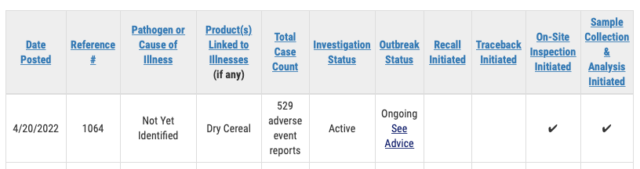
The FDA approached the issue a bit more obliquely, noting that there has not been found a pathogen or cause of the illness (now numbering 529 adverse event reports’) linked to “Dry Cereal.”
I guess I will stick with what I said to the Guardian last week:
 William Marler, a lawyer who has been at the center of food safety battles for decades, isn’t convinced that the cereal is to blame for the reported illnesses. “Correlation is not necessarily causation,” he wrote in an email to the Guardian, echoing comments by colleagues elsewhere.
He noted the common experience of Googling a handful of symptoms and learning that the itch on your arm is almost definitely proof of a fatal illness. Something similar may be happening here, Marler suggests.
“People try to connect the dots between something that’s happening and something that’s known, but the connection may not necessarily be accurate,” he said in a phone interview.
“There are hundreds of thousands of people today in the United States that are having vomiting and diarrhea, from a bunch of different causes. And it also may be happening that some of those thousandsof people also happen to eat Lucky Charms. And now they’re seeing it in the news and they’re going: ‘Hey, wait a second. I had diarrhea a week ago, and I ate Lucky Charms. Therefore, it had to be the Lucky Charms.’”
In some cases, many of the complainants may be right about the link between their symptoms and a particular food product – while many others are wrong about the same thing. He describes a 2007 case in which several hundred people got sick from salmonella detected in Peter Pan peanut butter jars. “But we got 5,000 phone calls … And the vast majority of them were people who go, ‘Well, no, I didn’t have any medical treatment,’” he said.
“You knew that there was a clear outbreak link to a product. But then you still had thousands of people presuming that they got sick from eating the product. And they probably did not.”
That’s not at all to suggest that people are making up their symptoms or trying to “game the system” – just that it’s very challenging to ascertain the source. “That’s why foodborne illness cases are sometimes really, really difficult to figure out,” he said. Without “solid epidemiological evidence – you have stool culture, you have purchase history, you have the product testing positive, you have, unfortunately, lots of people getting sick, so you can tell the common denominator of what it is – it’s kind of hard to put it together.”
And of course, some people posting online about a connection between their symptoms and a source are absolutely right, and social media such as iwaspoisoned.com can be a useful tool for getting to the root of a problem. Marler once got a call from a customer saying she’d gotten salmonella from a Los Angeles restaurant and posted about it on Yelp – where dozens of others had said the same thing on the same day. “Ultimately, the Yelp review was correct,” he said. “It was an early warning system for getting the health department to act.”
As for the Lucky Charms, Marler says he’d like to see some more hard evidence – testing of products, clear diagnoses of customers’ illnesses – to learn more.
I’ll still go with “Magically Suspicious.“


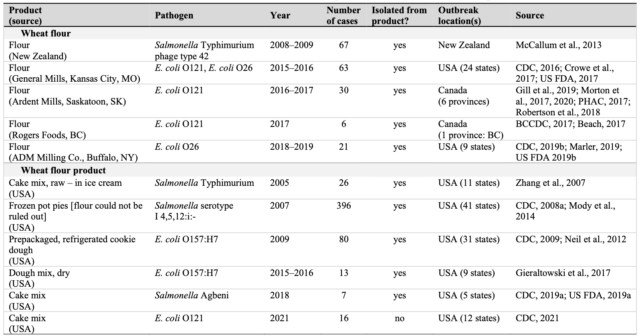

 According to


 The
The 


 As of today the USDA is still
 Congress passed the Federal Food, Drug, and Cosmetic Act in 1938 in reaction to growing public safety demands. The primary goal of the Act was to protect the health and safety of the public by preventing deleterious, adulterated or misbranded articles from entering interstate commerce. Under section 402(a)(4) of the Act, a food product is deemed “adulterated” if the food was “prepared, packed, or held under insanitary conditions whereby it may have become contaminated with filth, or whereby it may have been rendered injurious to health.” A food product is also considered “adulterated” if it bears or contains any poisonous or deleterious substance, which may render it injurious to health. The 1938 Act, and the recently signed Food Safety Modernization Act, stand today as the primary means by which the federal government enforces food safety standards.